

By Nancy Brannon
Showcase Equestrian Center in Eads, Tennessee hosted an Equine Light Therapy seminar with Dan Sumerel July 20-21. Sumerel was invited to introduce Light Therapy for horses, which is already in use for humans. His primarily focus was on people who are interested in becoming dealers for the devices or learning to offer the service as part of their horse business. But others were there just to learn about the technology.
Light Therapy uses specific wavelengths of light with light emitting diodes (LED), which studies show that specific wavelengths may have therapeutic and healing benefits for injuries. The therapeutic effects are the result of light energy absorption at the cellular level, which is then used to heal tissue faster. Two wavelengths that are primarily used are in the near-infrared and infrared spectrums. The near-infrared wavelength (visible red) is effective for stimulating acupuncture points, releasing trigger points, treating wounds and infections. The infrared wavelength (not visible) penetrates deeper, and may be effective in helping heal soft tissue injuries, joints and muscles.
The “Sumerel Therapy System” uses two components: a scanner, a device that is used to go over the horse’s body externally and pinpoint exactly where any problems exist; and the equine therapy unit, which is used to apply the lights to designated parts of the body, the sites where problems or potential problems have been “diagnosed.”
Before going into the stable area to demonstrate the technology, Dan first explained the system and franchising opportunities for buying and using the system. Dan said that a commercial barn can have its own equipment and designated people learn how to use it. He told the audience that the system saves lots of money in veterinarian bills. Or individuals can own the equipment for their personal use; or can buy it for a service business in which they make calls to scan and treat horses. He gave examples of typical charges for the service and explained that a training DVD and booklet show how to properly use the equipment. On hand with Sumerel was Taryn Edwards, an authorized dealer in the Memphis, TN area.
In his talk, Dan explained that two uses of the technology are in fixing physical problems and preventing physical problems. He gave numerous examples of the uses of this therapy in treating horses. One was of treating a colicky horse, whom the veterinarian thought might have to be put down. Dan told how he used the device to “treat all colic points,” working with the horse from 10 pm until 4 am. Around 4:00 am, “the horse got up, peed, and was relieved of colic,” he said. He gave another example of a racehorse in whom he had detected a developing tendon problem. The owner and trainer, however, had the horse examined by a veterinarian who did not find any problem. Against Sumerel’s advice, the horse was raced the next day and broke down on the track with a bowed tendon.
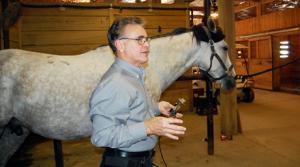
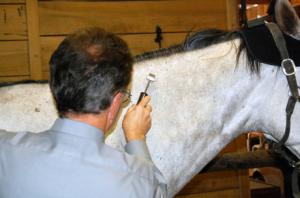
In the stable he demonstrated use of the scanner, then invited some members of the audience to practice using it. “You can’t scan a wet or sweaty horse,” he explained. The scanneremits a micro current of electricity, which neither the person nor the horse can feel. The current is used to measure the resistance in the tissue it contacts. High resistance means normal, healthy tissue. Low resistance means there is something wrong in the area. When a problem is detected, the scanner beeps to indicate the location. The strength of the beep varies with the severity of each problem. He drew lines on the horse with a piece of chalk to show how to break down scanning the horse’s body into segments, which culminates in scanning the whole horse. “Use the same pattern on every horse” to be organized in scan results.
First, wet a small sponge, which becomes a ground. Then scan the area in front of the sponge. “Go with the growth of the hair; the teeth must make contact with the skin.” As the scannergoes over the body, it may beep due to direct measurement of unhealthy tissue or it may beep due to finding an active acupuncture point. Each time the scanner beeps, he marked the spot with chalk so he would know where to treat after scanning is finished.
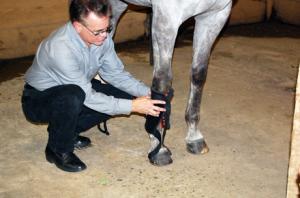
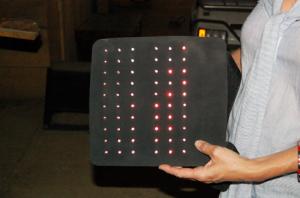
After the whole horse is scanned, the dots on his body indicate the areas causing problems. The second step to use the Equine Therapy Unit (ETU) to treating the problems located. The ETU uses red and infrared light (LEDs) to stimulate the body to heal itself. “This therapy will help anything that can regenerate and speeds up the process,” he said. “There are about 23 physiological changes that can happen, such as DNA and RNA synthesis. It stimulates the immune system. It also takes the inflammation out of soft tissue.”
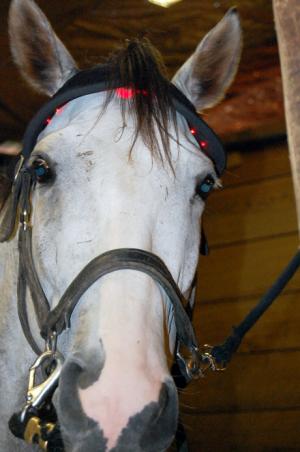
The demonstration horse, Banks, wore a Poll Therapy Unit (PTU) on his head before and during the body scanning. The PTUtreats the problems in the poll and creates an endorphin release that relaxes the horse.
Sumerel also used the time scanning and treating the horse to offer some training advice. “The key in any discipline is controlling the movement of the horse’s body. To do this, first get the horse’s attention. Second, to control the horse’s body, most people make the mistake of trying to get physical control only. But instead, you must go for the horse’s mind and attitude. You must get the horse’s mind to agree, rather than making control just a physical thing. All the equipment in the world won’t give you control if you don’t first get the horse’s mind to cooperate. Third, calm the horse. Teach the horse to associate being calm and relaxed whenever humans are around. Then you can have control, even in a crisis situation. Humans often make the mistake of making too many demands on the horse – constantly! This can be very irritating! Instead, do something, then calm down and give the horse a moment to rest. Then do something else, followed by calm down time. Following this pattern helps the horse become comfortable around people.”
Sumerel is founder of Sumerel Training and Sumerel Therapy, based in Salem, Virginia. For more information about his training methods and therapy system, visit:
http://sumereltraining.com/therapy.htm. To contact Taryn Edwards, call (901) 573-1961, A Balanced Outlook.
Showcase Equestrian Center in Eads, Tennessee hosted an Equine Light Therapy seminar with Dan Sumerel July 20-21. Sumerel was invited to introduce Light Therapy for horses, which is already in use for humans. His primarily focus was on people who are interested in becoming dealers for the devices or learning to offer the service as part of their horse business. But others were there just to learn about the technology.
Light Therapy uses specific wavelengths of light with light emitting diodes (LED), which studies show that specific wavelengths may have therapeutic and healing benefits for injuries. The therapeutic effects are the result of light energy absorption at the cellular level, which is then used to heal tissue faster. Two wavelengths that are primarily used are in the near-infrared and infrared spectrums. The near-infrared wavelength (visible red) is effective for stimulating acupuncture points, releasing trigger points, treating wounds and infections. The infrared wavelength (not visible) penetrates deeper, and may be effective in helping heal soft tissue injuries, joints and muscles.
The “Sumerel Therapy System” uses two components: a scanner, a device that is used to go over the horse’s body externally and pinpoint exactly where any problems exist; and the equine therapy unit, which is used to apply the lights to designated parts of the body, the sites where problems or potential problems have been “diagnosed.”
Before going into the stable area to demonstrate the technology, Dan first explained the system and franchising opportunities for buying and using the system. Dan said that a commercial barn can have its own equipment and designated people learn how to use it. He told the audience that the system saves lots of money in veterinarian bills. Or individuals can own the equipment for their personal use; or can buy it for a service business in which they make calls to scan and treat horses. He gave examples of typical charges for the service and explained that a training DVD and booklet show how to properly use the equipment. On hand with Sumerel was Taryn Edwards, an authorized dealer in the Memphis, TN area.
In his talk, Dan explained that two uses of the technology are in fixing physical problems and preventing physical problems. He gave numerous examples of the uses of this therapy in treating horses. One was of treating a colicky horse, whom the veterinarian thought might have to be put down. Dan told how he used the device to “treat all colic points,” working with the horse from 10 pm until 4 am. Around 4:00 am, “the horse got up, peed, and was relieved of colic,” he said. He gave another example of a racehorse in whom he had detected a developing tendon problem. The owner and trainer, however, had the horse examined by a veterinarian who did not find any problem. Against Sumerel’s advice, the horse was raced the next day and broke down on the track with a bowed tendon.
In the stable he demonstrated use of the scanner, then invited some members of the audience to practice using it. “You can’t scan a wet or sweaty horse,” he explained. The scanneremits a micro current of electricity, which neither the person nor the horse can feel. The current is used to measure the resistance in the tissue it contacts. High resistance means normal, healthy tissue. Low resistance means there is something wrong in the area. When a problem is detected, the scanner beeps to indicate the location. The strength of the beep varies with the severity of each problem. He drew lines on the horse with a piece of chalk to show how to break down scanning the horse’s body into segments, which culminates in scanning the whole horse. “Use the same pattern on every horse” to be organized in scan results.
First, wet a small sponge, which becomes a ground. Then scan the area in front of the sponge. “Go with the growth of the hair; the teeth must make contact with the skin.” As the scannergoes over the body, it may beep due to direct measurement of unhealthy tissue or it may beep due to finding an active acupuncture point. Each time the scanner beeps, he marked the spot with chalk so he would know where to treat after scanning is finished.
After the whole horse is scanned, the dots on his body indicate the areas causing problems. The second step to use the Equine Therapy Unit (ETU) to treating the problems located. The ETU uses red and infrared light (LEDs) to stimulate the body to heal itself. “This therapy will help anything that can regenerate and speeds up the process,” he said. “There are about 23 physiological changes that can happen, such as DNA and RNA synthesis. It stimulates the immune system. It also takes the inflammation out of soft tissue.”
The demonstration horse, Banks, wore a Poll Therapy Unit (PTU) on his head before and during the body scanning. The PTUtreats the problems in the poll and creates an endorphin release that relaxes the horse.
Sumerel also used the time scanning and treating the horse to offer some training advice. “The key in any discipline is controlling the movement of the horse’s body. To do this, first get the horse’s attention. Second, to control the horse’s body, most people make the mistake of trying to get physical control only. But instead, you must go for the horse’s mind and attitude. You must get the horse’s mind to agree, rather than making control just a physical thing. All the equipment in the world won’t give you control if you don’t first get the horse’s mind to cooperate. Third, calm the horse. Teach the horse to associate being calm and relaxed whenever humans are around. Then you can have control, even in a crisis situation. Humans often make the mistake of making too many demands on the horse – constantly! This can be very irritating! Instead, do something, then calm down and give the horse a moment to rest. Then do something else, followed by calm down time. Following this pattern helps the horse become comfortable around people.”
Sumerel is founder of Sumerel Training and Sumerel Therapy, based in Salem, Virginia. For more information about his training methods and therapy system, visit:
http://sumereltraining.com/therapy.htm. To contact Taryn Edwards, call (901) 573-1961, A Balanced Outlook.


