

by Linda Parelli
Photography by Coco
Studying the posture, musculature and movement of horses is an important component of our Fluidity Program. Horses that have been ridden often look very different from horses that have never been ridden, and unfortunately, they usually don’t look better!
In ridden horses, here are some of the common issues:
Posture:
• “Down-hill” (hips are higher than the withers)
• Small or flat withers (mutton-withered)
• Sway, hollow or dipped back
• Strung-out hind legs
• Rotated scapula
• Rotated sacrum (“jumper’s bump”)
• Short neck / long back
• Ewe neck
• High tail set (instead of low and sloping)
Musculature:
• Poor top line, muscle wastage on crest, back and rump
• Irregular muscling, some are under-developed and some are overdeveloped
• Thin withers
• Overdeveloped underline (under neck, lower chest, forearms, gaskins, and top of hip)
• Dropped belly
• Thin neck
Movement:
• Short, choppy strides
• Heavy on forehand
• Hind legs weak, “disengaged”, can’t come under the body, are strung out behind
• Inability to ‘collect’ or engage
• Stiff in the body or neck
• Stiff in the legs, doesn’t bend joints well
• Doesn’t use whole body
• Pulls itself along with the forelegs vs. pushing with hind legs
As you can imagine, on-going issues like these can lead to a horse breaking down in the long term, usually in the areas they over use to compensate for not sharing the load through the entire body, such as the stifle, lower back, suspensories, hocks, and the knee joints from landing heavily on the forehand.
How do horses get into this condition when ridden?
Unfortunately, a lot of this happens from ignorance. Riders place their saddle too far forward and add weight to the forehand making it more difficult for the horse to carry his weight equally or more on the hindquarters – which is important for collection and engagement.
Many saddles are also pretty restrictive for the horse. When too long in the bars, the horse’s back is held more rigid, interrupting the flow of energy through the whole body. As a result, the neck often gets small while the hip gets bigger. When the saddle is too narrow, it pinches the horse on the shoulders and around the spine causing muscle wastage.
The reason the muscles waste are usually:
1. From lack of use.
2. The horse escapes the pinching pressure by hollowing his back and not using it at all.
3. When the horse tries to flex and expand his muscles, the pinching restricts the muscles and retards their development.
The second reason is the rider. When the rider restricts a horse’s movement, pulls on the reins constantly or leans forward on the forehand they will block the flow of energy through the whole horse much like a poor saddle does. Probably the worst is when they use a “driving seat” and literally push the horse’s back down with every stride.
Can you imagine now how damaging the combination of a rigid rider and a restrictive saddle would be?!
Stop riding so the horse can heal
Here’s the hard part: some people are so obsessed with riding that they would have a lot of trouble staying off his back so he can heal. If the horse had blown a suspensory ligament or went lame or had an injury, we’d do it understanding that he needs rest; but to do it when the horse is not limping or acting hurt is sometimes difficult to comprehend. Think of it this way: the horse is an injury waiting to happen - and it may be something that ends his riding days forever. That’s what you call a broken down horse; you’ve just got to see it coming and act on it now to prevent it.
A simple yet incredibly effective treatment that takes about six weeks: Hill Therapy
1. You need to remove all the things that could be causing the horse to change his posture and way of moving, namely the saddle and the rider.
2. You need to exercise the horse for a specific amount of time in a specific way so he can find his way to move more naturally again. In some cases the horse’s movement has been altered from the first day they ever carried a saddle and rider, and over the years they have actually habituated to it, they’ve completely changed their natural way of moving even without a rider on them. They need to learn how to use their whole body.
3. Hills are the best medicine. You don’t want a steep hill, just an incline that encourages the horse to use himself more efficiently.
a. A small incline, say 10 degrees, is ideal for trot and canter.
b. 15–20 degrees would only be suitable for walk and trot.
c. Anything steeper than that should only be at the walk.
Note: This should not be physically stressful for the horse because you are trying to restore his health, not wear him out more!
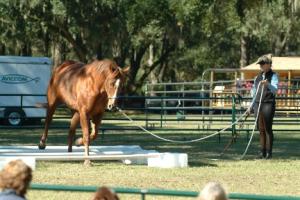
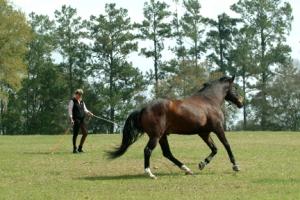
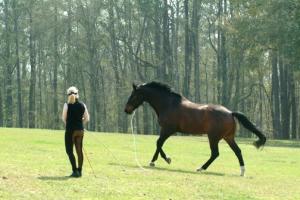
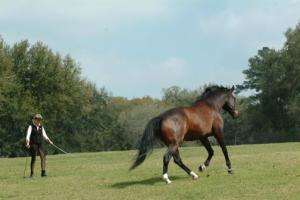
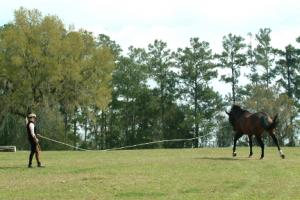
Send your horse out on a circle using a 22-foot Line. A 12-foot Line is too short and a 45-foot is too long! This is not the ‘Circling Game’ so don’t worry about your horse changing gait. See the troubleshooting/questions section at the end for possible issues you may have.
(If you don’t have hills, use barrels or barrel-sized logs (18 inches high) placed on the circle at three o’clock and nine o’clock. You would use a 22-foot Line.)
Finally, the horse must be sound, not limping or sore to move because he has an injury or arthritis or a bad back. Hill Therapy does not help a broken down horse, it restores one that is breaking down.
The Hill Therapy Program
Week 1: DAILY for 7 days
5 minutes circling.
2 minutes rest.
5 minutes circling in the other direction.
Week 2: Three times per week
5 minutes circling.
2 minutes rest.
5 minutes circling in the other direction.
Week 3–6: Twice per week
5 minutes circling.
2 minutes rest.
5 minutes circling in the other direction.
Note: If the horse is fit, you could double the times by Week 3. But if the horse is not very fit and the worse its condition, take it easy and go slower.
After that you shouldn’t need to do it anymore unless something causes the horse to deteriorate again. It makes sense that you would also need to check the suitability of your saddle and how shims may help and address your Fluidity skills (see New Parelli Level 1 and 2 At-Home Study Programs).
Results!
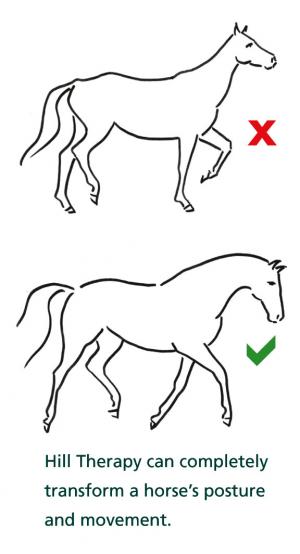
In just six weeks the transformation can be significant. You’ll see the stride lengthen, back and neck muscles smooth out and develop, short necks lengthen, long backs shorten, strong undernecks and dropped bellies tighten up, withers come up, high tail sets go down… it’s quite amazing.
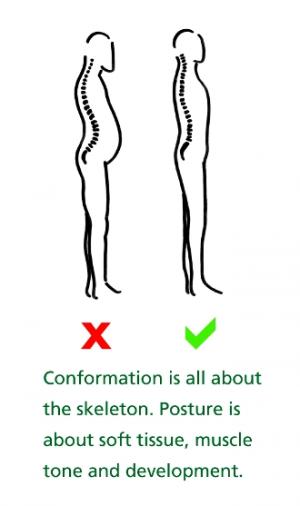
Many people cannot understand how horses can change their “conformation” so quickly, but actually, it’s not their conformation. Conformation is all about the skeleton, the size and length and proportions of the bones. Posture is all about the soft tissue, muscle tone and development. Muscles hold the skeleton in place and that’s why a horse can change shape.
Try this… stand with your shoulders rounded and belly sticking out. Now stand up straight… Do you see how dramatically different you look just because you changed your posture? How do you tell a horse to stand up straight? How do you tell him to use his whole body when he moves? You can’t do this like you would with another person. You have to set it up so it occurs naturally. By asking your horse to keep moving, and setting it up to be a bit awkward because he has to take care of his balance going up and down hills, he finds a way to move much more efficiently. Part of the reason you have to do this for six weeks is because it has to become a new habit.
Troubleshooting
• Your horse keeps changing gait while circling.
Don’t worry about it! I know, that can be hard, but remember this is not the Circling Game. It’s a therapy. While your horse is trying to figure out how to move better, he’ll probably change gait a lot, in fact the worse shape he’s in the more likely he is to change gait. Usually what you see is them slowing down on the way up the hill and speeding up on the way down because they ‘fall’ down the hill on their forehand and can’t push well enough and round their back on the way up.
Allow your horse to change gait, wait for half a lap and then ask him to take up the original gait again. If you make him feel wrong for breaking gait he’ll get emotionally upset and tense in his body. You need him to be soft, confident and relaxed which will come with patience and understanding. Remember, he’s having trouble in his body so don’t force him through it.
• Your horse keeps coming in to you.
Smile, rub him and politely send him on his way again. Don’t sacrifice the relationship over his body!
• Your horse keeps trying to snatch grass as he goes around.
Great… he’s stretching his back! Allow him to grab a mouthful, count to three and ask him to move on again. Then each time allow less time… three seconds, two seconds, one second. Just don’t let it bother you or your horse will use it to rattle you!
• Nothing seems to be happening!
At first your horse will probably have a lot of trouble making a circle. He’ll make oblongs in trying to shorten the uphill and downhill parts; he’ll have terrible posture, speed up and slow down, even look really uneven and almost lame as he hollows out and stiff-legs it on the downhill run. He may even stop dead before going down the hill, or bend his body all wrong, or not want to go in one direction at all.
Just know that all this is quite usual. He’s experimenting and pretty soon the changes will come. What you must not do is try to correct everything, just observe and understand why. It seems to be by the fourth day that the biggest change can be observed and right up until then you could see little or no improvement at all!
But then the prize comes! The neck stretches down; the back starts to round up; the strides get softer, longer, springy; his balance improves; he’s not on the forehand anymore; he doesn’t change speed or rhythm on any part of the circle; and you start to notice subtle changes in his muscling, like overdeveloped areas getting smaller and underdeveloped areas building up. It’s very exciting!
• Is it better to trot or canter rather than walk?
Not necessarily because you can change the grade of the slope you use to cause the horse to use himself more efficiently. It’s not about working up a sweat or tiring out your horse. What you can think about is asking for the canter towards the end of the program, e.g., Week 4 to help develop your horse’s balance at that gait.
• Why wouldn’t you keep doing it?
Because it shouldn’t be necessary. Once you’ve brought the horse back to health physically, you maintain it with ground skills and good riding and saddles. This is remedial therapy so once the horse is healed you shouldn’t have to keep doing it.
• In what situations would you NOT do Hill Therapy?
If your horse was:
• Too green, meaning uneducated. Put the mental and emotional first so Hill Therapy is really not recommended until a good way through Level 2 as a minimum. If you do this too early in a horse’s education or relationship with you, problems such as pulling away or boredom could result. At the right time, horses get to understand that there’s something to this. They feel the benefits, get to know the routine and can actually seem to enjoy it.
• Lame.
• Too old. I would probably not do this with a horse that was older than 17 unless it was in good health, no arthritis. And even then I would probably only do it at the walk on a slightly steeper incline. You have to be mindful that wear and tear on old joints is not what you want.
• Sway back. I would use walking cavalettis/poles instead and over a much longer period of time. Where exercise is indicated but needs to be minimal physical stress/impact, walking over a cavaletti can be a good substitute. It helps horses to stretch their backs and use their top line but is not as efficient in getting horses to dramatically change the way they move.
• Locking stifles. Check with your vet first. We’ve had some very good reports about changes in this problem but you need to be careful. It would be best at the walk, over a longer period of time.
About Parelli
Pat Parelli, coiner of the term “natural horsemanship”, founded his program based on a foundation of love, language and leadership. Parelli Natural Horsemanship allows horse owners at all levels of experience to achieve success with their at-home educational program. Together with his wife Linda, Pat has spread PNH across the globe with campuses in the United States, United Kingdom and Australia. Newly launched in 2011, parelliconnect.com provides an online social forum packed with training tools, step-by-step to do lists, video and more. Log on today for your FREE 30-day trial at www.parelliconnect.com.
Photography by Coco
Studying the posture, musculature and movement of horses is an important component of our Fluidity Program. Horses that have been ridden often look very different from horses that have never been ridden, and unfortunately, they usually don’t look better!
In ridden horses, here are some of the common issues:
Posture:
• “Down-hill” (hips are higher than the withers)
• Small or flat withers (mutton-withered)
• Sway, hollow or dipped back
• Strung-out hind legs
• Rotated scapula
• Rotated sacrum (“jumper’s bump”)
• Short neck / long back
• Ewe neck
• High tail set (instead of low and sloping)
Musculature:
• Poor top line, muscle wastage on crest, back and rump
• Irregular muscling, some are under-developed and some are overdeveloped
• Thin withers
• Overdeveloped underline (under neck, lower chest, forearms, gaskins, and top of hip)
• Dropped belly
• Thin neck
Movement:
• Short, choppy strides
• Heavy on forehand
• Hind legs weak, “disengaged”, can’t come under the body, are strung out behind
• Inability to ‘collect’ or engage
• Stiff in the body or neck
• Stiff in the legs, doesn’t bend joints well
• Doesn’t use whole body
• Pulls itself along with the forelegs vs. pushing with hind legs
As you can imagine, on-going issues like these can lead to a horse breaking down in the long term, usually in the areas they over use to compensate for not sharing the load through the entire body, such as the stifle, lower back, suspensories, hocks, and the knee joints from landing heavily on the forehand.
How do horses get into this condition when ridden?
Unfortunately, a lot of this happens from ignorance. Riders place their saddle too far forward and add weight to the forehand making it more difficult for the horse to carry his weight equally or more on the hindquarters – which is important for collection and engagement.
Many saddles are also pretty restrictive for the horse. When too long in the bars, the horse’s back is held more rigid, interrupting the flow of energy through the whole body. As a result, the neck often gets small while the hip gets bigger. When the saddle is too narrow, it pinches the horse on the shoulders and around the spine causing muscle wastage.
The reason the muscles waste are usually:
1. From lack of use.
2. The horse escapes the pinching pressure by hollowing his back and not using it at all.
3. When the horse tries to flex and expand his muscles, the pinching restricts the muscles and retards their development.
The second reason is the rider. When the rider restricts a horse’s movement, pulls on the reins constantly or leans forward on the forehand they will block the flow of energy through the whole horse much like a poor saddle does. Probably the worst is when they use a “driving seat” and literally push the horse’s back down with every stride.
Can you imagine now how damaging the combination of a rigid rider and a restrictive saddle would be?!
Stop riding so the horse can heal
Here’s the hard part: some people are so obsessed with riding that they would have a lot of trouble staying off his back so he can heal. If the horse had blown a suspensory ligament or went lame or had an injury, we’d do it understanding that he needs rest; but to do it when the horse is not limping or acting hurt is sometimes difficult to comprehend. Think of it this way: the horse is an injury waiting to happen - and it may be something that ends his riding days forever. That’s what you call a broken down horse; you’ve just got to see it coming and act on it now to prevent it.
A simple yet incredibly effective treatment that takes about six weeks: Hill Therapy
1. You need to remove all the things that could be causing the horse to change his posture and way of moving, namely the saddle and the rider.
2. You need to exercise the horse for a specific amount of time in a specific way so he can find his way to move more naturally again. In some cases the horse’s movement has been altered from the first day they ever carried a saddle and rider, and over the years they have actually habituated to it, they’ve completely changed their natural way of moving even without a rider on them. They need to learn how to use their whole body.
3. Hills are the best medicine. You don’t want a steep hill, just an incline that encourages the horse to use himself more efficiently.
a. A small incline, say 10 degrees, is ideal for trot and canter.
b. 15–20 degrees would only be suitable for walk and trot.
c. Anything steeper than that should only be at the walk.
Note: This should not be physically stressful for the horse because you are trying to restore his health, not wear him out more!
Send your horse out on a circle using a 22-foot Line. A 12-foot Line is too short and a 45-foot is too long! This is not the ‘Circling Game’ so don’t worry about your horse changing gait. See the troubleshooting/questions section at the end for possible issues you may have.
(If you don’t have hills, use barrels or barrel-sized logs (18 inches high) placed on the circle at three o’clock and nine o’clock. You would use a 22-foot Line.)
Finally, the horse must be sound, not limping or sore to move because he has an injury or arthritis or a bad back. Hill Therapy does not help a broken down horse, it restores one that is breaking down.
The Hill Therapy Program
Week 1: DAILY for 7 days
5 minutes circling.
2 minutes rest.
5 minutes circling in the other direction.
Week 2: Three times per week
5 minutes circling.
2 minutes rest.
5 minutes circling in the other direction.
Week 3–6: Twice per week
5 minutes circling.
2 minutes rest.
5 minutes circling in the other direction.
Note: If the horse is fit, you could double the times by Week 3. But if the horse is not very fit and the worse its condition, take it easy and go slower.
After that you shouldn’t need to do it anymore unless something causes the horse to deteriorate again. It makes sense that you would also need to check the suitability of your saddle and how shims may help and address your Fluidity skills (see New Parelli Level 1 and 2 At-Home Study Programs).
Results!
In just six weeks the transformation can be significant. You’ll see the stride lengthen, back and neck muscles smooth out and develop, short necks lengthen, long backs shorten, strong undernecks and dropped bellies tighten up, withers come up, high tail sets go down… it’s quite amazing.
Many people cannot understand how horses can change their “conformation” so quickly, but actually, it’s not their conformation. Conformation is all about the skeleton, the size and length and proportions of the bones. Posture is all about the soft tissue, muscle tone and development. Muscles hold the skeleton in place and that’s why a horse can change shape.
Try this… stand with your shoulders rounded and belly sticking out. Now stand up straight… Do you see how dramatically different you look just because you changed your posture? How do you tell a horse to stand up straight? How do you tell him to use his whole body when he moves? You can’t do this like you would with another person. You have to set it up so it occurs naturally. By asking your horse to keep moving, and setting it up to be a bit awkward because he has to take care of his balance going up and down hills, he finds a way to move much more efficiently. Part of the reason you have to do this for six weeks is because it has to become a new habit.
Troubleshooting
• Your horse keeps changing gait while circling.
Don’t worry about it! I know, that can be hard, but remember this is not the Circling Game. It’s a therapy. While your horse is trying to figure out how to move better, he’ll probably change gait a lot, in fact the worse shape he’s in the more likely he is to change gait. Usually what you see is them slowing down on the way up the hill and speeding up on the way down because they ‘fall’ down the hill on their forehand and can’t push well enough and round their back on the way up.
Allow your horse to change gait, wait for half a lap and then ask him to take up the original gait again. If you make him feel wrong for breaking gait he’ll get emotionally upset and tense in his body. You need him to be soft, confident and relaxed which will come with patience and understanding. Remember, he’s having trouble in his body so don’t force him through it.
• Your horse keeps coming in to you.
Smile, rub him and politely send him on his way again. Don’t sacrifice the relationship over his body!
• Your horse keeps trying to snatch grass as he goes around.
Great… he’s stretching his back! Allow him to grab a mouthful, count to three and ask him to move on again. Then each time allow less time… three seconds, two seconds, one second. Just don’t let it bother you or your horse will use it to rattle you!
• Nothing seems to be happening!
At first your horse will probably have a lot of trouble making a circle. He’ll make oblongs in trying to shorten the uphill and downhill parts; he’ll have terrible posture, speed up and slow down, even look really uneven and almost lame as he hollows out and stiff-legs it on the downhill run. He may even stop dead before going down the hill, or bend his body all wrong, or not want to go in one direction at all.
Just know that all this is quite usual. He’s experimenting and pretty soon the changes will come. What you must not do is try to correct everything, just observe and understand why. It seems to be by the fourth day that the biggest change can be observed and right up until then you could see little or no improvement at all!
But then the prize comes! The neck stretches down; the back starts to round up; the strides get softer, longer, springy; his balance improves; he’s not on the forehand anymore; he doesn’t change speed or rhythm on any part of the circle; and you start to notice subtle changes in his muscling, like overdeveloped areas getting smaller and underdeveloped areas building up. It’s very exciting!
• Is it better to trot or canter rather than walk?
Not necessarily because you can change the grade of the slope you use to cause the horse to use himself more efficiently. It’s not about working up a sweat or tiring out your horse. What you can think about is asking for the canter towards the end of the program, e.g., Week 4 to help develop your horse’s balance at that gait.
• Why wouldn’t you keep doing it?
Because it shouldn’t be necessary. Once you’ve brought the horse back to health physically, you maintain it with ground skills and good riding and saddles. This is remedial therapy so once the horse is healed you shouldn’t have to keep doing it.
• In what situations would you NOT do Hill Therapy?
If your horse was:
• Too green, meaning uneducated. Put the mental and emotional first so Hill Therapy is really not recommended until a good way through Level 2 as a minimum. If you do this too early in a horse’s education or relationship with you, problems such as pulling away or boredom could result. At the right time, horses get to understand that there’s something to this. They feel the benefits, get to know the routine and can actually seem to enjoy it.
• Lame.
• Too old. I would probably not do this with a horse that was older than 17 unless it was in good health, no arthritis. And even then I would probably only do it at the walk on a slightly steeper incline. You have to be mindful that wear and tear on old joints is not what you want.
• Sway back. I would use walking cavalettis/poles instead and over a much longer period of time. Where exercise is indicated but needs to be minimal physical stress/impact, walking over a cavaletti can be a good substitute. It helps horses to stretch their backs and use their top line but is not as efficient in getting horses to dramatically change the way they move.
• Locking stifles. Check with your vet first. We’ve had some very good reports about changes in this problem but you need to be careful. It would be best at the walk, over a longer period of time.
About Parelli
Pat Parelli, coiner of the term “natural horsemanship”, founded his program based on a foundation of love, language and leadership. Parelli Natural Horsemanship allows horse owners at all levels of experience to achieve success with their at-home educational program. Together with his wife Linda, Pat has spread PNH across the globe with campuses in the United States, United Kingdom and Australia. Newly launched in 2011, parelliconnect.com provides an online social forum packed with training tools, step-by-step to do lists, video and more. Log on today for your FREE 30-day trial at www.parelliconnect.com.


