

by Nancy Brannon
The rider’s body position, balance, coordination, skeletal structure, muscle tone, etc. are major influences on how a horse moves and performs assigned tasks. Understanding how the rider’s body works, how the horse’s body works and how the rider’s body influences the horse’s movement is the essential study of rider biomechanics.
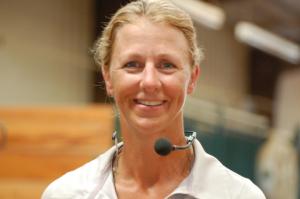
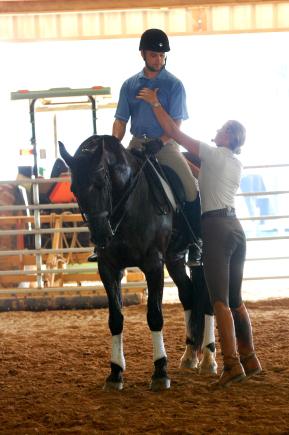
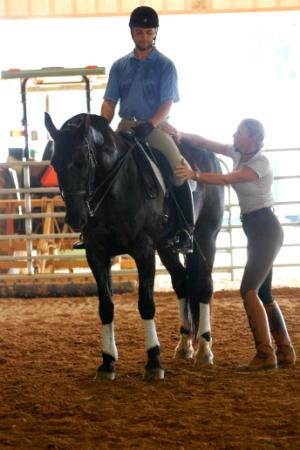
Heather Blitz, international Grand Prix dressage rider and trainer, teaches rider biomechanics. She was at Kim Gentry Dressage near Moscow, TN June 4-5working with riders on their positions to improve their effectiveness with their horses. She was in Franklin, TN June 17-19 for another clinic.
Heather explained the principles of biomechanics and balanced riding: “The riders have to find a basic alignment in their body: shoulder, hip, heel. Within this alignment, they have to learn how to have elastic tone quality in their bodies. So you have to then determine how the horse’s body should be, rather than vice versa. Everyone’s body is different. Stiff, wiggly riders need both high tone to control themselves and strength in the core of the body. All riders should learn how to ride with a clear and concise body language.”
Heather first watches the rider work to assess what the rider needs to improve. “Then let me chime in when I need to,” she told one rider. She then asked the rider, “Is he heavy [in the bridle]? If your reins broke right now, would your horse speed up, or fall on his nose?” The assessment is: “He needs to get more in front of your leg. He’s not using his hind legs the way an Intermediate horse should. He exists too much in the front 1/3 of his body.” The remedy? Transitions and collecting, half halts to change the horse’s balance. “The horse should go forward in response to your legs,” she said.
The series of transitions she proposed for this particular horse were: halt, collect the trot, halt, then go promptly to collected trot, with energy coming from the hind legs. “Go directly from halt to trot without walk steps. You want the horse to push with the hind leg when the rider asks with his leg. It’s important not to halt by bringing your upper body back. Instead, make a wall with your stomach muscles and in your back. Get anchored.”
Heather uses analogies to help the rider “picture” in the mind what to do and how to balance. One image is a medicine ball. Imagine a medicine ball inside the horse’s body that can roll forward or backward; weight forward or backward will change the horse’s balance. So if the horse is too much on the forehand, e.g., in “front wheel drive,” then imagine rolling the ball further back in the body “so that it falls directly under the rider’s seat and you can sit on it. If it rolls forward, roll it back and see if it stays.” Repeat as needed. After explaining the analogy, she asked, “Does that analogy make sense? Do you get the picture? How do you use your body when you halt? How does the horse use his body in the halt?”
Further advice on getting the horse to push from behind: “Don’t let the horse go to front wheel drive. The horse needs to transition from a stop to a go. An upper level horse can make a transition every stride. With this exercise, the horse’s back goes up and the croup goes down as you roll the medicine ball back and the horse can engage from behind.”
Another exercise is to make a square figure as you are riding. Halt at each corner of the square, then make a quarter turn without allowing the horse’s hind legs to move. Then walk forward to the next corner. Halt. Make a quarter turn as before, then walk to the next corner.
Heather states, “The person who has been the biggest influence in my riding is my biomechanics coach, Mary Wanless. I met Mary in 1993 and have continued to learn from her to the present. Her research into the effect of riders’ bodies on horses is extensive and unique and not found in more “traditional” training. Her theories continue miles beyond teaching the beginner to improve their seat. The more advanced I become in my riding, I find her even more helpful – like a mechanic tuning my engine as I need more technique, power, and refinement. As you progress up the levels, it gets harder to find words to describe what we’re trying to achieve, but Mary’s style, using analogies and sensory feedback, allows for amazing communication and understanding in a world of feel and timing.”
Mary Wanless commented about Heather’s ability: “Heather Blitz, whom I have coached for 15 years, provides the most wonderful demonstration of the power of correct rider biomechanics in action. Her biomechanical skills enable her to create the same results on horse after horse - and what's more, she can communicate those skills to others! Her own insights on training have led to her developing a philosophy about reactivity, which has added hugely to our combined body of knowledge. I can't wait for Paragon to get out there, hopefully on the PanAm team and then the Olympic team, so we can show everybody what sophisticated biomechanical skills can do!”
Mary Wanless is an internationally renowned coach, author of the Ride With Your Mind books. She has B.S. degrees in Physics and Applied Sports Coaching, and holds the BHSI certificate.
The Heather Blitz clinic in Nashville, TN was a tremendous success! Eight riders participated with dressage levels from from training level to Grand Prix represented.
Vocabulary between riders and Heather was creative and descriptive. Each rider found a way to verbalize the concepts that Heather was communicating, with imagery that was fun for those watching and effective for the rider.
Consistent themes throughout the clinic focused on self carriage, which was described as “moving the horse’s particles” back or “moving the horse’s medicine ball” back. This was accomplished by the rider maintaining a strong core strength or “bear down,” which was described by riders as squeezing the plunger of a french coffee press down, or blowing out air through a small hole located at their belly button.
Heather stressed that the rider's posture needed to be upright with a long underneath pelvic contact, a sternum located just in front of the belly button, parallel front and back sides of the rider, and “armcuffs,” which attached the back of the armpits to the shoulder blades. This was a lot to think about all at once!
The riders who were successful appeared strong and immovable. They appeared as if they were a carousel pole that remained still while the horse moved up and down or sideways. If the rider was able to maintain this strong presence and position, then it was much more difficult for the horse to throw it’s weight down or forward or left or right.
These concepts helped the Grand Prix riders working on canter pirourettes to the first level riders working on straightness and beginning collection with 10 meter circles.
We also discussed the learning process. Without a doubt, everyone riding in the clinic wanted to grasp these concepts and perform better. However, we all know that wanting to ride better doesn’t necessarily bring success. Heather spoke about the learning process of making the coaching and words mean something useful to the rider. This process is the development of the “brainscape” concepts (what we hear) turned into what we actually do or perceive (the “mindscape”). We therefore were all focusing on both body awareness in our riding and “mind" awareness so that we could deeply and effectively understand a particular statement. Whew! Hard work for mind and body, but so rewarding! We are hopeful that Heather can return to our area in the near future.
The rider’s body position, balance, coordination, skeletal structure, muscle tone, etc. are major influences on how a horse moves and performs assigned tasks. Understanding how the rider’s body works, how the horse’s body works and how the rider’s body influences the horse’s movement is the essential study of rider biomechanics.
Heather Blitz, international Grand Prix dressage rider and trainer, teaches rider biomechanics. She was at Kim Gentry Dressage near Moscow, TN June 4-5working with riders on their positions to improve their effectiveness with their horses. She was in Franklin, TN June 17-19 for another clinic.
Heather explained the principles of biomechanics and balanced riding: “The riders have to find a basic alignment in their body: shoulder, hip, heel. Within this alignment, they have to learn how to have elastic tone quality in their bodies. So you have to then determine how the horse’s body should be, rather than vice versa. Everyone’s body is different. Stiff, wiggly riders need both high tone to control themselves and strength in the core of the body. All riders should learn how to ride with a clear and concise body language.”
Heather first watches the rider work to assess what the rider needs to improve. “Then let me chime in when I need to,” she told one rider. She then asked the rider, “Is he heavy [in the bridle]? If your reins broke right now, would your horse speed up, or fall on his nose?” The assessment is: “He needs to get more in front of your leg. He’s not using his hind legs the way an Intermediate horse should. He exists too much in the front 1/3 of his body.” The remedy? Transitions and collecting, half halts to change the horse’s balance. “The horse should go forward in response to your legs,” she said.
The series of transitions she proposed for this particular horse were: halt, collect the trot, halt, then go promptly to collected trot, with energy coming from the hind legs. “Go directly from halt to trot without walk steps. You want the horse to push with the hind leg when the rider asks with his leg. It’s important not to halt by bringing your upper body back. Instead, make a wall with your stomach muscles and in your back. Get anchored.”
Heather uses analogies to help the rider “picture” in the mind what to do and how to balance. One image is a medicine ball. Imagine a medicine ball inside the horse’s body that can roll forward or backward; weight forward or backward will change the horse’s balance. So if the horse is too much on the forehand, e.g., in “front wheel drive,” then imagine rolling the ball further back in the body “so that it falls directly under the rider’s seat and you can sit on it. If it rolls forward, roll it back and see if it stays.” Repeat as needed. After explaining the analogy, she asked, “Does that analogy make sense? Do you get the picture? How do you use your body when you halt? How does the horse use his body in the halt?”
Further advice on getting the horse to push from behind: “Don’t let the horse go to front wheel drive. The horse needs to transition from a stop to a go. An upper level horse can make a transition every stride. With this exercise, the horse’s back goes up and the croup goes down as you roll the medicine ball back and the horse can engage from behind.”
Another exercise is to make a square figure as you are riding. Halt at each corner of the square, then make a quarter turn without allowing the horse’s hind legs to move. Then walk forward to the next corner. Halt. Make a quarter turn as before, then walk to the next corner.
Heather states, “The person who has been the biggest influence in my riding is my biomechanics coach, Mary Wanless. I met Mary in 1993 and have continued to learn from her to the present. Her research into the effect of riders’ bodies on horses is extensive and unique and not found in more “traditional” training. Her theories continue miles beyond teaching the beginner to improve their seat. The more advanced I become in my riding, I find her even more helpful – like a mechanic tuning my engine as I need more technique, power, and refinement. As you progress up the levels, it gets harder to find words to describe what we’re trying to achieve, but Mary’s style, using analogies and sensory feedback, allows for amazing communication and understanding in a world of feel and timing.”
Mary Wanless commented about Heather’s ability: “Heather Blitz, whom I have coached for 15 years, provides the most wonderful demonstration of the power of correct rider biomechanics in action. Her biomechanical skills enable her to create the same results on horse after horse - and what's more, she can communicate those skills to others! Her own insights on training have led to her developing a philosophy about reactivity, which has added hugely to our combined body of knowledge. I can't wait for Paragon to get out there, hopefully on the PanAm team and then the Olympic team, so we can show everybody what sophisticated biomechanical skills can do!”
Mary Wanless is an internationally renowned coach, author of the Ride With Your Mind books. She has B.S. degrees in Physics and Applied Sports Coaching, and holds the BHSI certificate.
Nashville Clinic
by Linda HolsteThe Heather Blitz clinic in Nashville, TN was a tremendous success! Eight riders participated with dressage levels from from training level to Grand Prix represented.
Vocabulary between riders and Heather was creative and descriptive. Each rider found a way to verbalize the concepts that Heather was communicating, with imagery that was fun for those watching and effective for the rider.
Consistent themes throughout the clinic focused on self carriage, which was described as “moving the horse’s particles” back or “moving the horse’s medicine ball” back. This was accomplished by the rider maintaining a strong core strength or “bear down,” which was described by riders as squeezing the plunger of a french coffee press down, or blowing out air through a small hole located at their belly button.
Heather stressed that the rider's posture needed to be upright with a long underneath pelvic contact, a sternum located just in front of the belly button, parallel front and back sides of the rider, and “armcuffs,” which attached the back of the armpits to the shoulder blades. This was a lot to think about all at once!
The riders who were successful appeared strong and immovable. They appeared as if they were a carousel pole that remained still while the horse moved up and down or sideways. If the rider was able to maintain this strong presence and position, then it was much more difficult for the horse to throw it’s weight down or forward or left or right.
These concepts helped the Grand Prix riders working on canter pirourettes to the first level riders working on straightness and beginning collection with 10 meter circles.
We also discussed the learning process. Without a doubt, everyone riding in the clinic wanted to grasp these concepts and perform better. However, we all know that wanting to ride better doesn’t necessarily bring success. Heather spoke about the learning process of making the coaching and words mean something useful to the rider. This process is the development of the “brainscape” concepts (what we hear) turned into what we actually do or perceive (the “mindscape”). We therefore were all focusing on both body awareness in our riding and “mind" awareness so that we could deeply and effectively understand a particular statement. Whew! Hard work for mind and body, but so rewarding! We are hopeful that Heather can return to our area in the near future.


