

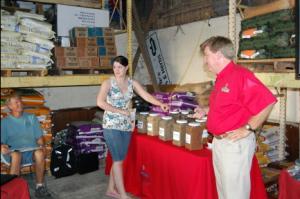
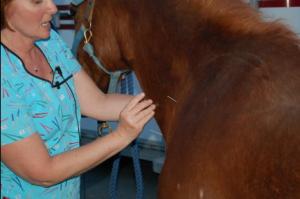
Jimmy and Beverly Thompson, owners of Hall’s Feed and Seed in Collierville, TN generously hosted a very informative Purina Horse Owners Workshop (HOW) at their store on May 10, 2011. The Workshop featured information about horse nutrition and the economy of feeding from Rusty Bane, Purina Equine Specialist, and an acupuncture demonstration Dr. Kathy Mitchener, DVM Veterinary Oncologist and Equine Acupuncturist.
Rusty explained general guidelines for feeding horses, compared feeds in terms of nutritional value, and explained the intended uses for the various Purina Feeds. He had an entertaining way to educate the audience about feed, forage, and supplements with the game The Feed is Right based on the TV game show The Price is Right. Four audience members, Martin Lindbergh, Pam Gaston, Jackie Gaston and Vanessa Derrick, were selected at random to sit on the contestants’ panel. Different types of feed, forage, and supplements were displayed as Rusty asked questions about the products such as weight, ingredients, mineral content, nutritional qualities, and cost.
The audience learned how to assess the nutritional needs of their horses by considering the horse’s lifestyle, use, age, history, and their body condition score. The system scores horses on a scale of 1 through 10, with 1 being very emaciated to 10 being extremely obese. The ideal score is 5 to 6.5 depending on age. He showed how to estimate the weight of a horse using a horse weight tape measure around the hart girth.
Weight is one of the most important considerations when developing a feeding plan. Most people measure feed by the scoop and hay by the flake, but these measurements vary widely. Different feeds and hays vary in density and, therefore, have different weight to nutrition ratios. A simple scale for the feed room is one of the best tools to use to determine your feeding plan.
Dr. Mitchener explained how acupuncture works, the ailments for which it is suited, and demonstrated acupuncture on two demonstration ponies. Mitchener is a veterinary oncologist for dogs and cats and an acupuncturist for horses. After completing her veterinary oncology residency at The University of Tennessee and going into private practice in Memphis, she became very frustrated and was often at a loss on how to manage the pain in some of her canine patients. She attended a seminar on acupuncture and was intrigued enough to get extensive training to become a certified Acupuncture Practitioner. An avid Dressage rider, Dr. Mitchener brings a perspective from both atop and beside a horse to her practice.
Acupuncture was developed by the Chinese 3,000 years ago, in an agricultural society. The Chinese observed the body and recorded the effects from poking, leaching, and bleeding in a variety of places on the body. The language they used to describe these specific points and the responses these points evoked were based on metaphor, which doesn’t easily translate into today’s modern neurophysiology. But they were actually studying and mapping the neurophysiology of the body.
The Chinese were also interested in the treatment of horses with acupuncture, so the first veterinary acupuncture book was written between 659 and 621 BC. Today acupuncture is recognized by the American Veterinary Medical Association and the American Association of Equine Practitioners as a scientifically valid treatment for relieving musculoskeletal pain, lameness, and back pain. Acupuncture can also be very effective for treating hormone and metabolic diseases; gastrointestinal and urogenital conditions; respiratory and cardiovascular problems; neurological disorders; heaves (COPD & RAO); behavioral problems, and the prevention of disease.
Each body function is modulated by the central nervous system. Acupuncture involves hundreds of points that fall along a group of primary meridians, which relate to the musculoskeletal system and internal organs. When you tap the needle into a strategic place on the body, it stimulates the nervous system. In Chinese medicine, pain or illness is thought to be caused by the blockage of energy along the meridians. The energy, referred to as Qi (pronounded “chee”), can be blocked by internal and/or external factors including stress, trauma, bacteria, and viruses.
Acupuncture treats pain and illness by stimulating specific points with small needles placed at point centers where there is a high density confluence of lymphatic vessels, nerve endings, mast cells, and arterioles. Stimulation of these points can trigger biochemical and physiological reactions that assist the body in healing itself.
She said acupuncture could be used alone or in conjunction with other treatments to treat health problems. She showed the audience the lengths and types of needles she uses.
Mitchener starts by examining the horse’s body for areas of pain or soreness. She showed the acupuncture points on the horse which are mapped out and have a number. After determining where the painful areas lie, she first inserts three needles into the triangle in the neck, called the relaxation triangle. She uses two types of needles, both of which are surrounded by a tube that stretches the skin to allow the needle to go in. She twists the needle slightly until she gets a catch. She leaves them in 20 minutes because Qi takes about 20 minutes to travel around the body.
Some treatments are for pain, some for body functions like the digestive system, and some behavioral problems. Some neural responses include release of endorphins, serotonins, and norepinephrine.
Mitchener explained the two parts of the autonomic nervous system: the sympathetic system, which evokes the “fight or flight” response, and the parasympathetic system, which is the calming system. Acupuncture balances these two parts of the system.
Domestic horses live in a world humans have created, not designed for their nature. We create anxiety in horses, thus they develop problems like ulcers, cribbing, and colic. Behavioral problems like cribbing are addressed by increasing the endorphins in the system.
She described generally the types of ailments she treats in horses. She sees a lot of soreness in the shoulder in hunter/jumper horses, especially where the saddle goes. The sacroiliac joint and the poll are two very vulnerable locations in the horse’s body. The lumbar area is the most vulnerable place in long-backed horses. She has seen the most success with non-surgical colics. She can even insert needles in the horses during the colic episode, with positive results.
Mitchener is very impassioned about acupuncture because of the healing results she sees. “It’s a very powerful treatment! I get to go into the barn and help horses get relief! A lot of horses go into a trance-like state with acupuncture,” because it’s so calming. She reiterated that acupuncture works because it modulates the nervous system. It is effective in treating musculoskeletal ailments, asthma, non-surgical colics, muscle spasms, laminitis, arthritis, and it can stimulate the immune system so may be helpful with autoimmune disease.


