

Book Review
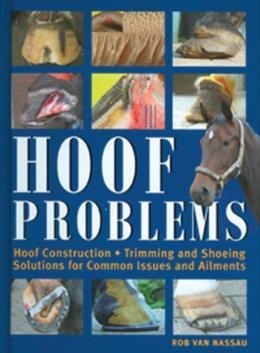
Hoof Problems, by Rob Van Nassau
Highly recommended by Mary Ann and Lim Couch, this book provides one of the best guides to the hoof they have found. Its detailed illustrations of the horse’s conformation, limbs, and hoof structures provide an excellent guide for farriers and horse owners alike to develop a thorough understanding of the mechanisms that allow the horse to move, and how hoof care, proper and improper, affects the horse’s way of going and general health. Mary Ann Couch: “This is a good book with the basics for both the horse owner and horse shoer. It is written so that both can clearly understand [the information]. It is our best seller and very affordable at only $45,” a worthy educational investment.
Part I is devoted first to the general physiology of the horse: joints, bones, muscles, tendons, and ligaments. Chapter 2 describes construction of the hoof, hoof mechanism, hoof shapes, foot axis, and limb conformation. Chapter 3 covers hoof care and horseshoes, trimming and shoeing, and the “Hoofcare Breakover shoe.” It describes how to recognize good and faulty shoeing; explains the mechanics of the foot in motion; discusses foot balance; illustrates the anatomy of the foot and limb alignment; and offers advice on how to keep the hooves healthy.
Part II covers common disorders and ailments of the limbs and hooves in relation to hoof care and horseshoes. Each problem is clearly illustrated and accompanied by a straightforward description of the problem, its cause, and treatment. Each problem is described in a one- to two-page spread with multiple photographs of each case.
Chapter 1 focuses on disorders of the limb: arthrosis, wire wounds, stringhalt and spasms. Chapter 2 covers the lower limb: splint and bone spavin. Chapter 3 details conditions in the lower foot outside: over-reaching, deformed hooves, greasy heel, over at the pastern, pes Equinus and club foot; and lower foot inside: cyst, keratoma, low and high ring-bone, ostitis. Chapter 4 explores the hoof in further detail, beginning with the coronary band, moving to the horny wall, toe, heels, frog, sole, hoof capsule, pedal bone, and navicular bone. Problems occurring at the coronary band include irritation and damage to the coronary band and sand crack. Problems with the horny wall include cracks, rings of horn, seedy toe, false quarter, and separating walls. Problems in the toe area are long toes and low heels, inflammation of the toe. At the heel area there are rolled-under heels, under-run heels, and inflammation of the heel. In the frog, a most common problem is thrush. In the sole, problems can occur from puncture wounds, dropped sole, bruised and cracked sole. In the hoof capsule, the problem is white line disease. In the pedal bone, chip fractures, laminitis, sinker, and side-bone are all problems in this area. Navicular disease is the ailment of the navicular bone.
The excellent illustrations, photos, and diagrams show clearly the relations and functions of tendons, ligaments and bones and how they affect movement. Jargon used to describe the physiology is clearly defined.
About the author: Rob Van Nassau is a qualified farrier working in a specialist equine veterinary clinic for over 30 years. He is a respected farrier teacher and lecturer, and is a former European Champion Farrier and National Champion in Holland. He has lectured at the Bluegrass Laminitis Symposium in the USA.
For more information, visit http://www.hoofcare.com/hoofproblems.html.


