

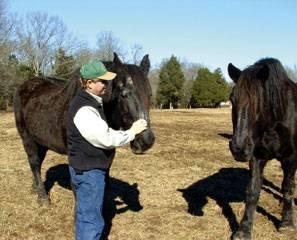
Hutton Percherons Find Quality Accomodations At Ames
by Nancy Brannon
They may not be staying in the "Ames Plantation Hilton," as the guest house and former squash court building is known, but the five Percherons of the Hutton Hitch have found more than adequate accomodations at the Ames Plantation located in Fayette County near Grand Junction, Tennessee.
Superintendant Rick Carlisle speaks well of the latest equine acquisition at Ames and has plans to make the "Hitch" a permanent part of the field trials held there every year.
The caretaker of the gentle giants is Cornelius Dickson. Carlisle says Dickson has found it remarkable how "they all have their own individual personality. It's great to pick up on that just by taking care of them."
COUNT, an 18-year-old, is the boss of the herd. He always eats first and is the marshall of the herd. JAKE, as a 12-year-old, is the other lead horse. It is important to put him on the left in the hitch. If he is put on the right, he goes to the right; but if on the left, he goes straight. He also has an interesting white star - it is the perfect shape of a bell. JOHN, at 26, is the "old man" of the group, more or less retired. He is second in the pecking order, but whatever handlers want the team to do, they must get JOHN first, then the others will follow. FRED, a 10-year-old and the youngster of the group, was raised by a little girl as a 4-H project, so to this day he prefers females. He will allow women to ride him, prefers little girls, but if a man gets on him, he will likely be bucked off! SHANE, a 13-year-old, is the low man on the totem pole; he is just allowed to be part of the group and follows along with everyone else.
Ames' good fortune came on the heels of tragedy in the Henry Hutton family of Memphis. Last spring, Lisa and Henry Hutton lost their son, Henry, Jr., age 22, in a tragic accident at Mississippi State. Then JETT, the first Percheron that Hutton bought and also his favorite, coliced and died on Hutton's birthday in the late summer. As Carlisle describes the circumstances of the adoption, "That really knocked the wind out of his sails. They are also devout Christians and prayed that the Lord would lead them to the right place." They all believe that prayer has been answered.
Previously, Hutton had used his team in commercials, parades, rides around the Square in Collierville, and other such activities. But Carlisle says, "Henry hadn't used the hitch in about 18 months and he didn't want them just wasting away. So he began looking for a good home for them."
Carlisle continues the story, "His wife Lisa talked to Daryl Nephew, the head saddle maker at Tucker Saddlery about it. He immediately thought of Ames. Daryl contacted me, I said I was interested, and I contacted Lisa." Then the arrangements to donate the horses to Ames Plantation just fell into place.
Carlisle says the terms are that, "He has donated them for our use here as we see fit. But he wants the horses kept here and not sold to anybody else. He really wants them to have a good home."
Hutton is also donating a wagon and the harness to go with the horses. In fact, on the afternoon of the interview with the Review, Carlisle had an appointment to pick up the wagon and harness from the Huttons. Hutton has even promised to give the folks at Ames some "driving lessons."
Carlisle has a person in mind to do the driving: Chris Weatherly, who primarily works as a carpenter at Ames, but also likes to ride in the National Championship. He has expressed an interest in learning how to drive the team. Carlisle says Hutton told them he would be "honored to come out, show them how to hook up the team, show them the commands and how to drive them."
Hutton has two wagons, one small one with rubber tires and a larger cargo wagon with wooden wheels. It is the smaller wagon that Hutton is donating to Ames. The larger wagon is so heavy, Hutton told Carlisle, that it takes a minimum of six horses to pull it. It is currently on display in the showroom at the Chuck Hutton Chevrolet Truck Center in Memphis.
Carlisle continues, "Henry got to be friends with the guy who drove the Heinz Hitch and he learned how to hook up the horses and drive them from him." Carlisle plans to use the team to pull spectators, and owners who don't ride at the Field Trials. "We hope to have them go along with the gallery during the field trials. Now we have to provide a four-wheel-drive vehicle for those who don't ride."
It is appropriate that the Ames Plantation is now home to the Percherons because the Ames family started a tradition of having Percherons on the place. In the Manor House there are photos in the "Gun Room" of the original Percherons that Mr. Ames had on the Plantation.
Currently there are about 50 horses at the Ames Plantation. Twenty-four of them are in the "field trial string" and ten are used in the beef cattle operation. There are also the privately-owned horses of Ames employees. Carlisle explains that "Ames provides horses to judges, reporters, trustees of the foundation and other folks during the field trials. So we don't always have enough horses for the employees, thus they like to have their own here to ride."
Some horses adapt easily to the "field trial string," while others just cannot handle the stress of being in such a large group. Carlisle says they "had seven Arabians donated in September, which they want to use in the field trial, but they probably won't work out. They are too high strung and don't have the pace for field trials." They range in age from 2 years to 10 years and Carlisle is "beginning to look for a good home for them."
Most of the horses at Ames are Tennessee Walking Horses or gaited horses, even the horses that work the cattle. "The cowboys who work the cattle prefer the Tennessee Walking Horses because they are smoother to ride," Carlisle explains. They may have to herd the cattle over several miles and appreciate the smoother ride.
Carlisle has to be careful about the type of horses that are used for the field trials. "If you put a horse in a large gallery when the horse has not been in a situation like that, it puts a lot of pressure on the horse. Some can't take the pressure and just go bonkers. So we are always looking for horses that anyone can ride."
But he is also looking for younger horses, too. "When I first came here, the average age of the horses here was 20."
They use the horses an average of 40 to 45 days per year in the field trials, and the rest of the year is "time off." It's not a bad life at all for the Ames horses!
The Ames Amateur field trial runs January 5-10, 2004. The Hobart Ames Memorial trial begins on January 12. The National Championship opens on February 9th.


