

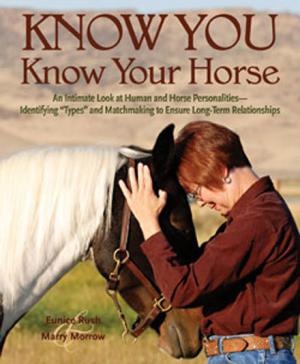
Review by Leigh Ballard
This is a fascinating book on people and horse personalities! Based on theories of introvert and extrovert social styles, and left brain and right brain personality traits, the book attempts to help readers “match-make” and choose the right horses to ensure long term positive relationships.
Humans and horses have four distinct personality types. These types, modified by categories of variables, result in particular behaviors that can be predicted with a reasonable bit of certainty. Evaluating personality types, aptitudes, and social styles has long been accepted in predicting business and career success. Rush and Morrow are using these same principles to give the reader guidelines to match the right person to the right horse, and to match the right job to the right horse.
The book is divided into four parts: 1) The Human Personality 2) The Horse Personality 3) Matching Human to Horse and Horse to Human 4) Training Techniques for Your Horse’s Social Style.
There are questionnaires to help analyze both human and horse styles. There are in-depth discussions of right brain and left brain tendencies for both horses and people. There are case studies of horse and human matches that worked or didn’t work, and why.
For both humans and horses, there are introverts (I) and extroverts (E) and right or left brain dominance (RB or LB.) This gives four possible personality types: RBI or RBE and LBI or LBE, and any of these can be strong or weak in any of their components, for example: very strongly right brained or only moderately right brained. In Rush and Morrow’s work, human introverts are Mediators and Analysts. Human extroverts are Advocates and Powerfuls. Horse introverts are Thinkers and Actors. Horse extroverts are Workers and Talkers. And they all have a “best” match depending on training, rider skill, job to do, etc. The best matches are always Introvert with Introvert or Extrovert with Extrovert. Then the right brained or left brained tendencies come into play, pairing with introvert or extrovert tendencies to give the final definition of the best match for the job. There are “core” personalities, but many variables can come into play and be “modifiers” to personality traits.
Training techniques for certain social styles take up the fourth section of the book, with discussion of what responses to expect from each type in ground work, training, and riding situations. Also, the learning styles and strengths and weaknesses of each type help determine the disciplines for which the horse is best suited.
In addition to all the personality discussion, there is an interesting section on conformation and its indicators of personality. Finally, there is a thoughtful chapter on pain as a possible cause for behaviors.
I found this book to be innovative and impressive in its analysis of why some horse and rider teams “click” and make great partners, and others just don’t get along. I think it should be explored certainly by all trainers, and probably by most riders. The information would be especially helpful for someone looking to buy a new horse, but also fantastic for either learning how to get along with the one you have or realizing it needs to move along to a new owner that fits!
This is a fascinating book on people and horse personalities! Based on theories of introvert and extrovert social styles, and left brain and right brain personality traits, the book attempts to help readers “match-make” and choose the right horses to ensure long term positive relationships.
Humans and horses have four distinct personality types. These types, modified by categories of variables, result in particular behaviors that can be predicted with a reasonable bit of certainty. Evaluating personality types, aptitudes, and social styles has long been accepted in predicting business and career success. Rush and Morrow are using these same principles to give the reader guidelines to match the right person to the right horse, and to match the right job to the right horse.
The book is divided into four parts: 1) The Human Personality 2) The Horse Personality 3) Matching Human to Horse and Horse to Human 4) Training Techniques for Your Horse’s Social Style.
There are questionnaires to help analyze both human and horse styles. There are in-depth discussions of right brain and left brain tendencies for both horses and people. There are case studies of horse and human matches that worked or didn’t work, and why.
For both humans and horses, there are introverts (I) and extroverts (E) and right or left brain dominance (RB or LB.) This gives four possible personality types: RBI or RBE and LBI or LBE, and any of these can be strong or weak in any of their components, for example: very strongly right brained or only moderately right brained. In Rush and Morrow’s work, human introverts are Mediators and Analysts. Human extroverts are Advocates and Powerfuls. Horse introverts are Thinkers and Actors. Horse extroverts are Workers and Talkers. And they all have a “best” match depending on training, rider skill, job to do, etc. The best matches are always Introvert with Introvert or Extrovert with Extrovert. Then the right brained or left brained tendencies come into play, pairing with introvert or extrovert tendencies to give the final definition of the best match for the job. There are “core” personalities, but many variables can come into play and be “modifiers” to personality traits.
Training techniques for certain social styles take up the fourth section of the book, with discussion of what responses to expect from each type in ground work, training, and riding situations. Also, the learning styles and strengths and weaknesses of each type help determine the disciplines for which the horse is best suited.
In addition to all the personality discussion, there is an interesting section on conformation and its indicators of personality. Finally, there is a thoughtful chapter on pain as a possible cause for behaviors.
I found this book to be innovative and impressive in its analysis of why some horse and rider teams “click” and make great partners, and others just don’t get along. I think it should be explored certainly by all trainers, and probably by most riders. The information would be especially helpful for someone looking to buy a new horse, but also fantastic for either learning how to get along with the one you have or realizing it needs to move along to a new owner that fits!


