

By Leigh Ballard
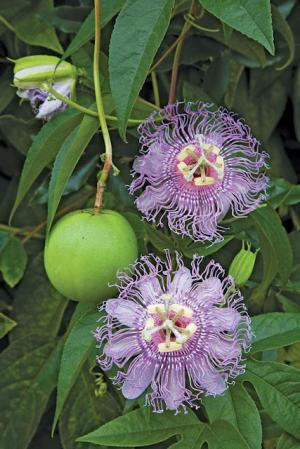
The exotic frilly blue flower you often see in fields or tumbling down scruffy banks is commonly called Maypop. The botanical name fits its exotic look: Passiflora incarnata or Passion Flower. The flowers turn to little round fruits, Passion Fruits. As kids we used to stomp on them to hear the little puffy “pop” they produce.
The herbaceous vines emerge rapidly in May and can grow prolifically in pastures and fields all over the mid-south to the Gulf. Their native habitat is a sunny open area, with dry and somewhat poor soil. Passiflora incarnata is the Tennessee State Wildflower. Cherokee Indians called the plant “ocoee,” and in Tennessee the Ocoee River is presumably named for the plant. Native Americans were known to medicinally use parts of the plant in teas for alleviating insomnia and anxiety. Spanish missionaries in the 1600s attributed religious significance to the flower structures, which they interpreted as symbols of the Passion of Christ, hence the name, Passiflora.
The fruits of the Passion Flower are edible, having a tart, sweet, “tropical” flavor. The fruit is politely called “gelatinous,” translated: somewhat slimy. It is sometimes used to make jelly.
The plant is the sole food source for the larvae of the Gulf Fritillary butterfly, and as such is important for survival of this particular butterfly. The caterpillars eat holes in the leaves, but the fruit and flowers are the main attractions for humans anyway. The Gulf Fritillary is abundant in the mid-south. It is important to preserve this lovely plant whenever you see it, not only for its flower, but for its important role as a habitat plant.
The exotic frilly blue flower you often see in fields or tumbling down scruffy banks is commonly called Maypop. The botanical name fits its exotic look: Passiflora incarnata or Passion Flower. The flowers turn to little round fruits, Passion Fruits. As kids we used to stomp on them to hear the little puffy “pop” they produce.
The herbaceous vines emerge rapidly in May and can grow prolifically in pastures and fields all over the mid-south to the Gulf. Their native habitat is a sunny open area, with dry and somewhat poor soil. Passiflora incarnata is the Tennessee State Wildflower. Cherokee Indians called the plant “ocoee,” and in Tennessee the Ocoee River is presumably named for the plant. Native Americans were known to medicinally use parts of the plant in teas for alleviating insomnia and anxiety. Spanish missionaries in the 1600s attributed religious significance to the flower structures, which they interpreted as symbols of the Passion of Christ, hence the name, Passiflora.
The fruits of the Passion Flower are edible, having a tart, sweet, “tropical” flavor. The fruit is politely called “gelatinous,” translated: somewhat slimy. It is sometimes used to make jelly.
The plant is the sole food source for the larvae of the Gulf Fritillary butterfly, and as such is important for survival of this particular butterfly. The caterpillars eat holes in the leaves, but the fruit and flowers are the main attractions for humans anyway. The Gulf Fritillary is abundant in the mid-south. It is important to preserve this lovely plant whenever you see it, not only for its flower, but for its important role as a habitat plant.


