

Somerville Farm Supply Horse Seminar
By Tommy Brannon
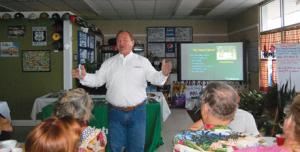
On July 12 Somerville Farm Supply in Somerville, Tennessee hosted their 2012 horse seminar, with food and location for the seminar provided by The BBQ Store in Somerville. There was a full house of 68 guests in attendance. Featured speakers were Tim Mays of Nutrena Feeds to talk about Equine nutrition and Leigh Ballard of Equine Imaging Solutions to demonstrate Equine thermal imaging.
Leigh showed the audience the camera used in thermal imaging and how it works to detect heat and display the temperature differences with various colors. She explained that, since a horse is bisymmetrical, the heat patterns in a horse should be symmetrical. If they are not, that indicates that there is something wrong. Various parts of a horse’s body have different heat patterns, with some parts warmer than others. For example, if the coronet on the left fore leg is red (warm) in the image and coronet in the right fore leg is white (very hot) in the image, this may be an indication of inflammation in the right leg. She said horses are very stoic animals. They have instincts to hide pain if they can, because in nature, the horse is a prey animal and the individuals in a herd that show weakness will be singled out by predators. This is one of the reasons that lameness can be so difficult to diagnose.
Leigh said that thermal imaging is used extensively at race tracks by trainers as a preventative measure. Horses are regularly scanned for problems before these problems manifest themselves during a race. She said that in a normal body scan, a series of 28 images are taken to be used as a baseline, and periodically horses are scanned during the training period. She said that she does not interpret the images. She is trained to take the photos, but not interpret them. She sends electronic images to veterinarian Dr. Joanna Robinson in California who has read over 15,000 images. Dr. Robinson is one of the most experienced veterinarians in the field of thermography. The turnaround time for the analysis is three to four days. She said that a very experienced farrier is also used to interpret the hoof images.
Leigh showed the audience images of how thermography is used as a tool to test saddle fitment. She explained how detrimental a poorly fitted saddle can be to the horse, sometimes even killing the nerve endings in the horses hide. Thermography can show where the saddle is pinching, rubbing, as well as where the saddle makes contact on the horse.
Tim Mays, the equine nutrition specialist for Cargill Animal Nutrition (Nutrena Feeds), gave a very comprehensive talk on” understanding your horses nutritional needs.”
Tim made a declarative statement that seemed surprising coming from a representative of a feed company: “Horses do not need to be fed.” The proof is that wild horses are not fed. He qualified that statement, though, by explaining how the needs of domestic horses are very different from those of wild horses.
Tim asked the audience to list the six most important nutritional needs of horses in order of importance. Many in the audience got some of them correct, but most were surprised by the answer. He gave the answer in reverse order: #6 vitamins; #5 minerals; #4 protein; #3 energy; #2 forage; and the #1 most important nutrient is clean water. As the temperature the day of the seminar was reaching 100 degrees the audience could definitely relate to that!
He used a diagram to demonstrate the digestive system of a horse, explaining that 36% of digestion takes place in the stomach and small intestine; the rest takes place in the hind gut. It takes thirty-one hours for the feed or forage to move through the entire system. He explained how the horse utilizes each of the six important nutrients and how important it is to have the correct balance in the diet.
He asked the audience a series of questions about equine nutrition, debunking some common myths. Prizes were awarded for correct answers. One question,” Is brown mineral block salt is better than a white block salt?” Answer: no. The minerals may not be in the correct balance for horses.
Tim discussed the variety of Nutrena Feed products for horses; the types and textures of the feeds; the percentages of nutrients in each of the feeds; and which horses would benefit from particular feeds. The audience went away with a better understanding of horses nutritional needs, based on the breed and use of the horse, as well as some very generous door prizes provided by Somerville Farm Supply.
By Tommy Brannon
On July 12 Somerville Farm Supply in Somerville, Tennessee hosted their 2012 horse seminar, with food and location for the seminar provided by The BBQ Store in Somerville. There was a full house of 68 guests in attendance. Featured speakers were Tim Mays of Nutrena Feeds to talk about Equine nutrition and Leigh Ballard of Equine Imaging Solutions to demonstrate Equine thermal imaging.
Leigh showed the audience the camera used in thermal imaging and how it works to detect heat and display the temperature differences with various colors. She explained that, since a horse is bisymmetrical, the heat patterns in a horse should be symmetrical. If they are not, that indicates that there is something wrong. Various parts of a horse’s body have different heat patterns, with some parts warmer than others. For example, if the coronet on the left fore leg is red (warm) in the image and coronet in the right fore leg is white (very hot) in the image, this may be an indication of inflammation in the right leg. She said horses are very stoic animals. They have instincts to hide pain if they can, because in nature, the horse is a prey animal and the individuals in a herd that show weakness will be singled out by predators. This is one of the reasons that lameness can be so difficult to diagnose.
Leigh said that thermal imaging is used extensively at race tracks by trainers as a preventative measure. Horses are regularly scanned for problems before these problems manifest themselves during a race. She said that in a normal body scan, a series of 28 images are taken to be used as a baseline, and periodically horses are scanned during the training period. She said that she does not interpret the images. She is trained to take the photos, but not interpret them. She sends electronic images to veterinarian Dr. Joanna Robinson in California who has read over 15,000 images. Dr. Robinson is one of the most experienced veterinarians in the field of thermography. The turnaround time for the analysis is three to four days. She said that a very experienced farrier is also used to interpret the hoof images.
Leigh showed the audience images of how thermography is used as a tool to test saddle fitment. She explained how detrimental a poorly fitted saddle can be to the horse, sometimes even killing the nerve endings in the horses hide. Thermography can show where the saddle is pinching, rubbing, as well as where the saddle makes contact on the horse.
Tim Mays, the equine nutrition specialist for Cargill Animal Nutrition (Nutrena Feeds), gave a very comprehensive talk on” understanding your horses nutritional needs.”
Tim made a declarative statement that seemed surprising coming from a representative of a feed company: “Horses do not need to be fed.” The proof is that wild horses are not fed. He qualified that statement, though, by explaining how the needs of domestic horses are very different from those of wild horses.
Tim asked the audience to list the six most important nutritional needs of horses in order of importance. Many in the audience got some of them correct, but most were surprised by the answer. He gave the answer in reverse order: #6 vitamins; #5 minerals; #4 protein; #3 energy; #2 forage; and the #1 most important nutrient is clean water. As the temperature the day of the seminar was reaching 100 degrees the audience could definitely relate to that!
He used a diagram to demonstrate the digestive system of a horse, explaining that 36% of digestion takes place in the stomach and small intestine; the rest takes place in the hind gut. It takes thirty-one hours for the feed or forage to move through the entire system. He explained how the horse utilizes each of the six important nutrients and how important it is to have the correct balance in the diet.
He asked the audience a series of questions about equine nutrition, debunking some common myths. Prizes were awarded for correct answers. One question,” Is brown mineral block salt is better than a white block salt?” Answer: no. The minerals may not be in the correct balance for horses.
Tim discussed the variety of Nutrena Feed products for horses; the types and textures of the feeds; the percentages of nutrients in each of the feeds; and which horses would benefit from particular feeds. The audience went away with a better understanding of horses nutritional needs, based on the breed and use of the horse, as well as some very generous door prizes provided by Somerville Farm Supply.


