

By Tommy Brannon
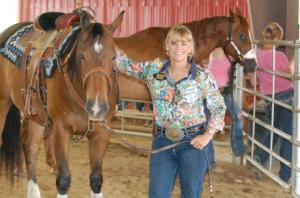
Blue Creek Arena near McEwen, Tennessee hosted a barrel racing clinic by Texas-based trainer Dena Kirkpatrick June 19-20, 2012. A full complement of riders came from as far away as Georgia to sample the country air and learn Dena’s training methods. She said that she was very happy to have the opportunity to teach in the mid-south because it is “barrel horse central.” She stated “There are so many barrel racers here. This is one of the few areas where men barrel race.” At this particular clinic, however, all of the riders were female.
Dena’s method can be described as getting the horse to make a perfect circle in “one smooth motion” with the barrel in the center. The horse and rider’s body position in relation to the barrel is critical. She said that the rider needs to start and stay in the circle, with the barrel behind the rider’s leg and at the horse’s hip. Riders need to use the laws of physics. “It’s like spinning a rock on a string,” She said “Too many barrel racers aim for the barrel and then have to make adjustments to the circle, getting the horse out of position and consequently slowing down. A horse can see better peripherally than he does in front of him. He can keep the barrel in sight at all times when going around it. If you don’t ask him to go to the wrong place, you don’t have to get him out of the wrong place.”
Her teaching methods are to start slow, to walk and trot through the pattern and get it right. “I want to help the rider with horsemanship,” she stated. “I’m on a mission to teach ‘feel.’ Some say that ‘feel’ cannot be learned, but I disagree. You’d better be aware of what the horse is thinking because he knows what you are thinking. Horses are living, breathing, emotional, and telepathic.”
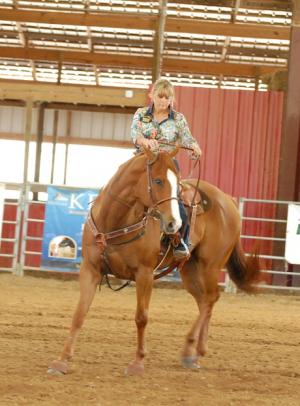
Dena teaches a lot from horseback. She demonstrated her “one smooth motion” technique at a trot on one of the participant’s horses, and she rode each of the participant’s horse at least once during the session. She watched the participants work away from the pattern, and then had them go slowly through the pattern, observing problems that needed to be solved. She suggested doing a lot of slow ground work. “If you do most of it right, a lot of the rest of it will be right; but practice does not make perfect unless you are practicing perfect. At slow work they [the horses] will tell you exactly what they are thinking.”
Dena uses figure eights a lot and works away from the barrels to teach the horses not to drop the shoulder. She said, “The pattern is very stressful by nature. The front of the arena and the beginning of the pattern is where most horses get stupid, crazy. Walk him there. Turn him to the right if your pattern is to the left.” One participant was asked to do quite a bit of groundwork to get control of her horse.
Dena asked several participants about their choice of tack, bit, and headgear. She said, “It is not a good idea to substitute headgear for training, but you do need enough bit, and some will not take to a gag.” More than one participant was asked if she had tried a hackamore.
Dena stresses the need for balance. She said that every discipline of riding requires balance. She pointed out that the really good male riders “sit on their pockets” and that some women tend to ride too far forward. She said, “Your position changes everything the horse does. If you lean forward, he has to take a lot more steps.” She had one of the clinic participants reposition her saddle much further back on the horse.
She advised that barrel racers need to ride one handed. “The saddle horn is your friend,” she said. “It is there to balance you. There is no way to ride that circle two handed without pulling on him.”
She critiqued several of the riders neck-reining. They were cutting across the horse’s neck with their hand and reins. “If you cut across his neck anywhere in that turn, he will tilt his head and be out of balance.” One participant’s horse was responding by frequently throwing his head up. Dena pointed out, “If the head is up and the shoulder locks, he is out of balance and cannot move his shoulder. His shoulder gets in the way.” There was a significant improvement after Dena rode the horse.
Dena frequently sought feedback from the clinic participants, asking if they understood what she was trying to teach them and answering their questions. She was asked, “How do I know when I’ve done enough?” She answered, “When he has lost his concentration. Under-doing is better than overdoing.” She had previously stated, “Horses learn from the release of pressure. The slightest good should be rewarded. When he gets a circle right, let him out.” And “If you don’t let your horse be still after teaching him something, he will not absorb it.” Another question asked was “What do I look at, the left ear or the right ear?” Dena’s answer was :“You look ahead where you want to go, particularly around the barrel.”
For more information about Dena Kirkpatrick, visit her website: http://www.denakirkpatrick.com/
Blue Creek Arena is located 299 Little Blue Creek Rd., McEwen, TN. Call 615-310-9210 or visit their website: http://www.bluecreekarena.com.
Blue Creek Arena near McEwen, Tennessee hosted a barrel racing clinic by Texas-based trainer Dena Kirkpatrick June 19-20, 2012. A full complement of riders came from as far away as Georgia to sample the country air and learn Dena’s training methods. She said that she was very happy to have the opportunity to teach in the mid-south because it is “barrel horse central.” She stated “There are so many barrel racers here. This is one of the few areas where men barrel race.” At this particular clinic, however, all of the riders were female.
Dena’s method can be described as getting the horse to make a perfect circle in “one smooth motion” with the barrel in the center. The horse and rider’s body position in relation to the barrel is critical. She said that the rider needs to start and stay in the circle, with the barrel behind the rider’s leg and at the horse’s hip. Riders need to use the laws of physics. “It’s like spinning a rock on a string,” She said “Too many barrel racers aim for the barrel and then have to make adjustments to the circle, getting the horse out of position and consequently slowing down. A horse can see better peripherally than he does in front of him. He can keep the barrel in sight at all times when going around it. If you don’t ask him to go to the wrong place, you don’t have to get him out of the wrong place.”
Her teaching methods are to start slow, to walk and trot through the pattern and get it right. “I want to help the rider with horsemanship,” she stated. “I’m on a mission to teach ‘feel.’ Some say that ‘feel’ cannot be learned, but I disagree. You’d better be aware of what the horse is thinking because he knows what you are thinking. Horses are living, breathing, emotional, and telepathic.”
Dena teaches a lot from horseback. She demonstrated her “one smooth motion” technique at a trot on one of the participant’s horses, and she rode each of the participant’s horse at least once during the session. She watched the participants work away from the pattern, and then had them go slowly through the pattern, observing problems that needed to be solved. She suggested doing a lot of slow ground work. “If you do most of it right, a lot of the rest of it will be right; but practice does not make perfect unless you are practicing perfect. At slow work they [the horses] will tell you exactly what they are thinking.”
Dena uses figure eights a lot and works away from the barrels to teach the horses not to drop the shoulder. She said, “The pattern is very stressful by nature. The front of the arena and the beginning of the pattern is where most horses get stupid, crazy. Walk him there. Turn him to the right if your pattern is to the left.” One participant was asked to do quite a bit of groundwork to get control of her horse.
Dena asked several participants about their choice of tack, bit, and headgear. She said, “It is not a good idea to substitute headgear for training, but you do need enough bit, and some will not take to a gag.” More than one participant was asked if she had tried a hackamore.
Dena stresses the need for balance. She said that every discipline of riding requires balance. She pointed out that the really good male riders “sit on their pockets” and that some women tend to ride too far forward. She said, “Your position changes everything the horse does. If you lean forward, he has to take a lot more steps.” She had one of the clinic participants reposition her saddle much further back on the horse.
She advised that barrel racers need to ride one handed. “The saddle horn is your friend,” she said. “It is there to balance you. There is no way to ride that circle two handed without pulling on him.”
She critiqued several of the riders neck-reining. They were cutting across the horse’s neck with their hand and reins. “If you cut across his neck anywhere in that turn, he will tilt his head and be out of balance.” One participant’s horse was responding by frequently throwing his head up. Dena pointed out, “If the head is up and the shoulder locks, he is out of balance and cannot move his shoulder. His shoulder gets in the way.” There was a significant improvement after Dena rode the horse.
Dena frequently sought feedback from the clinic participants, asking if they understood what she was trying to teach them and answering their questions. She was asked, “How do I know when I’ve done enough?” She answered, “When he has lost his concentration. Under-doing is better than overdoing.” She had previously stated, “Horses learn from the release of pressure. The slightest good should be rewarded. When he gets a circle right, let him out.” And “If you don’t let your horse be still after teaching him something, he will not absorb it.” Another question asked was “What do I look at, the left ear or the right ear?” Dena’s answer was :“You look ahead where you want to go, particularly around the barrel.”
For more information about Dena Kirkpatrick, visit her website: http://www.denakirkpatrick.com/
Blue Creek Arena is located 299 Little Blue Creek Rd., McEwen, TN. Call 615-310-9210 or visit their website: http://www.bluecreekarena.com.


