

Article and photos by Nancy Brannon
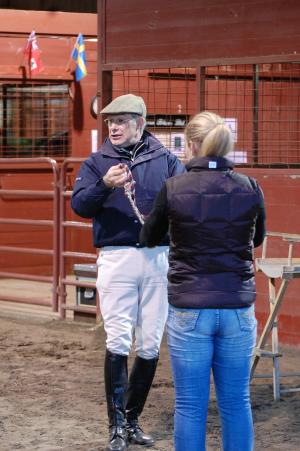
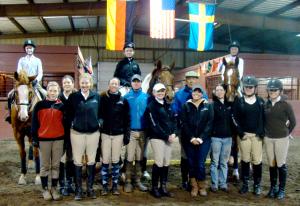
McKrell and Christian Baier hosted a clinic with international, award-winning show jumper Albert Voorn January 2-4 at their Southern Blues Equestrian Center in Collierville, TN.
Voorn is from the Netherlands and was Individual Silver Medalist in Show Jumping at the 2000 Summer Olympics in Sydney, Australia. His Golden Dream Stables is in Evertsoord, a village in Horst aan de Maas, in the province of Limburg. He specializes in training show jumpers and eventers, giving clinics, and instructing riders with their horses at home as well as abroad.
Voorn has a non-stressful approach to improving riding and the horse’s performance. While a renowned successful rider himself, he maintains a modest demeanor and doesn’t worry about mistakes. He encourages his riders not to worry about mistakes either. Following are some comments he offered to riders in a late afternoon lesson: Cheyenne Ewing on Stella, Senica Ewing on Sonya, and Amy Turner on Guiness.
He began the clinic with warm-up on the flat, carefully watching riders and pointing out subtle changes they could make to improve. He had riders doing lots of transitions, giving this advice on sitting the trot: “Wait until all is in balance and the stride is slow enough that you can comfortably sit the trot. When the pace is so slow that the rising trot gets difficult, then the stride is slow enough to sit the trot as comfortably as possible.” This ensures the least discomfort to the horse’s back. “You always want to be as comfortable as possible, so adapt your position to the pace you’re in.”
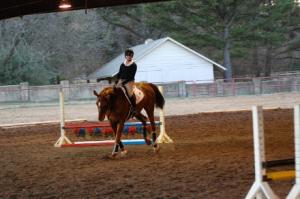
For the jumping phase, he set a low vertical jump in the center of the arena and had riders jump it three times. Following that, he had all riders go over a small course over fences. Afterwards he de-briefed each rider, explaining and demonstrating what they were doing and what they could change to improve their jumping efforts.
He explained to one rider how she could keep a slight flexion of the horse to the inside and avoid dropping the shoulder to the inside or running to the outside. “The more you soften the outside rein, the more your horse can soften his body.”
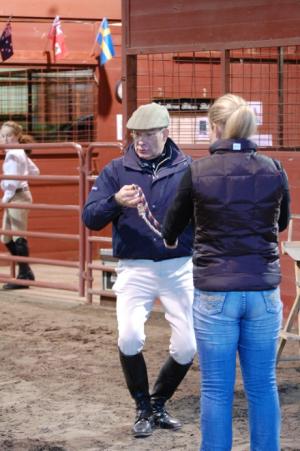
He demonstrated what to do with the leg and body when asking the horse to slow down. “When slowing down, remove the leg pressure. Then you can add leg pressure to go forward again. When you slow down, take a deep breath. You loosen your body, making sure you are not gripping with the knee, or with the calf.”
“Allow the horse to carry his head where he wants,” he advised. “The horse always carries his head where it is most comfortable for him, so there is no point in trying to put his head in a position where it is difficult for him. The higher the horse’s head, the higher the rider’s hands.
“We want to disturb the horse as little as we can. Make the horse comfortable – because the rider, no matter how good he/she is, is always a disturbance to the horse just because the horse has to carry us on his back. “
He demonstrated making turns to fences: “Keep to the inside of the turn. It makes the approach easier. Allow the horse to get his body in the line of the turn you are making.”
Responsiveness to the rider’s aids is always a topic at riding clinics. “When you give an aid, the horse must respond,” he said. “When you maintain contact and the horse goes somewhere we don’t want him to go, we can always make adjustments with the rein – on the approach, over the fence, wherever needed. Over the top of the fence, stay off the horse’s neck. If the fence [i.e., jumping effort] wasn’t what you wanted, don’t worry about it.” His frequent response to riders’ efforts was “Very nice.”
His approach to jumping is uncomplicated. “For show jumpers, the only thing they need to do is go faster when needed, slower when needed, turn left and turn right. Those are the basic things a show jumper needs to know. All the rest is not necessary. But the show jumper needs to do these four things extremely well. When we want to slow down, we don’t push with the legs. When we want to go faster, we don’t pull on the reins. When you turn left, use the left rein and vice versa. Don’t use indirect reins. Always use direct reins.
“There are many riding systems and so many books about riding. All systems work when the horse is accepting what you want him to do. But sometimes they don’t do what you want because they find what you asked them to do physically too difficult. For that reason, the only correct way of riding is the method that respects the natural way of functioning from the horse and the rider. The other can be done, but is incorrect and always creates more problems than necessary. Anything should be based on logical thinking. It’s all about logical thinking, but for many that is not easy, or not interesting. The more complicated people make something, maybe the more interesting it is, but that doesn’t work.
“Riding is like fashion – we like to follow the winner of the day. There are lots of different winners, so we change fashion. But the classics never go out of style.”
I asked Albert about his own family riding career and goals. “I’m a Dutchman, 55 years old. I’m doing three days of clinics here; then I travel to Pennsylvania, then back home. I started back riding again in 2011, at 2-star and 3-star level. My goal is to do well in April at the National Championship again. I think one of my horses could give me a second Championship: Eurocommerce Lexington or Tobalio. After Championships, I hope to be chosen on the Dutch Team for LaBaulle. Doing well there, I would go to St. Gallen, then Aachen, then London. That wraps up 2012. Do I achieve my goals? Maybe. If not, no problem!”
His philosophy of life makes him a delight just to be around. “Happiness is the most important thing in life. Not money, not things. Respect for each other. Respect for the horse. If we respect each other, we have no wars! Respect for the environment. Earth can only support so many people; now we have an overpopulation problem. A liveable wage: it is important to pay people enough to survive, and we should not exploit children for labor. The most important are happiness and respect – no drama!” Read more about Voorn at: www.goldendreamstables.com.
McKrell and Christian Baier hosted a clinic with international, award-winning show jumper Albert Voorn January 2-4 at their Southern Blues Equestrian Center in Collierville, TN.
Voorn is from the Netherlands and was Individual Silver Medalist in Show Jumping at the 2000 Summer Olympics in Sydney, Australia. His Golden Dream Stables is in Evertsoord, a village in Horst aan de Maas, in the province of Limburg. He specializes in training show jumpers and eventers, giving clinics, and instructing riders with their horses at home as well as abroad.
Voorn has a non-stressful approach to improving riding and the horse’s performance. While a renowned successful rider himself, he maintains a modest demeanor and doesn’t worry about mistakes. He encourages his riders not to worry about mistakes either. Following are some comments he offered to riders in a late afternoon lesson: Cheyenne Ewing on Stella, Senica Ewing on Sonya, and Amy Turner on Guiness.
He began the clinic with warm-up on the flat, carefully watching riders and pointing out subtle changes they could make to improve. He had riders doing lots of transitions, giving this advice on sitting the trot: “Wait until all is in balance and the stride is slow enough that you can comfortably sit the trot. When the pace is so slow that the rising trot gets difficult, then the stride is slow enough to sit the trot as comfortably as possible.” This ensures the least discomfort to the horse’s back. “You always want to be as comfortable as possible, so adapt your position to the pace you’re in.”
For the jumping phase, he set a low vertical jump in the center of the arena and had riders jump it three times. Following that, he had all riders go over a small course over fences. Afterwards he de-briefed each rider, explaining and demonstrating what they were doing and what they could change to improve their jumping efforts.
He explained to one rider how she could keep a slight flexion of the horse to the inside and avoid dropping the shoulder to the inside or running to the outside. “The more you soften the outside rein, the more your horse can soften his body.”
He demonstrated what to do with the leg and body when asking the horse to slow down. “When slowing down, remove the leg pressure. Then you can add leg pressure to go forward again. When you slow down, take a deep breath. You loosen your body, making sure you are not gripping with the knee, or with the calf.”
“Allow the horse to carry his head where he wants,” he advised. “The horse always carries his head where it is most comfortable for him, so there is no point in trying to put his head in a position where it is difficult for him. The higher the horse’s head, the higher the rider’s hands.
“We want to disturb the horse as little as we can. Make the horse comfortable – because the rider, no matter how good he/she is, is always a disturbance to the horse just because the horse has to carry us on his back. “
He demonstrated making turns to fences: “Keep to the inside of the turn. It makes the approach easier. Allow the horse to get his body in the line of the turn you are making.”
Responsiveness to the rider’s aids is always a topic at riding clinics. “When you give an aid, the horse must respond,” he said. “When you maintain contact and the horse goes somewhere we don’t want him to go, we can always make adjustments with the rein – on the approach, over the fence, wherever needed. Over the top of the fence, stay off the horse’s neck. If the fence [i.e., jumping effort] wasn’t what you wanted, don’t worry about it.” His frequent response to riders’ efforts was “Very nice.”
His approach to jumping is uncomplicated. “For show jumpers, the only thing they need to do is go faster when needed, slower when needed, turn left and turn right. Those are the basic things a show jumper needs to know. All the rest is not necessary. But the show jumper needs to do these four things extremely well. When we want to slow down, we don’t push with the legs. When we want to go faster, we don’t pull on the reins. When you turn left, use the left rein and vice versa. Don’t use indirect reins. Always use direct reins.
“There are many riding systems and so many books about riding. All systems work when the horse is accepting what you want him to do. But sometimes they don’t do what you want because they find what you asked them to do physically too difficult. For that reason, the only correct way of riding is the method that respects the natural way of functioning from the horse and the rider. The other can be done, but is incorrect and always creates more problems than necessary. Anything should be based on logical thinking. It’s all about logical thinking, but for many that is not easy, or not interesting. The more complicated people make something, maybe the more interesting it is, but that doesn’t work.
“Riding is like fashion – we like to follow the winner of the day. There are lots of different winners, so we change fashion. But the classics never go out of style.”
I asked Albert about his own family riding career and goals. “I’m a Dutchman, 55 years old. I’m doing three days of clinics here; then I travel to Pennsylvania, then back home. I started back riding again in 2011, at 2-star and 3-star level. My goal is to do well in April at the National Championship again. I think one of my horses could give me a second Championship: Eurocommerce Lexington or Tobalio. After Championships, I hope to be chosen on the Dutch Team for LaBaulle. Doing well there, I would go to St. Gallen, then Aachen, then London. That wraps up 2012. Do I achieve my goals? Maybe. If not, no problem!”
His philosophy of life makes him a delight just to be around. “Happiness is the most important thing in life. Not money, not things. Respect for each other. Respect for the horse. If we respect each other, we have no wars! Respect for the environment. Earth can only support so many people; now we have an overpopulation problem. A liveable wage: it is important to pay people enough to survive, and we should not exploit children for labor. The most important are happiness and respect – no drama!” Read more about Voorn at: www.goldendreamstables.com.


