

By Mike Branch
Over the years I have done several symposiums, in which people brought horses for me to work with that had particular problems. There is problem that a lot of folks might find quite intriguing, but only because they may have never run into this before, or have always bought adult domestic horses that have already been started. What I’m talking about is “leading” the horse.
Many times, young horses that have not been handled much have this problem, or a wild horse that has not been domesticated. I suggest that rather than view this as a problem, see it as an obstacle that the horse has not yet learned. You see, it is the horse’s innate characteristic to resist steady pressure.
So what we can do to help the horse understand that we wish for it to follow our lead? Many times it is the steady pressure that the horse feels across the poll. When pressure is applied the horse wants to sit back and resist, or fight the steady pressure, and I have seen many people join the fight. As Ray Hunt said, “You can’t contest a horse.” So, the more you join the contest, the less you get from the requested task. Consider some alternative methods that will cause forward motion in your horse.
The first time I dealt with this problem in a symposium, where I had limited time to get the job done, I realized that driving pressure would cause the horse to move (it seems to me that a horse will fight steady pressure, but move away from driving pressure). This was a young colt that had never had anything around it’s girth, so I could not use a saddle to run the lines through the stirrups. But I knew that if I could keep some “long lines” low enough, I could perhaps long rein him, using pressure from behind to motivate the horse to move away from the pressure while wearing the halter and having the lines attached to it. Sure enough, my past experiences proved me right, and in no time the little fellow was long reining like a champ! Once pressure was applied under the chin with the line, it was as if he had done it all his life. In fact the owner lead the little fellow out of the round pen and all the way out to her truck and trailer with no difficulty.
Since then, I have used this technique many times, from domestic horses to wild mustangs, draft horses to Dartmoor Hill Ponies, from America to England. It works.
How does it work? It is a bonus if you can saddle your horse, or use a surcingle. The surcingle has pre-positioned rings to run lines through, and on the saddle you can tie the stirrups together and run the lines through the stirrups. This will keep the lines from riding up your horse’ body and getting the lines out of position, thus troubling the horse. Once you have the lines through the stirrups or surcingle rings and attached to the halter, gently swing an end of one line until your horse moves away from the stimulus you just created. If this does not cause movement, try holding your lines out and allow them to come back in and gently “bump” the sides of your horse.
Once the horse is walking off smooth, keep the “driving” energy or “life up” in your body and extended toward the horse. Allow the lines to have some slack. Anytime the horse begins to show signs of uncertainty, or tries to stop, give a little encouragement by using the end of your lines as stated earlier. With either technique you may have to follow a rule which involves the use of “phases:” begin lightly and increase pressure as needed. In other words, 1: suggest, 2: ask, 3: tell, 4: insist. The lighter you begin to ask your horse, the lighter your horse will be later.
To change direction of travel, simply hold one rein tight and allow the other to become loose. The horse will follow the tight line, and the loose one will allow it comfort necessary to complete the turn.
Once your horse is moving forward with ease, and making nice smooth turns, you may unclip the long lines and hook to the loop in the fiador knot. Your horse will now be leading without trouble, and will have found a new respect for your leadership abilities, which will cause it to begin to look to you as the leader it needs.
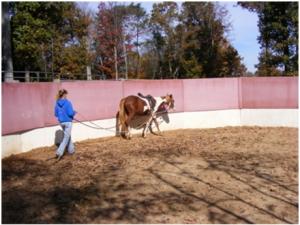
In the photographs I had just taught this method to my apprentice, (“Harley Goad”, of Jamestown, TN), using a mustang that had never been worked with until about an hour before this picture was taken. Many times a horse will relax and bond to you when you can display this type of leadership capabilities.
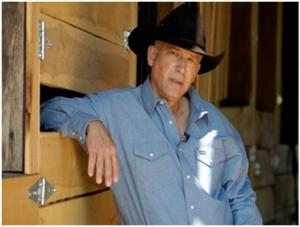
Mike Branch travels internationally, from the U.S. to Canada to the UK to start horses, hold clinics, and give lectures and demos. Mike has appeared on television in the U.S. as well as all across the United Kingdom. Has been featured on BBC’s Edwardian Farm, and received formal introductions to members of the royal family in England. Mike may be available for your next function. You may inquire at flyingbhorsemanship@gmail.com or by calling 865-548-0112
Once the horse is walking off smooth, keep the “driving” energy or “life up” in your body and extended toward the horse. Allow the lines to have some slack. Anytime the horse begins to show signs of uncertainty, or tries to stop, give a little encouragement by using the end of your lines as stated earlier.
To change direction of travel, simply hold tight to one rein and allow the other to become loose. The horse will follow the tight line, and the loose one will allow it comfort necessary to complete the turn.
Once your horse is moving forward with ease, and making nice smooth turns, you may unclip the long lines and hook to the loop in the fiador knot. Your horse will now be leading without trouble, and will have found a new respect for your leadership abilities, which will cause it to begin to look to you as the leader it needs.
In the photographs I had just taught this method to my apprentice, (“Harley Goad”, of Jamestown, TN), using a mustang that had never been worked with until about an hour before this picture was taken. Many times a horse will relax and bond to you when you can display this type of leadership capabilities.
Mike Branch travels internationally, from the U.S. to Canada to the UK to start horses, hold clinics, and give lectures and demos. Mike has appeared on television in the U.S. as well as all across the United Kingdom. Has been featured on BBC’s Edwardian Farm, and received formal introductions to members of the royal family in England. Mike may be available for your next function. You may inquire at flyingbhorsemanship@gmail.com or by calling 865-548-0112
Over the years I have done several symposiums, in which people brought horses for me to work with that had particular problems. There is problem that a lot of folks might find quite intriguing, but only because they may have never run into this before, or have always bought adult domestic horses that have already been started. What I’m talking about is “leading” the horse.
Many times, young horses that have not been handled much have this problem, or a wild horse that has not been domesticated. I suggest that rather than view this as a problem, see it as an obstacle that the horse has not yet learned. You see, it is the horse’s innate characteristic to resist steady pressure.
So what we can do to help the horse understand that we wish for it to follow our lead? Many times it is the steady pressure that the horse feels across the poll. When pressure is applied the horse wants to sit back and resist, or fight the steady pressure, and I have seen many people join the fight. As Ray Hunt said, “You can’t contest a horse.” So, the more you join the contest, the less you get from the requested task. Consider some alternative methods that will cause forward motion in your horse.
The first time I dealt with this problem in a symposium, where I had limited time to get the job done, I realized that driving pressure would cause the horse to move (it seems to me that a horse will fight steady pressure, but move away from driving pressure). This was a young colt that had never had anything around it’s girth, so I could not use a saddle to run the lines through the stirrups. But I knew that if I could keep some “long lines” low enough, I could perhaps long rein him, using pressure from behind to motivate the horse to move away from the pressure while wearing the halter and having the lines attached to it. Sure enough, my past experiences proved me right, and in no time the little fellow was long reining like a champ! Once pressure was applied under the chin with the line, it was as if he had done it all his life. In fact the owner lead the little fellow out of the round pen and all the way out to her truck and trailer with no difficulty.
Since then, I have used this technique many times, from domestic horses to wild mustangs, draft horses to Dartmoor Hill Ponies, from America to England. It works.
How does it work? It is a bonus if you can saddle your horse, or use a surcingle. The surcingle has pre-positioned rings to run lines through, and on the saddle you can tie the stirrups together and run the lines through the stirrups. This will keep the lines from riding up your horse’ body and getting the lines out of position, thus troubling the horse. Once you have the lines through the stirrups or surcingle rings and attached to the halter, gently swing an end of one line until your horse moves away from the stimulus you just created. If this does not cause movement, try holding your lines out and allow them to come back in and gently “bump” the sides of your horse.
Once the horse is walking off smooth, keep the “driving” energy or “life up” in your body and extended toward the horse. Allow the lines to have some slack. Anytime the horse begins to show signs of uncertainty, or tries to stop, give a little encouragement by using the end of your lines as stated earlier. With either technique you may have to follow a rule which involves the use of “phases:” begin lightly and increase pressure as needed. In other words, 1: suggest, 2: ask, 3: tell, 4: insist. The lighter you begin to ask your horse, the lighter your horse will be later.
To change direction of travel, simply hold one rein tight and allow the other to become loose. The horse will follow the tight line, and the loose one will allow it comfort necessary to complete the turn.
Once your horse is moving forward with ease, and making nice smooth turns, you may unclip the long lines and hook to the loop in the fiador knot. Your horse will now be leading without trouble, and will have found a new respect for your leadership abilities, which will cause it to begin to look to you as the leader it needs.
In the photographs I had just taught this method to my apprentice, (“Harley Goad”, of Jamestown, TN), using a mustang that had never been worked with until about an hour before this picture was taken. Many times a horse will relax and bond to you when you can display this type of leadership capabilities.
Mike Branch travels internationally, from the U.S. to Canada to the UK to start horses, hold clinics, and give lectures and demos. Mike has appeared on television in the U.S. as well as all across the United Kingdom. Has been featured on BBC’s Edwardian Farm, and received formal introductions to members of the royal family in England. Mike may be available for your next function. You may inquire at flyingbhorsemanship@gmail.com or by calling 865-548-0112
Once the horse is walking off smooth, keep the “driving” energy or “life up” in your body and extended toward the horse. Allow the lines to have some slack. Anytime the horse begins to show signs of uncertainty, or tries to stop, give a little encouragement by using the end of your lines as stated earlier.
To change direction of travel, simply hold tight to one rein and allow the other to become loose. The horse will follow the tight line, and the loose one will allow it comfort necessary to complete the turn.
Once your horse is moving forward with ease, and making nice smooth turns, you may unclip the long lines and hook to the loop in the fiador knot. Your horse will now be leading without trouble, and will have found a new respect for your leadership abilities, which will cause it to begin to look to you as the leader it needs.
In the photographs I had just taught this method to my apprentice, (“Harley Goad”, of Jamestown, TN), using a mustang that had never been worked with until about an hour before this picture was taken. Many times a horse will relax and bond to you when you can display this type of leadership capabilities.
Mike Branch travels internationally, from the U.S. to Canada to the UK to start horses, hold clinics, and give lectures and demos. Mike has appeared on television in the U.S. as well as all across the United Kingdom. Has been featured on BBC’s Edwardian Farm, and received formal introductions to members of the royal family in England. Mike may be available for your next function. You may inquire at flyingbhorsemanship@gmail.com or by calling 865-548-0112


