

The University Of Tennessee Extension Service Advanced Equine Management Course was held at the Agricenter in Memphis, TN August 15 -16 2011. This was the second in a series of seminars held this summer for horse owners and horse enthusiasts. The first course, held in June also at the Agricenter, was oriented for people who may have little experience with horses. The second seminar was a more advanced course with hands-on demonstrations.
Bridgett McIntosh, Ph.D., the equine specialist and nutrition expert at The University of Tennessee Extension Service, spoke in depth about equine nutrition requirements. She explained how to read and interpret a feed tag. She showed a formula on a spread sheet that horse owners can use to calculate the calories in a particular feed. She also helped the horse owners calculate the nutritional needs of their horse, including trace minerals, taking into account forage, weight, exercise and work requirements, and whether or not the horse is genetically an “easy keeper.” She emphasized the importance of precise record keeping in one’s feed and forage program
Dr. McIntosh’s Powerpoint presentation included a forage study that she had conducted at Virginia Tech. This study took place over 42 continuous hours, using 100 people over several months in different seasons; it analyzed grazing habits, the digestive cycle, and a forage analysis was done before and after grazing, and at different times of day. One interesting bit of information found was that there is a significant difference in forage total digestible nutrients (TDN) during the middle of the day and at night.
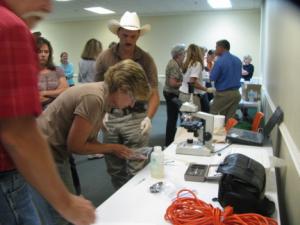
Stephen Galloway, DVM gave a hands -on demonstration of the latest method of parasite control. He explained how the conventional method of de-worming, i.e., de-worming the horse every 6 weeks or giving a daily de-wormer, is causing parasites to become resistant to de-wormers. He said that if the horse industry does not change its methods soon, there will longer be an effective means of controlling parasites. The newer comprehensive method uses fresh fecal samples to obtain a fecal egg count (FEC), which determines whether a particular horse is a high, medium, or low shedder of eggs, and whether de-worming would be recommended for that horse. The method also calls for precise record keeping and rotational pasture management. Participants in the seminar were requested to bring fecal samples from their horses, and they got to put their samples on slides and examine them under a microscope. Dr. Galloway demonstrated how the fecal egg count can be done by horse owners themselves, if they choose to do so, rather than sending it to a lab.
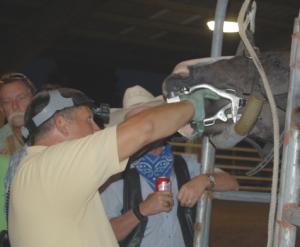
Dr. Galloway, whose practice is in veterinary dentistry, also gave hands-on and Powerpoint presentation of equine dentistry. Participants got to see many photos of the inside of a horse’s mouth. He showed dental wear patterns and examples of bad and good dentistry. A conventional practice that Dr. Galloway debunked is the removal of wolf teeth, regardless of true need. UT Extension Agent Becky Muller’s horse was used to demonstrate a dental exam and teeth floating. Participants got to examine the tools necessary to do a proper exam and float. Muller’s mare was sedated, properly haltered, and a speculum was used, as in any dental exam and treatment. The participants were encouraged to check the inside of her mouth. The mare’s teeth and mouth were in good shape.
Amy Weatherly, DVM gave a talk on pre-purchase exams, afterwards fielding questions from the audience, such as: What is normally included? What to ask the seller? What can one learn from a blood test? Can you tell if the horse has had colic in the past? Does the horse’s veterinarian have to give the purchaser the horse’s medical records? All of these questions she answered indetail.
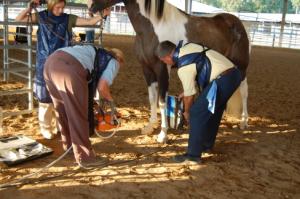
Dr. Weatherly also talked on lameness in horses: what is involved in a comprehensive lameness exam; and techniques in diagnosing lameness. She demonstrated Ultrasonography and Radiography (X ray) using a horse. She used pieces of horses hoof and bone to show what was in the image. Participants were able see the equipment close up, and seemed amazed by what they showed.
The University of Tennessee Agriculture Extension Service schedules agricultural seminars throughout the year. The Mid-South Horse Review will post the dates in the Calendar of Events. UT Extension Agent Becky Muller is asking for suggestions for topics for upcoming horse educational seminars. Contact her at: rcherry1@utk.eduor at 901-752-1207.
Bridgett McIntosh, Ph.D., the equine specialist and nutrition expert at The University of Tennessee Extension Service, spoke in depth about equine nutrition requirements. She explained how to read and interpret a feed tag. She showed a formula on a spread sheet that horse owners can use to calculate the calories in a particular feed. She also helped the horse owners calculate the nutritional needs of their horse, including trace minerals, taking into account forage, weight, exercise and work requirements, and whether or not the horse is genetically an “easy keeper.” She emphasized the importance of precise record keeping in one’s feed and forage program
Dr. McIntosh’s Powerpoint presentation included a forage study that she had conducted at Virginia Tech. This study took place over 42 continuous hours, using 100 people over several months in different seasons; it analyzed grazing habits, the digestive cycle, and a forage analysis was done before and after grazing, and at different times of day. One interesting bit of information found was that there is a significant difference in forage total digestible nutrients (TDN) during the middle of the day and at night.
Stephen Galloway, DVM gave a hands -on demonstration of the latest method of parasite control. He explained how the conventional method of de-worming, i.e., de-worming the horse every 6 weeks or giving a daily de-wormer, is causing parasites to become resistant to de-wormers. He said that if the horse industry does not change its methods soon, there will longer be an effective means of controlling parasites. The newer comprehensive method uses fresh fecal samples to obtain a fecal egg count (FEC), which determines whether a particular horse is a high, medium, or low shedder of eggs, and whether de-worming would be recommended for that horse. The method also calls for precise record keeping and rotational pasture management. Participants in the seminar were requested to bring fecal samples from their horses, and they got to put their samples on slides and examine them under a microscope. Dr. Galloway demonstrated how the fecal egg count can be done by horse owners themselves, if they choose to do so, rather than sending it to a lab.
Dr. Galloway, whose practice is in veterinary dentistry, also gave hands-on and Powerpoint presentation of equine dentistry. Participants got to see many photos of the inside of a horse’s mouth. He showed dental wear patterns and examples of bad and good dentistry. A conventional practice that Dr. Galloway debunked is the removal of wolf teeth, regardless of true need. UT Extension Agent Becky Muller’s horse was used to demonstrate a dental exam and teeth floating. Participants got to examine the tools necessary to do a proper exam and float. Muller’s mare was sedated, properly haltered, and a speculum was used, as in any dental exam and treatment. The participants were encouraged to check the inside of her mouth. The mare’s teeth and mouth were in good shape.
Amy Weatherly, DVM gave a talk on pre-purchase exams, afterwards fielding questions from the audience, such as: What is normally included? What to ask the seller? What can one learn from a blood test? Can you tell if the horse has had colic in the past? Does the horse’s veterinarian have to give the purchaser the horse’s medical records? All of these questions she answered indetail.
Dr. Weatherly also talked on lameness in horses: what is involved in a comprehensive lameness exam; and techniques in diagnosing lameness. She demonstrated Ultrasonography and Radiography (X ray) using a horse. She used pieces of horses hoof and bone to show what was in the image. Participants were able see the equipment close up, and seemed amazed by what they showed.
The University of Tennessee Agriculture Extension Service schedules agricultural seminars throughout the year. The Mid-South Horse Review will post the dates in the Calendar of Events. UT Extension Agent Becky Muller is asking for suggestions for topics for upcoming horse educational seminars. Contact her at: rcherry1@utk.eduor at 901-752-1207.


