

By Nancy Brannon
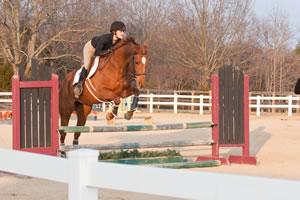
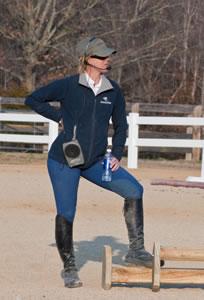
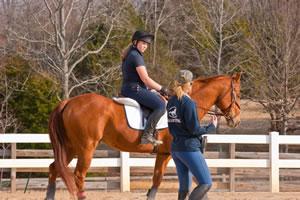
Allison Springer was back in Eads teaching another riding clinic at Saybrook Farm, February 19 and 20. Saybrook owner Susan Bills was very pleased to host another clinic, and delighted to watch Dana Pier ride her horse. Caroline Smith and Sarah Beckham came from Little Rock, AR to ride in the clinic. This is Allison’s second clinic at Saybrook, which she hopes will become a regular stop on her teaching tour. “I love the day-to-day training of the horses,” as much as or more than the competitions. “I love teaching clinics and seeing the riders’ improvements. I love helping them understand how to train their horses better.” She has additional incentives to come back: one of her former horses and some of her family live in the Memphis area.
Allison will be riding again in the Rolex Kentucky Three-Day Event this year, competing Arthur plus a new horse: Destination Known, aka “Burger.” She has previously competed Arthur at Rolex three times, but Destination Known has not done the event yet. At last year’s Rolex, Springer was tied for second place with Karen O’Connor after dressage with a score of 43.7. Unfortunately, Arthur had a stop on cross-country and some rails down in the stadium course, so her finish was not in the top ten.
Still, Arthur’s second place in dressage is something Springer always knew he was capable of doing. “It was great to be there for sure,” said Springer. “I’ve been working to improve both mine and my horse’s consistency. This is a place I’d always dreamed to be.”
Springer also made headlines in the dressage competition with her decision to forego wearing the traditional top hat and, instead, wear a Charles Owen safety helmet. She was the only competitor to wear a safety helmet instead of a top hat. Yet she was elegant as always on the 11-year-old Irish Thoroughbred. “I had been thinking a lot about it; it just felt right to do it,” she said. “I thought it looked pretty. It was a very personal choice.”
Undaunted by their disappointing 2010 finish, Allison has her sights on doing better this year, and her ultimate goal is to represent the United States in Olympic competition. “2011 is a pre-Olympic year, so I am working to improve my four-star performances, with my sights on making the Olympic team. I was one of two alternates on the WEG team, so I got to train with the team.” Allison has an Intermediate horse, Jack of Hearts, that she would like to compete in the Pan Am Games this year. She’s bringing along a new horse, Going for Gusto, who is running Training Level now, with plans to advance him to Preliminary Level soon. He’s an interesting horse in that “he raced 42 times,” she said. “He has special qualities and he tries so hard!”
She works from her barn in Upperville, VA. She goes to Wellington, FL in January for specialty training from her dressage trainer J. J. Tate and show jumping trainer Katie Prudent. She shows jumpers there to improve her horses’ stadium performances. Then she travels to Aiken, SC in February and March for the eventing season. Her first Advanced event was February 25-27, 2011 the Pine Top Spring Advanced Horse Trials.
Allison’s approach to training is simple: develop a correct, basic foundation in both horse and rider. “The more complicated the questions and competitions get, the better the basic foundation has to be,” she explained. “Horses must respond correctly to light aids and learn to accept light aids. That’s what dressage is! I often sound like those natural horsemanship guys, but they haven’t invented anything new. You almost want the horse to the point that they can read your mind and your body intentions. Releasing the pressure is so important – being soft and giving to your horse.”
When she’s teaching, she works with riders on their position and the effectiveness of their aids. “You only use more aid once you have used a lighter aid and didn’t get the correct response. The more complicated the questions, the more the rider has to present the horse to the questions in the simplest way possible. When there’s confusion between horse and rider, you’ve probably been too complicated in your approach.”
Maintaining a steady rhythm, relaxed but with impulsion, is important. “You want the same [engaged] canter over fences that you get in dressage. It is the rider’s job to produce the right canter to jump the fence well.” These are the basic elements to jumping any fence well: “Line of direction, correct speed, balance, and steady rhythm. Practice a canter that is correct for the fence; then maintain balance and rhythm. So many people concentrate on counting strides and worry about getting a correct distance to the fence. But correct distance is produced from the right canter,” she explained, which includes both speed and stride length. “You want a range of distances from which the horse can jump in a balanced frame. When you have the correct canter, then the appropriate distance always appears. Produce the right canter for each fence; for example, there is a difference between canters for a distance of 5 strides between fences and 6 strides between fences at the same distance. So it is important to produce the right canter for the appropriate strides and distance between fences.”
Her philosophy: “Correct basic foundations; the rider in the correct position using the aids correctly; and having the horse respond correctly. Keeping it simple and basic, though, is not always easy. But it makes it more fun!”
Allison has “been riding horses since age six. I had missed the bus home from school one day and went home with a neighbor who had a pony. I brushed the pony, fed the pony, rode the pony… LOVED the pony. I remember thinking that was the most glorious day of my life.”
She earned her colors in the Fox River Valley Hunt at an early age and had achieved the A rating in United States Pony Club by the age of 16.
She recalled, “…watching the [1984] Los Angeles Games on television. I watched all the equestrian sports, but the Three-Day Event was what captured me. To me this was the ultimate horse sport. And once again I felt destiny knocking on the door! From that day forward my dream and determination have never wavered. I am going to represent our country in Olympic competition.”
To read Allison’s blog visit: http://allisonspringer.com/allisons-blog/.
For more information about Saybrook Farm, visit http://www.saybrookfarm.net/.


