

Pitchfork Farm
One of the larger operating hay farms
by Tommy Brannon &
Lauren Pigford
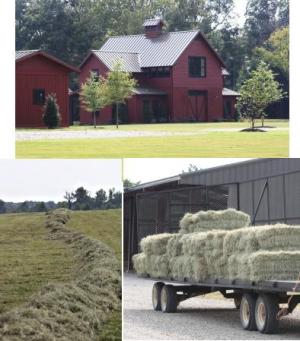
In Dancyville, TN there is a farm that has about 1500 acres of rolling hills, beautifully landscaped grounds with impressive barns, farm buildings and brand new farming equipment. It was all designed and planned to make a crop that horse people cannot go without, especially during the winter months. David Skudder’s Pitchfork Farm is one of the larger operating hay farms in the Mid-South area.
Ask just about any hay producer in the Mid-South what form of hay they produce and the answer is usually “big round bales.” That is because big rounds bales can be produced without hand labor and can be stored outside exposed to the weather. This is fine for cattle and other ruminants with their multiple stomachs and ability to digest almost any plant matter; but for horses, it can be pretty risky to feed round bales. Many horse owners like to feed square bales. They are stored out of the weather and when they are opened, it is easy to examine the hay for quality, and smell them for mold. Finding high quality hay produced for horses and bailed in the square form can be a challenge.
David saw a need for high quality, weed-free horse hay and decided to grow the sometimes hard to find horse crop. Pitchfork Farm produces only square hay bales. David and his crew sprigged Vaughn’s #1 Bermuda grass, a variety discovered and patented by Terrell Vaughn of Walling, Tennessee. Vaughn’s #1 is known among hay produces for its cold weather tolerance and its high TDN (total digestible nutrients). Pitchfork Farm has also established a stand of Orchard grass. Both of these types of forage are quite popular with horse owners. David realized that he needed to produce a lot of hay to serve the market and to turn a profit. He also knew it would take a few years to establish the number of fields needed. The farm is very well organized. Each field is mapped and marked with signs so that production and yields can be monitored and fertilized. Harvests can be systematically planned. The 1500-acre farm still has some soybean fields that were there when David purchased the land, but as demand grows for horse hay, they are being converted to hay production. Pitchfork Farm has only been growing hay for two years and the estimated yield this year is already 10,000 bales.
All that hay requires a lot of storage space and easy, all-weather access. David said that the falling economy was actually an advantage in that respect. At the time that he needed to put in the roads and build the barns, the bottom fell out of the housing market and the building trades. The contractors who were hired were easy to find. All of them could schedule the jobs right away and keep working until everything was completed. Lumber and materials were readily available also. There were few delays in getting the necessary roads and bridges built. The farm has ample covered storage for all of the tractors, equipment and hay as well as a state of the art (eat off the floor) maintenance shop. One of the numerous luxury items is the picnic pavilion with a barbeque grill that would rival any suburbanite’s outdoor kitchen, not to mention the fire pit where large groups of people can gather. This is especially useful during the opening of Dove Hunt Season. The Skudders have a yearly get together for the opening weekend.
The problem with producing square bales, of course, is that traditionally square bales require a lot of manual labor to load and stack. That problem has been solved with some pretty sophisticated machinery. Hay accumulators attached to the back of the balers bundle the hay, and grapplers attached to skid steers grab the bundles to stack on the trailers and in the barn. If a customer comes with a flatbed trailer to purchase hay, it can be machine -loaded in a matter of minutes. Pitchfork Farm will deliver hay for a flat fee, but the customer should know that, to make the delivery fee cost effective, he should purchase at least 100 to 200 bales in one load. For customers without a way to pick up hay, Pitchfork Farm also will lend a flatbed trailer.
Due to weather conditions and an infestation of army worms in the Mid-South this summer, horse hay may be in short supply. It is good to know that some farmers are still producing quality horse hay in quantity to serve the needs of the horse owner.
Pitchfork Farm offers top quality hay, easy pick up or delivery, and friendly people who want only to supply the best for all types of horses throughout the region. To learn more about Pitchfork Farm and their hay, contact Sarah Hill at 901-579-0014 or email: Sarah@Pitchforkfarm.us.


