

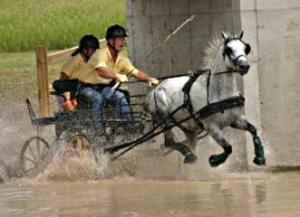
The “Gator”
Job of a Navigator in a speeding horse-drawn carriage
By Joanna Wilburn of Rollingwoods Farm
Imagine climbing on the back of a speeding horse-drawn carriage careening about in small areas at breakneck speed. Then imagine that you have NO control over any of this! Your job is to balance the carriage in case of a possible turn over, “jump” the carriage over if it gets too close to an immovable object, and make sure all this is done in proper sequence and at the appropriate time. Such is the job of a Navigator, also known as a “Gator.” This job requires you to know more, react quicker, and be ultimately responsible for every aspect of the driving event, even though you never touch the reins.
The gator is in charge of everything, from knowing the location of the spares kit to knowing what to do if there is an accident. The spares kit is needed to repair your harness or carriage, in case something breaks. It also contains a halter and lead, in case the carriage or harness cannot be repaired.
The gator’s responsibilities also include mundane responsibilities, like checking the score board several times daily for possible time or course changes, and knowing how to keep time on course.
Driving rules require a Navigator: one horse or two horses - one gator; three or four horses - two people; one is the gator and one is the backstep person.
Communication between driver and gator is of utmost importance. Different drivers expect different things from their gator. So a consistent combination, working together, is good for the horses and successful in winning. Some drivers only want a “warm body” on the back of the carriage. Other drivers want the Gator to talk them through everything. Most drivers are somewhere in the middle.
Once I showed up at an event as a spectator, but was promptly thrown on the back of a pair to compete in an event in whichI had never seen the course. The driver specifically told me that all she wanted was a warm body, for me not to say one word during the event. This made me feel better since I didn’t know the course. But halfway through the course, the driver screamed, “I am lost, I am lost!” Since I was experienced and had gatored many times, I told her we had just gone through gate 7. Since she knew where gate 8 was, we never lost a second of time. Had I not been watching the gates, elimination would have occurred.
It is important for driver and gator to work as a team. Knowing who is responsible for feeding, watering, cleaning stalls, tack, carriage, and hand-walking the animal(s) is very important. Some drivers want to do it all, while others want to concentrate on the necessities they need to know to perform to their best abilities. It is best to determine who does what as soon as you can. You don’t want to finally get back to the hotel after a long day and discover that either no one fed the animal(s), or worse, both of you did. Learning to work as a team and take on responsibilities as team members will help your team be the best. That comes with communication, both in and out of the competition zone.
Since the Driver, Gator, and horse/ horses are a team, the current trend is to be uniformed as a team. Finding a proper outfit is essential, but also knowing who is in charge of getting the outfits is another thing on the checklist.
There are three phases of a Combined Driving Event (CDE). In Dressage, similar to ridden dressage, the team performs specific tests for their particular level of competition. A Cones Course is an obstacle course that the teams have to complete. You want to go through each set of cones as fast as possible without knocking a ball off the top of the cones. If a ball is knocked from the cone, then penalty points are given. Each team’s carriage is measured and the teams are allowed a certain clearance at each driving level. A cones course usually has 20 sets of numbered cones.
The last phase is the Marathon, which is similar to a cross country ridden course. It is about 7 kilometers in length, which must be completed in optimum time (not too fast and not too slow). Within this phase are obstacles, with start and finish lines, which you must negotiate in your fastest time. Scoring is done in terms of penalty points, meaning the team finishing within the optimum time with the least deductions is the winner of this phase.
The job of a Navigator is most essential during the Marathon (the highest levels require a “groom” for dressage and cones). The gators must keep up with the time, know the course and, most importantly, know the obstacles. They must know ahead of time if their driver wants to be talked through the course or wants total silence. Most drivers have at least one obstacle with which they need assistance. The gator is told this ahead of time. The driver and gator walk the course and obstacles together to determine how to perform the obstacle in the correct way. It is important to walk courses together so the team know the course, although the driver may see an obstacle one way and the gator may see it another way. Teams decide on the best way to get through obstacles before they are on course and competing. The gator should ask, approaching the obstacle, if the driver has it. If the driver says “yes,” that means for the gator to leave him/her alone, or the drivers may tell how they are going to drive it. If the driver says “no,” that means the gator should be ready to talk them through it.
Another job of the navigator is to keep up with the “green card.” This card is handed out at the start of the marathon, on which your times are recorded by volunteers. The Navigator is required to sign this form at the end of the marathon, so must be certain the volunteers have written correct information. Volunteers’ work is most certainly appreciated, but they can make mistakes in competitions.
The Gator is also responsible for keeping up with “holds.” Sometimes there are holds in the action on the course, meaning the competitor in front of you was going too slow, had a turnover, destroyed an obstacle or something that can delay your time on course. It is the navigator’s job to make sure this hold time is documented; without this documentation, your team could be penalized for being late.
Exiting the carriage during the marathon will earn your team penalty points. If the gator must get down, make sure the driver approves. This does not include an accident. Once during a competition, one of my reins came unbuckled while negotiating an obstacle. My driver kept saying “I dropped a rein, I dropped a rein!” What he should have said was that the rein is no longer attached to the bridle. As soon as I realized this, I jumped off, reattached the rein and away we went. We lost valuable time because the driver did not communicate well what was really happening.
The Navigator should know the rules of the competition. In one competition, my team’s horse was getting very tired, so I was asked to exit the carriage and run along side. I had no problem with this, other than it would have meant penalty points. We debated this, but since the driver realized that I know the rule book and carry it to all events, he trusted me. After the event, he thanked me for knowing the rules. I continue to be his navigator; he competes on the East Coast.
I still say that gatoring is more fun than fun!Not everyone wants to be on the back of a fast carriage and not have any control over what is happening, where you are going, and how fast you go. However, I do feel that I have some control since I know the driver, animal, course and, most importantly, my job.
About the author.Joanna Wilburn of Rollingwoods Farm, where champion Welsh hunter and driving ponies are bred, teaches carriage driving lessons from beginner to advanced, 901-834-4922.


