

Whiskey For My Men, Beer For My Horses
Not just cowboy braggadocio, good practical advice
By Nancy Brannon
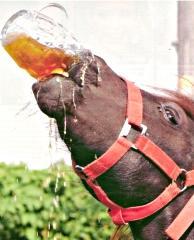
The words to that famous song by Willie Nelson and Toby Keith may sound like cowboy braggadocio to some, but giving beer to horses is actually good, practical advice for some horses who suffer so much from the extreme heat that they have stopped sweating. That condition is called Anhidrosis (also, anhydrosis) and horses with this condition are called non-sweaters.
Dr. Jennifer Dunlap, DVM has seen the positive effects of this remedy on her horses. “One of my event horses, my Irish Sport Horse, had to have a pint of Guinness when he came off cross-country, so his former owner recommended,” she said. It is one of her recommended treatments for horses not sweating. “A half can of beer a day until the horse starts sweating again,” she advised. “We don’t know why it works, but it does help them start sweating again. We do know that alcohol causes the blood vessels to dilate on the skin surface, so this may be a trigger. In the extreme heat we’ve been having, you want to see heavy sweat rolling off the horses. If you see changes in your horses’ breathing and sweating patterns, it’s time to do everything you can to cool them off.”
From the Texas Vet News, Dr. Bob Judd, DVM agrees, “The cause of anhidrosis is unknown. However, it is believed the receptors in the sweat glands that cause sweating become desensitized due to overstimulation.” His recommended treatments include: “A product called One A-C has been shown to help some horses. Also, supplementation of the horse’s diet with 2 ounces of lite salt, which is potassium chloride, has helped in some cases.”
Quoted in Equus Caballus, Grand Prix rider Molly Ashe finds the beer formula useful for her horses. Molly Ashe has her own secret weapon to combat equine anhidrosis: beer. And not just any beer. Molly took the advice of Jane F. Clark (prominent Olympic horse owner), who recommends Guinness Extra Stout n a 19th century British brew, which advertises higher alcohol content, more carbonation and ‘hoppy’ flavor than the average American beer. “We tried it just like Jane said, and you just can’t imagine,” Molly explained. “It’s like a miracle. A bottle in the morning and a bottle at night. You dump it in their feed, and they get real shiny, on top of becoming a better sweater. Jane says, ‘Makes them healthy from the inside out.’ ”
Non-sweating performance horses must be monitored very carefully to prevent overheating, heat exhaustion and potential death. Dr. Dunlap has seen some severe cases this summer: “I’ve seen two horses collapse, and over 18 who had to have IV fluids with electrolytes. Some signs of anhidrosis are: your horse is bone dry and has a high respiratory rate, which means the horse is trying to cool off, but it isn’t working. Pay particular attention to horses with respiratory problems, such as equine asthma, aka COPD or RAP (recurrent airway obstruction). If a horse has a body temperature as high as 106.5° F, this can cause brain injury and even death.”
Dr. Dunlap recommended several treatment regimens to cool horses during the extreme heat, especially horses with anhidrosis: (1) “Put horses in the barn with fans blowing on them. They probably should not go out until nightfall [when temperatures are cooler]. (2) Cold hosing and scraping the water off cools the skin. Don’t leave the water on because it just creates a blanket of warm moisture. You can also sponge the horse with ice water and rubbing alcohol. This cools and skin and helps the water evaporate quicker, lowering the body temperature. Again, be sure to scrape off the water. (3) Offer electrolytes: in one water bucket or in feed, or free choice salt. Be sure that your horse has fresh water at all times. Don’t put electrolytes in all the horses’ water buckets; it’s like drinking seawater. It’s also important to have large enough water troughs. The small ones allow the water to get too hot and the horses won’t drink, resulting in colic. Refill water troughs every day or every other day. (4) For horses with anhidrosis, give a half can of beer a day until the horse starts sweating. (5) One AC is a recommended feed supplement for the condition.” It contains L-Tyrosine, Choline Bitartrate, Niacin, Pyrodoxine HCL and d-Calcium Pantothenate, according to the product’s website: http://www.nonsweater.com/.
Dr. Kathy Mitchener has an alternative approach to healing anhidrosis: acupuncture. “All the horses I treated were non-responsive to beer and to One AC. All are performance horses. The problem (anhidrosis) is believed to be a stress response to the heat. The stress response is in the autonomic nervous system, which becomes unbalanced [with anhidrosis].”
The autonomic nervous system is part of the peripheral nervous system that affects heart rate, digestion, respiration rate, salivation, perspiration, and other functions. The autonomic nervous system has two subsystems: the parasympathetic and sympathetic nervous system. The sympathetic and parasympathetic divisions typically function in opposition to each other. The sympathetic division functions in actions requiring quick responses; the parasympathetic division functions with actions that do not require immediate reaction. Consider sympathetic as “fight or flight” and parasympathetic as “rest and digest.”
“The fight/flight response in the sympathetic nervous system overrides the parasympathetic nervous system, resulting in an imbalance,” Dr. Mitchener explained. “Acupuncture treats the sympathetic nervous system override, so the horse gets to sweating again, usually after about two treatments. Technically it’s called autonomic neuromodulation. Horses that are not sweating also have very rapid respiration rates, so their rib cage gets sore from the extraordinary amount of breathing. This creates stress, too. Acupuncture also treats the sore muscles and causes relaxation, so you get a dual effect. Other related symptoms may be colic, or the horse doesn’t eat well.”
Dr. Dunlap has seen related problems of severe chemical burns on horses’ skin from ointments, sprays, and liniments used in the high temperatures. “It just sits on the skin and burns it.” She has not seen problems with products like Swat, Corona and other lanolin-based products. But products such as Fungaway, MTG, and liniments such as Vetrolin and Absorbine, the latter of which seems to be a “hotter” liniment, can cause burns. “The skin is already overheated, so these chemicals mix with the salts in the sweat and cause skin burns. When the skin is hot or flushed, there is more histamine in that area, so the skin is more susceptible to problems. I am even seeing sweat scald.” She emphasized the importance of rinsing off these products and not leaving them on the horses’ skin. Even if you’re not using them, it is good to “rinse the horses off several times a week” to prevent sweat scald and cool the horses.
Dr. Dunlap has also seen horses losing weight due to the extreme heat. If this is the case with your horses, “Get some fat into their diet; it adds calories and fat is cooler to burn than carbohydrates. You can add corn oil, Purina Amplify, and/or rice bran products to increase the fat in their diet. As with any feed changes, be sure to go slowly with the change, or your horse could develop colic or fatty diarrhea. Limit the amount of corn oil; a horse should get no more than one and a half cups of corn oil a day,” she recommended.
Dr. Dunlap recommends, “If the base temperature is 100°F and the heat index is 105°F or above, don’t ride! Horses cannot disperse heat as fast as people. Think of this analogy: the horse is like a hot baked potato on sticks, holding the heat for an extended time. People are more like French fries, losing heat more rapidly.”
Dr. James H. Steere, DVM wrote in the July 2010 issue of Endurance News: “The most dangerous enemy of the horse in the 21st century is heat. The resting temperature of the horse is, on average, 101.5°F.” With exercise, a horse’s body temperature can reach 103°F. “Sweating is the primary method by which horses disperse the heat generated by energy burn, activating muscles for locomotion. Of 100 calories of energy burned, only about 20% is used for locomotion. The other 80% is heat. So take every opportunity to get cold water on your horse: sponge and bucket, ice packs, hose, and best of all, total immersion.”
Hmmm, go swimming with your horse? And share a beer afterwards? Maybe that’s the way to beat the heat.


