

De-Worming Seminar
On the latest equine de-worming strategies
by Tommy Brannon
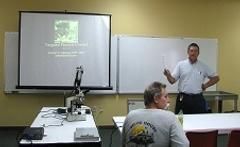
Dr. Stephen Galloway, DVM presented the latest information on equine de-worming strategies to horse owners on July 6, 2010 at Agricenter International. The seminar was sponsored by the University of Tennessee Agricultural Extension Service, arranged by Extension Agent, Becky Muller.
Attendees were requested to bring fresh fecal samples from their horses so that Dr. Galloway could conduct a fecal egg count of each sample. Fecal sampling is important for timely and effective de-worming. He projected the results, seen under a microscope, on a screen for the audience to see. He showed slides of various types of worms that infest horses.
Dr. Galloway explained the types of worms found in horses and noted that worms are species specific, i.e., the worms found in goats, sheep, and cattle, etc. do not infest horses, and vice versa. Thus, species rotation in pastures can be a very effective part of parasite control strategy. For example, graze cattle on the pasture for six weeks; let the pasture lie fallow for six weeks; then graze horses for six weeks. Horse specific parasites will not survive six weeks in the pasture without a host. He also said that horses who do not graze do not get worms; however, keeping a horse confined all the time creates a host of other health problems.
Galloway described the general classes of de-wormers, and which de-wormer to use when. The most commonly used strategy calls for broad spectrum de-worming, administered to every horse in the barn without testing for the presence of specific parasites and at what levels in individual horses. The strategies vary depending on the type of de-wormer used: either administered daily or in several-week intervals. These commonly used strategies are aimed to achieve zero levels of worms in the horse’s system, even though the horse may have no detrimental effects from some of level of parasites.
The newest de-worming strategy is designed to prevent parasites from growing resistant to the various classes of equine de-wormers, and poses that there may be an acceptable level of parasites in the horse. Galloway expressed some alarming concerns about the rapid rate at which parasites are becoming resistant to existing drugs, likely exacerbated by current de-worming strategies.
He told the group about parasite resistance in goats. Parasites have become so resistant to de-wormers in goats that there is no longer a drug that will kill them. He cites over-administering de-wormers as the cause of this problem. The idea behind over-use of de-wormers was that if some is good, more is better. Now, goat species-specific worms have become resistant to all de-wormers on the market. If a goat is found to have worms, the animal must be destroyed.
Horses have not yet reached that point, but predictions are that the problem could get that bad. Dr. Galloway said that there are no new and/or improved de-wormers being developed by any of the major drug companies at this time. Evidently, there is no perceived need that justifies the high research and government approval costs.
Dr. Galloway discussed the results of the most often used de-wormer: Ivermectin. It has been so effective in controlling large strongyles that it has practically wiped out that worm in horses. Yet it has not been so effective against small strongyles.
Small strongyles cannot be seen in the manure, so it is necessary to perform a fecal egg count under a microscope to determine whether the eggs are present in sufficient quantity to warrant treatment. Small strongyle larvae hatch immediately after defecation, so it is necessary to collect a fresh fecal sample. Dr. Galloway said that small strongyles cannot live outside the host in summer temperatures; thus, it is not necessary to treat healthy horses for small strongyles in the summer. He recommended treating only clinically ill adult horses in June, July, and August. Several audience members asked, “What do I do?” when their manure samples were under the microscope. Dr. Galloway replied, “Based on the egg count in the sample, do nothing until September.” He emphasized that de-worming treatment should be based on an individual horse’s egg count.
Dr. Galloway explained how an individual horse’s propensity to shed the eggs, and thus infect other horses, is measured by three classifications: Low shedders: egg count 0-200 eggs per gram (egm); Moderate Shedders: 201-500 egm; and High Shedders 500+ egm. Once the horse’s classification is determined, it usually remains the same throughout the horse’s life.
He did not recommend isolating high shedders. Isolating high or moderate shedders from low shedders results in a pasture becoming too contaminated. New horses brought to a barn should have a fecal egg count performed, be de-wormed, then quarantined for two weeks before being introduced to the pasture with the rest of the herd.
It is important not to over-populate a pasture with horses. The stocking ratio in the summer should be at least two acres per horse, and a higher ratio of acres to horses in the winter.
Removal of manure from the pasture also helps control parasite infestation. He emphasized that removal does not mean running over the pasture with a harrow to break up the manure.
Dr. Galloway provided the audience with a handout outlining step-by-step the new strategy in equine parasite control. The Mid-South Horse Review has reprinted it here (see next column) by permission, and it is also available on line at www.midsouthhorsereview.com/.
Dr. Galloway's handout follows below:
Equine Targeted Parasite Control
Background:
>High Levels of Intestinal Parasite throughout the Southern USA to available Deworkers.
>No new Deworkers will be available within 20 years
>Treatment Goals: Decrease Small Strongyle burden on pasture. Minimize parasite resistance to available drugs.
>Test (Fecal Egg Count) and Treat only clinically ill horses.
>Parasite Control Plan must be individualized for each farm!
Fecal Egg Count (FEC) Classification:
Low Shedders (LS): 0-200 eggs per gram (epg)
Moderate Shedders (MS): 201-500 epg
High Shedders (HS): 500 + epg
>LS and MS typically need 1-2 FEC and Treatment per year.
>HS will require individualize diagnostic plans to determine anthelmintic and appropriate treatment.
>Once FEC Classifications is established for a hors, the classification usually remains the same for the following years. Fewer FECs are required after 1st year.
Protocol for New Horses to Prevent the Introduction of Resistant Parasites:
>All new horses are quareentined for 2 weeks before entry into your pastures.
>On Day 1. A Fecal Egg Count Test is performed on the new horse and it is dewormed with a moxidectin/ praziquantel combination anthelmintic.
>On day 10 post treatment, a FEC is performed to determine the efficacy of the treatment.
Typical Herd Maintenance Plan:
>Fall: (Sept. 1) The beginning fo the transmission perios for Small Strongyles.
>FEC’s performed on all horses to determine worm burden in individual horses. (Most important FEC!)
>Possible Strategic Deworming of Herd to decrease pasture worm burden.
>All horses are dewormed with
1. A larvacidal anthelmintic to kill encysted small strongyles
2.A botanical anthelmintic to kill bot larvae
3.A cestodicidal anthelmintic to kill tape worms
>A moxidectin/ praziquantel combination product will perform all 3 treatments
Winter: (December 1)
>FEC’s performed on all horses to determine worm burden and the efficacy of the Fall Treatment.
>Possible Strategic Deworming of herd to decrease pasture worm burden (Most important Strategic Deworming!)
Spring: (March 1)
>FEC’s performed on all horses to determine efficacy of Winter Treatment.
Summer: (June, July, August)
>FEC testing of Moderate and High Shedders only.
>Treat only clinically ill adult horses. DO NOT TREAT Healthy Horses!
>60 day old foals:
>>FECs are performed.
>>Foals with roundworms are treated with pyrantel pamoate.
>>10 days post treatment, a FEC is performed to determine the efficacy of the treatment.
Please call Dr. Galloway, DVM, FAVD with any questions or concerns.


