

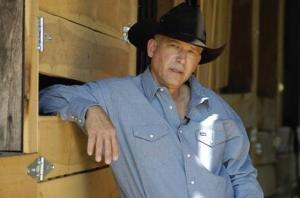
Mike Branch Horsemanship
What separates him from other clinicians are his gentling methods
By Nancy Brannon
Folks in West Tennessee have not yet had the opportunity to see Mike Branch in action, but he has earned a reputation for his work with Mustangs. Mike runs Flying B Horsemanship in Blaine, TN, northeast of Knoxville in east Tennessee. His work is dedicated to the trainability of the Mustang, and he has gentled many Mustangs from the Bureau of Land Management before adoption. “There is a craze now with Mustang Makeovers,” Mike said, which got him his first clinics and demonstrations.
At his Mustang School last year, “A lady from England came to the school, gentled and rode her Mustang. Then she invited me to England, where I went to the Devon County Show. That show usually gets a visit from one of the Royal Family, Prince Edward’s wife Sophie, Countess of Wessex. I was fortunate to get a formal introduction to her. She talked to me about Mustangs and what I found interesting about the Dartmoor Pony.” Last year, he went to England twice and plans another trip this May, where he works with the Friends of the Dartmoor Hill Pony and the Exmoor Pony Centre in Dulverton. “Camilla, the Duchess of Cornwall is a patron of the Exmoor Pony Centre. I hope do some work with them this year,” he said.
Mike’s goal is to educate people about wild horses, and his training techniques transfer easily to domesticated horses. “What seems to separate me from other clinicians are my gentling methods,” Branch explained. “I basically use the Ray Hunt philosophy: make the wrong thing difficult and, with a little pressure, make the right thing easy.” When working with a wild horse, he uses a small piece of plastic bag tied on the end of a 12-foot pole. He moves it over the horse’s body to simulate being touched and “with the first sign of softness,” he offers his hand. Many times the horse walks up and puts his nose on Mike’s hand. When the horse does the right thing, “Remove all pressure and offer your hand to the horse. When he turns and faces me, his problems are gone and he finds peace,” Mike said.
Once the horse is at ease with being touched, the next step is to be able to pick up the horse’s feet. Eventually, Mike can get the horse to lie down and let him touch their feet. “When you take their feet, you are almost tapping into the spiritual side of the horse. For the horse to trust me enough to lie down and let me trim their feet, we’re pals after that! A horse can read your intentions,” he intuited.
Mike continued, “Horses rely on their instincts for survival. One reason people have problems with horses is that they’re using a too-straightforward approach. You have to recognize that the horse has a personality as much as a human does. Somebody has to lead, and that must be the person, but you also have to have mutual respect. You are dealing with a horse’s mind. So ask yourself: are you helping the horse or stripping the horse of his dignity?”
Mike differentiates between being a cowboy and being a horseman. “A horseman is in tune with the horse, developing the necessary relationship with the horse. You don’t want to break the horse’s spirit; you want it to work for you.”
In addition to awareness of the horse’s mind and personality, “You have to become aware of the biomechanics of the horse’s movements. When you’re on the horse’s back, your arms and feet should be connected to the horse’s legs and feet. The rider uses the core for balance and uses legs and arms to communicate with the horse.” The rider should be able to work independently on the right and left, and independently with hands and feet. “The horse’s walk is a 4-beat gait. The rider should be able to feel when each hoof is about to leave the ground. When I need the horse to move, I speak to the horse by using a leg or helping the horse with a light rein. It is important to coordinate the use of the aids with the horse’s movements. Make it easy for the horse to do whatever the rider is asking the horse to do.”
Mike again quoted Ray Hunt: “The horse knows what you know and what you don’t know. If we ride with a light feel, the horse will respond quickly to those slight suggestions. If you take care of your horse, the horse will take care of you.” Mike continues his own education by taking clinics with other trainers at least once a year.
Mike believes, “There’s such a special thing that happens between a human and equine.” He mentioned the DVD “Mustang Redemption,” about the work of prisoners with Mustangs. [see the Mid-South Horse Review, September 2009 issue about the Parchman Prison program with Mustangs] “Working with Mustangs can give prisoners a sense of purpose. It gives prisoners a job and saves horses from slaughter, then sends the horses to deserving homes,” he said.
Mike believes a similar program for at-risk youth would be successful. Mike facilitates a program in his area, in conjunction with the Mustang Heritage Foundation, called “Youth and Yearlings.” It is open to any youth ages 8 to 19, with parental approval. “The youth get a chance to adopt a yearling for $25.” Mike instructs them on his gentling methods. “They take the yearling home and gentle it with halter and lead rope. After they work with the yearling for 90 days, they meet again with me and have a little competition. This gives them a goal to work toward. When they come back, they all get a check for $200, which helps cover their transportation and feeding costs. They get to keep the horse and they get a chance to compete for various prizes. Last year we had enough kids involved that we gave away two $1800 saddles for first place in Junior and Senior divisions. There were numerous other prizes given away for 1st through 10th places.”
Mike had 25 students sign up for this spring’s program. He will again give away an $1800 saddle and a nice trophy, buckle and other prizes for the winners.
Mike hopes to come to the Memphis area to do a Mustang demonstration some time this year. He has been to Memphis quite a lot over the last 17 years, as his daughter was a patient at St. Jude Children’s Research Hospital. She was released in April 2009, and “She turned 20 this year,” he said.
Mike’s motto is: Leadership through trust, partnership through leadership; trust, partnership, and leadership through love, understanding, and communication. For more information, visit http://flyingbhorsemanship.squarespace.com/


