

Music Hath The Power
“I don’t sing any particular songs, just whatever aria comes to mind. Or I may sing German art songs"
By Nancy Brannon
It is said, “Music has charms to soothe a savage breast,” a quote from The Mourning Bride, by William Congreve; spoken by Almeria in Act I, Scene 1. The quote is sometimes read as “music hath charms to soothe a savage beast.” While we do not think of our dogs and horses as beasts, music does have positive effects on them, often soothing. There are many who delight in “dancing with their horses” in musical dressage (Kur) or reining to music. Music helps both horse and rider maintain a steady rhythm in any gait, as well as other benefits.
Foxhunting enthusiast, huntswoman, and opera singer Amanda McGee makes interesting use of operatic music with her horse and the foxhounds she hunts. “I’ve sung all my life,” she explained. “I remember as a small child I stood on a chair and sang in church. I sang hymns while waiting for the school bus.” She comes from generations of musical heritage. “My mother’s mother was musical; my dad was musical; we always had music around us.” So singing to her animals and to her daughter is simply a part of the daily routine.
Amanda started foxhunting in Junior High School, and since 2005, she has been a huntswoman with Oak Grove Hunt Club. She works with the Oak Grove foxhounds on a regular basis and hunts them alternately with huntsman and Master of Foxhounds (MFH) Dickie Watson.
“I sing all the time, and always sing while I’m riding, especially with my Thoroughbred Hawk. Music tames the beast; it settles him. So I just started singing to the hounds. When I sing to the hounds, they focus more on me. If I’m silent, they tend to break or get into trouble, as their attention goes to other things. The hounds are just more attuned to me when I sing,” she explained. “I sing softly so they have to strain a bit to listen to me. It’s really an added benefit! The horse calms and the hounds are more obedient to me.
“I don’t sing any particular songs, just whatever aria comes to mind. Or I may sing German art songs, usually by Brahms, or something by Tchaikovsky. Habanera from Carmen works well, or Voi Che Sapete from the Marriage of Figaro (by Mozart).
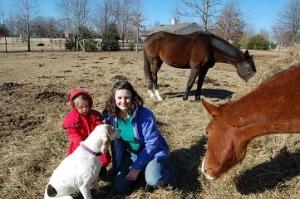
Foxhounds are a part in her home menagerie. “Summer” is the current foxhound resident and there will be puppies coming soon for in-home training. Her husband is small animal veterinarian Dr. Shannon McGee with Collierville Animal Clinic in Collierville, TN, which is a great advantage. “If a hound is sick or injured, I bring it home,” she said.
She goes several times a week to the kennels to work with the hounds, walk them out, and make sure they listen to her commands. She also teaches them the hunting calls on the horn. “I couple the young hounds to older hounds to help them learn. There are lots of treats involved! I call each hound by name, so they learn their names. I teach them to 'hold’ as a pack; to come when I blow the 'coming home’ call and when I say, 'come, come!’ The only horn call they don’t normally hear is the quick 'toot! toot! toot!’ used to put them on the line and send them off.” Since she has to have a lot of breath to blow the horn, Amanda found that blowing the hunt horn has helped improve her operatic voice.
Amanda is a mezzo-soprano with Opera Memphis (OM). This is her fourth season in the Chorus with OM and she has had a variety of roles. She most recently appeared in Orpheus in January. She has sung in Turandot, Cosi Fan Tutte and Macbeth, among others. “I often play a peasant. In Macbeth, I got to be a witch, so my costume included giant 'Don King’ hair,” she said. “It was an awesome costume.” She will appear in Madame Butterfly in April.
To hear a sample of the horn calls, Click here, and here.


