

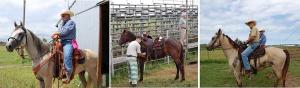
Mustang Miracles At Parchman Prison
"It takes a lot of gentleness and patience with these horses. We’ve got a miracle working here.”
By Nancy Brannon
Mention Parchman Prison, in the Mississippi Delta, and its reputation evokes a plethora of negative images. But a new program at Parchman offsets the bad reputation, where good things are happening. “By the Grace of God,” Scott Biggers put it, “Miracles happen here every day.” These miracles happen to both horses and people in the Parchman Animal Care and Training (P.A.C.T.) program.
Parchman is a 15,500-acre prison farm that produces nearly all the food consumed there. “We produce three million pounds of vegetables each year. We have 36,000 layer hens who produce over 550,000 dozen eggs a year,” said Director of Prison Agricultural Enterprises Stanley Brooks. Beginning this year, a new “product” of the prison farm is rehabilitated rescued horses and rideable Mustangs that are ready for adoption.
The P.A.C.T. program was started by brothers Scott and Rob Biggers in 2008. The program takes in selected rescue horses from the Mississippi Animal Rescue League and Mustangs from the Bureau of Land Management (BLM) and provides care and training for these “misfit” horses. The horses provide equine therapy to rehabilitate inmates, who are the trainers and riders of the horses. Rob is the barn manager, who does the daily coaching and training. Scott is the program manager. The program is supervised by Stanley Brooks, Director of the Mississippi Prison Agricultural Enterprises. The planning phase began in April 2008 and Rob was hired in November 2008. They got their first rescue horses in early 2009. Recently they have constructed a new barn and put in new pasture fence. They utilize the old rodeo arena for basic training and breaking of the horses. Brooks believes the program is highly successful so far and sees even greater potential for it.
P.A.C.T. is similar to other prison programs around the country, utilizing inmates to train horses. The PBS documentary “Homestretch: Racehorse Rescue” showed inmates working with retired Thoroughbred racehorses. An episode of ABC’s “Primetime: The Outsiders” examined the Wild Horse Inmate Program at a Colorado prison.
The P.A.C.T. program inmates work with the horses five days a week, under daily training supervision of Rob Biggers. Scott comes in several days a week and Professional Trainer Rick Wheat comes in regularly to provide training instruction. “We got 21 head of Mustangs on August 3rd, and by August 20th we’ve had our hands on 15, grooming and handling, and five are saddled and you can ride them anywhere you want to go. All this has been done in 14 working days with four working people!” Scott said.
“The inmates do all the work with the horses,” Scott explained. “They groom them, pet them, love on them and desensitize them. These guys gentle the horses, bond with them, teach them to lead, and eventually saddle and ride them. They truly care about horses. They do all they can to bring the horse from fear of man to friend of man. These guys are as good as the 'horse whisperers.’ The four guys we have working here now are high quality horsemen that I would hire at my ranch tomorrow. They earn respect,” Scott continued. Training these Mustangs takes “time and effort,” Scott said. “Quick fixes just don’t happen. It takes a lot of gentleness and patience with these horses. We’ve got a miracle working here.”
The day’s work begins with Bible study and devotional. “We do everything a person needs: spiritual, physical training, vocational, and academic work.” The program teaches the inmates marketable job skills. “We teach farrier science, horse training, basic veterinary care and first aid. When the inmates leave here, they are certified trainers and farriers,” Scott said, who is a certified farrier himself. They mainly use the Noavel Headstall, developed by Rick Wheat, in their program, although some horses are fitted with a regular snaffle bridle. “We do what each horse needs to work,” said Scott.
Scott had lots of stories to tell about the horses they’d rescued: “We’ve done rescues from five states.” New Frontier is a Quarter Horse who was hauled in a trailer with barbed wire. Consequently, he has numerous scars on his left side from contact with the barbed wire. “We doctored him for six months before bringing him here. Now he is sound. He is a sweet horse and rides everywhere.” Robbin, a handsome grey, is another rescued horse. “He was abused and run through barbed wire. Now he’s a fantastic riding horse,” Scott said. Then there’s the Spotted American Saddlebred that got out and couldn’t be caught. The police had tried everything to catch him and couldn’t. “They were ready to shoot him, in front of small children!” Scott recalled. “So they called me and I spent about two hours trying to catch him and eventually caught him. Now the horse rides is a good trail horse and you can even hunt off him.” Another horse was abandoned by his owners, and left haltered and chained to a tree. The horse worked a long time trying to free himself and eventually broke the halter. Unfortunately, the struggle with the halter left a huge hole in the side of his head, “so deep you could see his brain,” Scott said. After he got loose, he ran along the highways. Scott tracked the horse for three days and eventually caught up with him. To catch him, Scott rode his own horse into the trailer and the loose horse followed him in. After he got him home, “we worked with him, gentled him and rode him. We worked him in harness, too.”
“This upsets me n people not taking care of their horses and not training properly,” Scott said. Scott had stories of other “incorrigible” horses that are now good riding, safe horses, thanks to the training done through the program. The variety of rescued animals includes a draft horse, Quarter Horses, an Appaloosa, Ditto the mule and Lucky the blue heeler.
Currently, P.A.C.T. has a contract with the BLM to train Mustangs. “By the time our guys finish with these horses, they ride, load, can be handled, and you can trust them. They are good, productive horses. The key to the Mustang program is to send the horses to us, let us make them into safe, rideable mounts, and that will make adoptions more successful. At the same time, our program makes productive citizens of the inmates. It’s a win-win situation. We have ranches from three states that want to hire them. We produce good horsemen here, by the Grace of God. We’re high on serving the Lord here.”
P.A.C.T. has a new barn, with high quality, safe stalls manufactured by the metal working facility (MPIC) on the property. The program has received donations from churches, some private individuals, veterinary clinics, and businesses. The main funding source is the Inmate Welfare Fund, from canteen sales and telephone call revenues. P.A.C.T. also has a $50,000 grant over 5 years from the BLM to train Mustangs sent from their western pens. Saddles for the program are custom made by J & M Saddlery of Hazelhurst, MS. “We started from the grass roots and we’ve come a long way,” Scott said. Still, the program has lacked basic necessities, like safe boots for the guys to wear when riding. “Safety for the horses and inmates is paramount,” Scott emphasized. The program could use additional donations of money, feed, hay, tack, brushes and halters.
Scott rodeoed for over 25 years, was a PRCA rodeo judge, and is a certified trainer and farrier. Scott has learned from trainers such as John Lyons and Ray Hunt, from his dad and his brother Rob. Scott is retired from the Bureau of Narcotics. “I used to help put people in prison. Now I’m helping rehabilitate them and help them get hired when they leave here. Everyone makes mistakes in life. The guys do their time, but when they get out, many can’t find work. Through this program, there are ranches where they can get hired, get a home, and have a good life. We want to help them stay on the right side of the fence.” Scott and Rob would like to see more inmates join the program.
Rob and Scott can’t say enough good things about the success of the program for both horses and humans. “We use the gentlest methods with these horses and get amazing results with the Mustangs,” Scott said. He believes all this happens with the help of God, who makes miracles happen every day.


