

Tennessee Walking Horse Inspections: A Sore Point
Inspections began with passage of the 1970 Horse Protection Act (HPA).
By Nancy Brannon
Whenever the USDA inspectors arrive at a horse show where there are Tennessee Walking Horses, rumors begin to spread and exhibitors might leave without showing. Show Manager for Saddlebreds and Tennessee Walking Horses at the 2009 Germantown Charity Horse Show (GCHS) Charlie Byron said, “Prior to the arrival of the inspectors, there were 9 to 10 exhibitors in the classes. After they arrived, there were only about 2 to 3 exhibitors per class.” One exhibitor who stayed, Jimmy McConnell, won several championships on several different horses. There is quite a bit of controversy about the inspections, so we observed the inspection process at the GCHS, researched the law and rules for inspections, and talked with Dr. Rachel Cezar at the USDA to try to clear up misconceptions.
Inspections began with passage of the 1970 Horse Protection Act (HPA). “The federal government was directed by Congress to oversee enforcement of the act through the U.S. Department of Agriculture’s Animal and Plant Health Inspection Service (APHIS),” said Dr. Cezar. The Horse Protection Act prohibits horses subjected to a process called soring from participating in exhibitions, sales, shows, or auctions.” The practice is seen mainly in Walking and Racking horses,” said Dr. Cezar.
“There are about 700 horse shows for Tennessee Walking Horses that USDA oversees. But we [USDA] only go to shows where we think industry inspectors may not be performing adequately. We only go to about 30 shows out of the 700 per year. We attend the really big events and shows where we suspect there may be sored horses. When the USDA shows up, we do get negative reactions. We get a lot of criticism. We also get thanked by other competitors, who say that unfair competitive practices were going on. But people shouldn’t be afraid for their horses to go through inspection.” A letter noting concerns and problems with the 2009 inspection process from the Tennessee Walking Horse Breeders and Exhibitors Association (TWHBEA), Walking Horse Owners Association (WHOA) and Walking Horse Trainers Association (WHTA) is posted on the APHIS web site.
The HPA defines “soring as the cruel and inhumane practice used to enhance the height and reach of a horse’s gait. Horses can be sored in a number of ways including burning the animal’s legs with caustic chemicals, using illegal shoes, or chains that are too heavy, among other methods.” (USDA publication) Dr. Cezar explained, “There are multiple things that can be done. Examples are putting kerosene or diesel fuel on pasterns; that causes pain and makes the horse pick up his feet higher and quicker. We do foreign substance testing by swabbing the horses’ pasterns, looking for something that causes pain, or masks pain, a numbing agent. There are many different substances used, like fuel, menthol, lidocaine or benzocaine, or local anesthetics n blocking agents, to block any painful response. There was a rumor circulating that we were looking for liquid detergent like Palmolive. People told us they bathed their horses with such products and they were worried they would be falsely accused of soring. But there is a difference in use: if you bathe your horse in it, you wash it off. What we were looking for was very high concentrations of it embedded in the pastern, indicative that it may have been under plastic wrap for a day or few days. This causes irritation and burning, as a counter-irritant.”
The inspections are done by USDA personnel and by Designated Qualified Persons (DQP) employed by the Horse Industry Organization (HIO). See http://www.aphis.usda.gov/publications/animal_welfare/hp/hp_HIO.shtml for more information. The inspectors get criticism for not being duly qualified. Dr. Cezar replied, “Our USDA inspectors are all veterinarians: those are the personnel who are picking up legs, palpating legs, swabbing, using thermography and visual imaging. Those who are filming are vet assistants. All of our inspectors get lots of training before they go out to do inspections and, for our latest hires, we make sure they have an equine background.” USDA inspectors at the GCHS show were licensed veterinarians.
All Tennessee Walking Horses being shown come to the inspection area prior to going in the class. The first place and second place winners come back for a second inspection. “Inspectors evaluate a horse’s appearance and locomotion and physically examine for any signs of pain, scars, blisters, or odors associated with soring practices.” (USDA publication) At the inspection station, the tack is removed; the chains are inspected and weighed. [Letters of concern about removal of tack from the Heart of America Walking Horse Association and the Missouri Fox Trotting Horse Breed Association are posted on the APHIS web site.] The DQP picks up the foot, inspects the hoof, around the coronet band, and the back of the pastern. USDA inspectors swab around the coronet band and pastern “to sample for foreign substances,” said one inspector. The USDA inspectors use a thermography camera, snapping photos of the horse’s legs from the front, side, and rear views. The inspector said (Continued on next page)
that the thermography camera is used to “look for abnormal heat patterns.” The sample data is then entered into a computer on site.
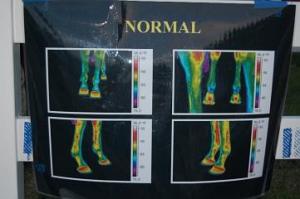
USDA integrated thermography into the inspection process beginning with the 2007 show season. It uses an infrared camera that measures surface temperatures. “In thermographic images, cooler areas appear blue, black, green or purple, while warmer areas appear yellow, orange, red or white.” (USDA publication) Cezar explained, ”If the thermography image is abnormal, we show the horse owner where the abnormality showed up. A horse owner may be concerned about this, so we bring it to their attention. They can then go back to the barn with no penalty, but we will be watching the horse more carefully. If the image shows red or white, this indicates inflammation and a painful area. The area may flinch with palpation. If the thermography image is black or blue, there may be numbing in the area. We swab for foreign substances to further check.”
I asked Dr. Cezar about gels or liniments that are regularly used on horses legs after a hard workout. Could these be detected as “foreign substances” and penalize the owner? Poultices are also used on horses’ legs, sometimes recommended by veterinarians, and are put under plastic wrap for a day or so to treat injuries. Could these be wrongly detected at inspection as indicative of soring? And what about wrapping horses’ legs for trailer shipping? The wraps can leave wavy line impressions on the horses’ legs; could these be visually interpreted as scaring? Dr. Cezar’s response: “These things would not be a concern, not a problem. The applications are mainly on the canon bone area. We are looking for foreign substances on the pastern and coronet area that are used inappropriately.”
USDA definitions of foreign substances are found at http://www.aphis.usda.gov/animal_welfare/hp/downloads/fs_definition.pdf. The foreign substances are listed and their illegal uses defined, which include counterirritant, masking agent, and numbing agent. Protocol for foreign substance penalty is outlined at: http://www.aphis.usda.gov/animal_welfare/hp/downloads/gcms_protocol08.pdf. The 2008 Foreign Substance Report is available at http://www.aphis.usda.gov/animal_welfare/hp/downloads/annual_test_results.pdf The substances listed on this report include: “Oxybenzone and Octyl Methoxycinnamate, Camphor and Benzocaine, Isopropyl Palmitate, Methyl Salicylate, Elemental Sulphur, Lidocaine, o-Aminoazotoluene, and aromatic hydrocarbons consistent with the composition of a fuel oil.” According to a National Institute of Health report, o-Aminoazotoluene is used in “the production of dyes. It is reasonably anticipated to be a human carcinogen” causing “hepatomas, lung tumors, and liver adenomas” among other cancerous tumors. “The primary routes of human exposure are dermal contact and inhalation. Symptoms of exposure to this compound include allergic reactions and eczema of the hands and arms.”
Dr. Cezar directed me to a 2009 USDA Horse Protection Program presentation that explains the enforcement process, how the horse is to be presented at inspection, and the banned substances and practices. http://www.aphis.usda.gov/animal_welfare/hp/downloads/2009_sp_present.pdf These include no acrylic or other hard substance used as hoof-packing. Dr. Cezar explained, “The use of black acrylic and hard hoof-packing on the bottom of the hoof can prevent the horse from feeling the hoof testers.” The presentation shows graphic photos of horses’ hooves and pasterns that have been sored, including scaring, illegal shoes, frog and bulbs of the heel pared out, and bruising. Some owners have complained that the combination of lubrication for the chain, the chain, and dirt where horses are worked can cause irritation, yet this is not considered soring according to Cezar.
Inspectors look for scaring, and I asked Dr Cezar if there were signs that might be interpreted as evidence of soring when they were clearly not. Dr. Cezar explained, “There may be wrinkles in the skin, for example from shipping wraps. If the skin stretches out flat, that is not a scar.“ I asked about Scratches, also called grease heal or mud fever, if that could be mistakenly ruled as scaring. Dr. Cezar replied that the inspectors can clearly distinguish Scratches. The pastern scars they look for are the result of painful devices that have caused irritation and are usually vertical. “We have found instances where the frog has been pared out. We have heard of taping a golf ball to the bottom of horses’ hooves so they have to stand on it.” This causes soreness and possibly bruising. The following link gives information on the Horse Protection Act, definition of Sore, the Scar Rule, photos of how inspections are done, normal pastern, and photos of 2008 Scar Rule Violations: http://www.aphis.usda.gov/animal_welfare/hp/downloads/scar_rule_violate2008.pdf.
On the USDA Disqualification List, as of 4/15/2009, eleven “dealers, licensees, and exhibitors are disqualified for violation of the HPA.” Disqualifications range from 2 years to 10 years and fines from $2,000 to $117,700. At the GCHS, there were 4 violations: 2 unilateral sore, 1 bilateral sore, and 1 foreign substance. (USDA 2009 Show Report) Yet TWH owners and exhibitors, as well as owners and exhibitors of other breeds and disciplines, have a lot of misconceptions about soring. “There is a need for educational seminars about this all over the country. This spring we did one at the Calsonic Arena in Shelbyville, but we need more of them,” said Dr. Cezar. The spring presentation can be viewed at the APHIS site, along with links to information on other related topics. http://www.aphis.usda.gov/animal_welfare/hp/index.shtml. There is also an applicable state law: The Tennessee Cruelty to Animals Statute (TCA 39-14-201).


