

Local Horse Owners Reflect On Clinton Anderson Clinic
June 21-22, 2008
by Nancy Brannon
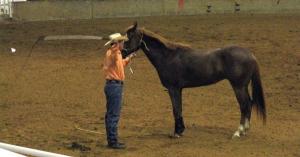
Clinton Anderson demonstrated his “Downunder” horse training skills to a receptive audience at the Agricenter Show Place Arena on June 21-22, 2008. Anderson’s training is designed to develop the horse into a “safe, responsive and willing partner.” He emphasizes obtaining respect from the horse and control over the horse to achieve those goals. Some Mid-south horse owners who attended the clinic shared their experiences and perceptions of Anderson’s methods.Brynda Read of Arlington, Tennessee described his training demonstration:
“The goal in Clinton Anderson’s clinics is to take a young horse who hasn’t been worked with before and Anderson will be able to ride the horse by the end of the weekend. The first day he did round pen and lunge line work. The second day he got on the horse.”
Read recalled how he analyzed the problems that most horses have, saying they “result from one of two causes: they are fearful or they are disrespectful.” Anderson emphasized teaching the horse to respect humans, while he, in turn, was respectful and tuned in to the audience: “he was good about answering people’s questions.”Anderson has several basic training devices he uses. “His work is mainly done in a round pen, but if you don’t have a round pen, you can do the same exercises with horse on the lunge line,” she said. He demonstrated “lungeing for respect” at two levels.
Another tool Anderson uses is called a Handy Stick. Read said it is similar to what Parelli uses and calls a ‘carrot stick: “It is basically a stick with a line on the end. It looks like a buggy whip and there is what he calls a ‘string’ that ties to the end of the stick.” The training tool is designed to be an extension of the trainer’s arm. She said, “Anderson claims Parelli got the idea from him. But he doesn’t mind, because he believes that the more people who are training horses correctly, the better for both horses and people.” For some training purposes, “He takes the line and ties it around the horse’s neck.” In other cases, “He uses the line as a dividing line between leading the horse and driving the horse.” He uses the stick to ask the horse to move directionally.Another training tool he uses is a Mecate Rein, which has a long leather piece on the end. She described the rein as having “a tail of about 6 or 7 feet with a popper at the end. If the horse doesn’t respond to the first couple of cues, he flicks the end of the rein with the leather piece” to increase the intensity of the cue or increase speed, she said. The bridle he uses with the snaffle bit has “slobber straps” that hang down from the snaffle bit. The “slobber straps” are designed to keep the bit from sliding through the horse’s mouth when using one-rein cues, and to give the horse advanced notice before the rider gives a command.
Anderson’s system is to “do things in a four-beat pattern,” Read said. He begins with less intense cues and gradually increases the pressure until the horse responds. “Then he quits giving the cue.” After the horse responds, “he rubs the spot with the stick where he formerly put pressure. He soothes the horse because he doesn’t want the horse fearful of the stick,” she explained. “When riding, he never kicks the horse. He first squeezes, then clucks” to get the desired response. Anderson’s steps of putting pressure on the horse are: first n asking; second n telling; and third n demanding. When Anderson gets the desired response, he uses a release word for the horse to stop doing what he’s doing. “When the horse minds you, you say the release word,” Read said.What Read liked about the clinic is that Anderson didn’t pass the buck to someone else. “He did the work himself the whole weekend. He rode his horse and showed what his horse could do. Anderson has two horses that he uses in demonstrations. He works one for six months and then turns it out to pasture to “be a horse” while he works the other horse for six months.After the demonstration with his own horse, Anderson worked with the untrained horse and gave examples of how the audience members could get their horses to do what his horse did. “He put it in layman’s language so people could easily understand. You do this with your horse; you get him to respond quickly; and you build on that to get your horse to do what his horse does,” Read said.A main theme in Anderson’s training is “to keep a balanced horse. You have to train with pressure, but then you desensitize the horse. If you only teach with pressure, you will have an unbalanced horse. Anderson started training when he was about 13 or 14 years old. He soon realized the importance of desensitizing the horse. Without it, the horse gets more and more jumpy about everything. So he gradually gets the horses used to things in the world around them,” Read said. He says to start and stop every lesson with desensitizing.
Regarding the horse’s work schedule, Anderson advises that it is better to do ten minutes a day five days a week than to do longer lessons only on the weekends. Use shorter lessons consistently and start the next day’s lesson where you left off the previous day. Always end the lesson with desensitizing the horse and giving the bit.Anderson starts each lesson/exercise with flexing the horse: “Having the horse turn his head all the way around to where it would touch the rider’s leg,” Read explained. He recommends doing the flexion exercise every time you ride n both before and after the ride. “The horse needs to be flexible enough to give to the bit.” He also recommended doing the lateral flexion at all three speeds: walk, trot, and canter. Responding to an audience question about the difference between this lateral flexion exercise and a one-rein stop, he said the difference is lack of leg pressure.Read summarized the main ideas she got from the clinic, “It’s all about teaching the horse respect for people. Don’t let horse move into your space and move you. When that happens, the horse is being disrespectful to the person and that is a problem for many horse owners.”Renee Toth of Collierville attended and also liked the strategy behind his training techniques. “I’m a dog trainer and I used to be an animal talent agent, training all types of animals. You always train around the animal’s behavior, like dogs’ pack behavior. That’s the way Anderson teaches: by horse behavior, by how the horse looks at everything. He applies everything he does to the horse’s [natural] behavior patterns. He makes the horse comfortable when he’s doing the right thing and uncomfortable when he’s not doing the right thing.”Toth agreed with what he said about nagging. Essentially - don’t do it because it is ineffective. Anderson “gets to the point. Everything is black and white; there is no grey area. He makes it very clear to the horse what he wants. I liked his no-nonsense attitude a lot,” she said.
At home she has already tried putting some of his methods into practice. “I even went out and bought a round pen. I have worked four of my horses in the round pen [using his methods], and quickly seen success.” In lieu of a round pen, you can work your horse on lunge line.
Toth didn’t find anything she didn’t like about his methods. “I understand where he’s coming from. You’ve got to fix any problem right away; you can wait a while and then try to fix it. I like his tapes, too. He shows you how to apply the training methods to your own horse. He shows you how to fix the problems. I was thoroughly impressed and would go again. My husband loved it, too.” She summarized the key to his success is “to reward the good behavior and ignore the bad behavior.”Shelby County Extension Agent Becky Muller attended, “enjoyed it, and found it very informative. He does a good job of teaching people how to train horses without a lot of show” or fanfare. She compared Anderson’s clinic to other trainers’ two-day events she has attended, “While I was ‘wowed’ at them, I felt like they were more of a show. Anderson is more into training. He is hands-on and very interactive with the audience. He explains things clearly.”Muller was impressed with the way Anderson handled all the questions from the audience, even anticipating some and “answering them without even being asked. I came away with new ideas and some new spark to do more with my horse.” She liked the way “he explains the techniques so the horse will understand what he wants. You understand clearly the point he is making with his techniques.”Muller emphasized her perspective of the difference between Anderson and other trainers. His philosophy is to “use the least amount of force necessary to teach the horse what you want.” Something that horse people may not always think about is that “you have to consider the consequences of your training methods.” Muller said she came away from the Anderson clinic “feeling more equipped to handle situations that come up with my horse.” She is also literally better equipped, having purchased some of his training products.
Anderson’s methods are an application of basic operant or behavioral conditioning. Reinforcement and punishment are the core tools of operant conditioning, and are either positive, a reward following a response, or negative, withdrawn following a response. Reinforcement causes the behavior to occur with more frequency and negative reinforcement or punishment causes the behavior to occur with less frequency or ultimately to diminish. B.F. Skinner formulated a detailed analysis of operant conditioning based on reinforcement, punishment, and extinction.
For more information on Anderson’s Downunder Horsemanship see: http://www.downunderhorsemanship.com/


