

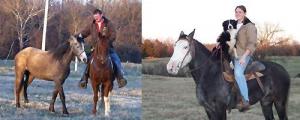
Unique Breed And Family History Connect Missouri, Mississippi
“You feel it when you ride it”
It’s a long ride from Lebanon, Missouri to Cockrum, Mississippi, but if you’ve got the right kind of horse the trip could prove to be really pleasurable. And Ronnie Esther has the horse; quite a few of them, in fact, at the Dale Esther Ranch located just outside Hernando, Mississippi.
The horse is the renowned Missouri Fox Trotter, and it’s been influencing Esther’s (pronounced ee-ster) life since before he was born.
Lebanon is located on the edge of the Ozarks in south-central Missouri, about 20 miles south of Lake of the Ozarks. In the earliest days of settlement of the region, many of the farmers were also cattlemen who often had to ride long distances to buy stock and then get the herd home. They needed horses with the endurance to make the long trips and still have enough left to work the herds. And they had to have a gaited horse or “...it would kill a fellow,” Esther says.
The ideal steed for the task turned out to be the Missouri Fox Trotter, and Ronnie’s grandfather, Dale Esther, was a pioneer with respect to the establishment of the breed. “It’s hard to find a registered Fox Trotter that doesn’t go to his place,” says Ronnie. “He raised Zane Grey, Golden Governor, Red Rawhide.”
Dale was also instrumental in the Missouri Fox Trotting Horse Breeder’s Association (MFTHBA) as it exists today; he and a friend re-organized the dormant organization in 1958 and held the first Celebration Horse Show in 1959. By 2005, the MFTHBA listed over 83,000 horses in its registry, and currently has members in every state of the Union and 7 foreign countries.
Which explains how the 42-year old Esther has such close ties to the breed. He grew up riding for his grandfather during visits to the 700-acre family farm near Lebanon. He’d round up cattle for a regular Wednesday night rodeo, help with the horses on frequent trail rides at Lake of the Ozarks, and show the horses Dale was raising. “All my grandfather did was work Fox Trotters,” says Esther.
And that association developed into a real favoritism for the Fox Trotter. “Everybody wants to say they have a working gaited horse, but these are the only ones that really are,” he says. “That doesn’t mean they’re the only horse, every horse has a talent and a job they can do. You can’t have one for every job, but the Fox Trotter gets about as versatile as you can get.”
Dale Esther’s love of Fox Trotters has carried down through most of his descendants but, like anything else, it can skip a generation. As a young man, Ronnie’s dad was “..one of the best riders, but he just wanted to step onto one. He didn’t want to have to saddle him up...All the other kids would be on horseback and Dad would be on his bicycle.”
That history is still being written on the 700 acres in Missouri. There are two barns; the main one dates back to the 1800’s, and was the first indoor riding barn in that area. Esther says the family started reworking the 160’ x 100’ facility earlier this year, adding a new well and new stall fronts, but that a recent ice storm took part of it down. His grandmother, Janet, was very involved with the operation when her husband was alive and remains an intricate part of the breeding program. “She knows the breeding on the farm and in the area,” says Esther. “Anyone could tell her the history of their horse and she can tell you how the horse was bred. She really likes that.” Janet is currently working for the Historical Society of the MFTHBA, interviewing people in the community where the horse originated, in order to create a complete history of the breed. She still rides and competes on a regular basis.
The Missouri Fox Trotters were developed by crossbreeding Morgans, Thoroughbreds, and Arabians with American Saddle Horses, Standardbreds, and Tennessee Walking Horses and a brief read of the horses’ history shows them to be well-suited to a variety of tasks: pulling carriages, working cattle, running barrels, field trial competitions, and endurance riding, in addition to the sport of long distance trail riding. Many of the breed’s champions have done double duty as both show and working horse.
The gait, which makes these horses so popular, is “...actually very complicated to explain to people,” says Esther. It’s described as “...a broken gait, the horse walking with the front feet and trotting with the back feet...(with a ) sliding action of the rear feet, rather than the hard step of other breeds.”
“They’re diagonally gaited instead of laterally gaited,” he says. “People think because they’re trotting that they’re not gaited...It’s not just mechanics, and it’s not just is whether the footfall pattern is right. When done correctly they do it throughout whole body. To create the rhythm, it has to use the whole body...a Fox Trotter uses his head to counterbalance the back end. The benefit is, when it’s in time it’s a fluid thing. That’s the reason they can do it for miles and miles.” The horses have three natural gaits, described as “the long and easy-going flat foot walk, the smooth and comfortable fox trot characteristic of its name, and the "rocking horse" canter. No special shoeing or training is required for these horses to perform their gaits.”
Esther says the gait makes them popular mounts for police and sheriff’s departments, and he’s had some recent inquiries from the Shelby County, Tennessee Sheriff’s Department for some Fox Trotters.
He shows Fox Trotters at Sunset Stables, which has a class for the horses, and at Hernando Saddle Club where he competes in Country Pleasure,
“In the show circuit, I like riding Country Pleasure because it shows the difference with other horses. It’s hard for a Fox Trotter to win against a Walking Horse because the Walking Horse is a little more flashy...,” he says. “It takes a really good Fox Trotting horse to place against Walking Horses, but it doesn’t bother me because people get to see the difference, and I like horse people.”
He probably inherited that trait from Dale, who often sold his horses through the Forestry Department. Ronnie relates the tale of one of the last buyers to visit Dale. “You must really like horses, doing this all these years,” the buyer remarked. Dale replied he “...wasn’t sure if he liked horses or the people who like horses more.”
And while he frequently brings a load of horses from the family homestead to sell at his place in Cockrum, he doesn’t consider himself a “horse trader.” ““To sell a horse is not a big deal. To have the right person with the right horse and they enjoy it, that’s the deal. If I can’t get those together it doesn’t matter if I never sell another horse...Do I have the right one (for them), where they really like it?”
He says he currently has about 65 registered horses in Missouri, with about a half dozen of them at the Dale Esther Ranch in Cockrum. Esther says temperament, and the legendary gait, are what set the price for a horse. “You feel it when you ride it,” he says, “and you don’t have to ask. The people who know don’t have to.”
Mississippi now has it’s own chapter of the Missouri Fox Trotting Horse Association, which gives owners a forum for both fellowship and activities. “They’re all really good people, and we like to ride throughout year,” he says. The group holds shows close to Jackson, Mississippi, rides near Oxford, and in Arkansas.
For more information on Missouri Fox Trotters and the regional associations, visit http://www.mfthba.com or contact Ronnie Esther at 662-233-0739 (home), 901-262-7230 (cell), or by e-mail at jesther@tds.net.


