

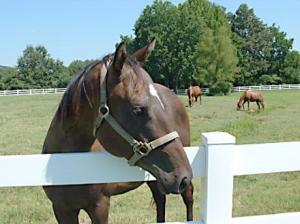
Raising Thoroughbred Race Horses In West Tennessee
by Nancy Brannon
Raising Thoroughbred race horses is a dream of many people, especially during the first of May when all attention is on the Kentucky Derby. Few people are able to succeed in the business, but Fayette County attorney Jim Gallagher seems to be doing it well—and enjoying it. His prize horses are raised at Gallagher Farm on Highway 196 near the Hickory Withe community.
Gallagher got into the Thoroughbred race horse business quite serendipitously. “I started in 1990 when I was introduced to the horse business by John Pierotti, who was District Attorney General for the western division, in Shelby County at that time,” Gallagher explained. “John introduced me to Ronnie Udonj, who had been in the racing business for over 40 years. Ronnie taught me a lot.”
Since that initial introduction, Gallagher has developed contacts with some of the bigger players in the Thoroughbred business in and around Kentucky. He will be sending four yearlings to the Keeneland September yearling sale in Lexington, Kentucky. Sheik Mohammed from Dubai has bought two horses from him, a yearling and weanling. The older one was a graded stakes winner and the younger will start racing this year.
Gallagher has also had some stakes winners of his own. One of his prize mares, SPECIAL TEST is a multiple stakes winner and has produced a stakes winner. Her daughter, DAZZLE, was unraced because of an injury, but produced a foal who won second-place in a stakes race at Keeneland. The mares were retired off the track for breeding and have new foals on the ground. “I’ve been very successful at it,” Gallagher humbly claims. “The returns can be great, but so can the costs.”
Gallagher moved to Hickory Withe in 1999 where he developed a 55-acre farm to pursue his avocation. “When we bought the place, it was over grown and in bad shape. We spend three years elevating and trimming trees before we could begin work on the pastures and paddocks for the horses. We have over two miles of vinyl fence.”
Gallagher designed both the barn and house himself. “I modeled the barn after several boarding barns I had seen.” He designed the barn for maximum ventilation, so two outside walls have shed row overhangs. One side accommodates nearly 300 bales of hay, which can be conveniently put into the horses’ hay racks through outside windows. There is a 5-foot exhaust fan at the north end of the barn, which “when you close the entry doors and turn the fan on, will totally change the air in the barn in 3 minutes,” Gallagher said. “The older horses know what is going on and will go to their windows to feel the breeze.” Flies are kept out of his barn by a Pyranha@ fly spray system, for which Gallagher has a distributorship in the area.
The barn is kept immaculately clean and the horses are watched carefully for any illnesses or injuries. “We make our own electrolytes and mud poultices here. We use the old proven race track remedies, ‘concoctions’,” Gallagher said.
He has been a trial lawyer for 30 years in the Memphis and Fayette County area. He and John Pierotti are good friends and he continues the story of how he got involved in horses. “I was at a point in my life where I was working all the time and not doing anything else, except a little golf. When John introduced me to horse racing, I didn’t even know how to read a racing form. John took me to Oaklawn to the races. I’m not a gambler, so putting a $2 bet on a horse is a big bet for me.” He watched the races, but “I wasn’t very impressed.” However, the next morning John took him to the “back side” of the track. “There I immediately felt at home and fell in love with it at that point,” Gallagher recalled.
He sees race horses as professional athletes in some stage of their career, “who can’t talk to tell you how they feel. So you deal with vets and trainers and try to figure out what length a horse can run, where in the pack they like to run. When you have a horse who didn’t run well a particular day, they can’t tell you why. So you have to read the athlete’s body language to see the problem and figure out how to get them to perform their best.”
Gallagher has found the race horse business “very interesting. I have met some great people. But you have to be careful. You’re dealing with a live commodity and as horse people know, horses will find a way to get hurt” despite all the measures taken to prevent injury.
He has 16 horses on the farm now, and usually keeps around 25. He breaks and trains horses “European style,” he said. He has a mowed track around the outside of the pasture fencing, so the horses are taken “cross country, up and down hills, to get all their muscles in tone.” He has a 1/3 mile area where the horses are breezed. “When they can gallop 3 times around clockwise and counterclockwise, they’re fit when they can do that. Then it’s time to send them to the race track trainers.”
Ernesto Romera breaks and trains all the horses. “He has a wealth of experience with horses,” Gallagher said. “He grew up on a ranch and has been handling horses and cows since he was a kid.”
For more information about the horses at Gallagher Farm, call 901-526-0100.


