

By Allison Armstrong Rehnborg
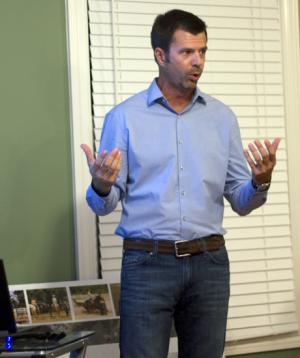
On October 15, 2013 Tennessee Equine Hospital of Thompson Station, Tennessee, wrapped up its 2013 Lecture Series on equine wellness with a final address. Dr. Matt Povlovich, who works as partner and co-owner of the practice, spoke about “Advances in Lameness Diagnostics and Treatment: The Future is Now” to a full conference room of horse owners, clients, and equine professionals.
An alumnus of the University of Missouri, Povlovich has worked at the hospital since 1996. Thanks to his extensive training in sport horse medicine and diagnostic imaging, Povlovich leads the clinic’s Sport Horse and Lameness Department.
As Dr. Monty McInturff, co-owner of the practice, acknowledged in his introduction, “Lameness is something we all have to deal with,” regardless of discipline or breed of horse. Lameness can be one of the trickier aspects of good horse-keeping. Consequently, years of research have been dedicated to studying the various ways in which horses can go lame and how to improve diagnosis and treatment.
Povlovich began his talk with a discussion of lameness locators, new technology that can collect data on the movements of trotting horses and wirelessly transmit that data to a computer.
“The lameness locator is a computer system with three wireless sensors that detect slight changes in a horse’s movement,” he explained.
One sensor, called a gyroscope, is attached to the right foreleg of the horse, and its purpose is to tell the computer when the horse’s right foreleg touches the ground and when it pushes off. Other sensors, called accelerometers, are placed on the horse’s poll and pelvis to record how those structures move as the horse trots. These sensors record data ten times faster than the human eye, and that data is then sent to a computer system. Taking into account variables such as the type of ground and the application of nerve blocks, the computer system develops graphs and calculations to indicate unsoundness in the horse.
The purpose of a lameness locator is to detect variations in a horse’s natural movements that may indicate levels of pain or unsoundness. However, Povlovich was careful to point out that the lameness locator is not a magic wand that can pinpoint lameness to a specific structure.
“The lameness locator is a tool, like an ultrasound or my hoof testers,” the veterinarian said. “The data sets provide me with information, just like my tools do.”
Povlovich then moved onto the treatment, which focuses on regenerative medicine. Regenerative medicine is “the process of replacing or regenerating equine cells, tissues, or organs to restore or establish nerve function.”
“We can replace the term ‘regenerative medicine’ with ‘healing,’” Povlovich said. “Healing is passive, but regenerative medicine is active and stimulatory.”
Regenerative medicine involves the use of stem cells or bioactive molecules to induce regeneration or to speed healing. Platelet Rich Plasma, or PRP, is one way of stimulating healing. While plasma is the fluid portion of blood that contains no cells, PRP is plasma that contains more platelets than the same volume of blood. Since platelets secrete growth factors at the site of an injury, the use of PRP helps injuries heal more quickly and more effectively. PRP is made by harvesting blood from a horse and using a centrifuge to separate the parts of the blood.
Another method used in regenerative medicine is the use of bone marrow aspirate concentrate, or BMAC. Povlovich explained that BMAC combines the technology of stem cells and PRP to speed healing. BMAC is typically extracted from a horse’s sternum, which Povlovich identified as the best site for removing bone marrow, and contains platelets, stem cells, and adhesion molecules. All of these elements can speed healing in a torn ligament or damaged tendon.
A veterinarian may also opt to use interleukin-1 receptor antogonist protein, or IRAP, which can help treat joint problems. Like PRP, IRAP is harvested from a horse’s blood. After incubating for 24 hours, IRAP is administered as a series of three intra-articular injections, one week apart. IRAP slows cartilage degradation and aids in healing by breaking the inflammation cycle.
Povlovich wrapped up his presentation by introducing the idea of mesotherapy, which is a “novel way to control pain in the horse.” Mesotherapy uses the same mechanism as acupuncture, and involves administering a series of small pinpoint injections into the mesoderm of the skin. These injections stimulate the nerve fibers of the horse, and can block the transmission of pain signals through shared nerve pathways.
The lecture and accompanying dinner were sponsored by Merial, and the evening concluded with a brief talk on Equioxx by one of Merial’s veterinarians, Dr. Hoyt Cheramie.
On October 15, 2013 Tennessee Equine Hospital of Thompson Station, Tennessee, wrapped up its 2013 Lecture Series on equine wellness with a final address. Dr. Matt Povlovich, who works as partner and co-owner of the practice, spoke about “Advances in Lameness Diagnostics and Treatment: The Future is Now” to a full conference room of horse owners, clients, and equine professionals.
An alumnus of the University of Missouri, Povlovich has worked at the hospital since 1996. Thanks to his extensive training in sport horse medicine and diagnostic imaging, Povlovich leads the clinic’s Sport Horse and Lameness Department.
As Dr. Monty McInturff, co-owner of the practice, acknowledged in his introduction, “Lameness is something we all have to deal with,” regardless of discipline or breed of horse. Lameness can be one of the trickier aspects of good horse-keeping. Consequently, years of research have been dedicated to studying the various ways in which horses can go lame and how to improve diagnosis and treatment.
Povlovich began his talk with a discussion of lameness locators, new technology that can collect data on the movements of trotting horses and wirelessly transmit that data to a computer.
“The lameness locator is a computer system with three wireless sensors that detect slight changes in a horse’s movement,” he explained.
One sensor, called a gyroscope, is attached to the right foreleg of the horse, and its purpose is to tell the computer when the horse’s right foreleg touches the ground and when it pushes off. Other sensors, called accelerometers, are placed on the horse’s poll and pelvis to record how those structures move as the horse trots. These sensors record data ten times faster than the human eye, and that data is then sent to a computer system. Taking into account variables such as the type of ground and the application of nerve blocks, the computer system develops graphs and calculations to indicate unsoundness in the horse.
The purpose of a lameness locator is to detect variations in a horse’s natural movements that may indicate levels of pain or unsoundness. However, Povlovich was careful to point out that the lameness locator is not a magic wand that can pinpoint lameness to a specific structure.
“The lameness locator is a tool, like an ultrasound or my hoof testers,” the veterinarian said. “The data sets provide me with information, just like my tools do.”
Povlovich then moved onto the treatment, which focuses on regenerative medicine. Regenerative medicine is “the process of replacing or regenerating equine cells, tissues, or organs to restore or establish nerve function.”
“We can replace the term ‘regenerative medicine’ with ‘healing,’” Povlovich said. “Healing is passive, but regenerative medicine is active and stimulatory.”
Regenerative medicine involves the use of stem cells or bioactive molecules to induce regeneration or to speed healing. Platelet Rich Plasma, or PRP, is one way of stimulating healing. While plasma is the fluid portion of blood that contains no cells, PRP is plasma that contains more platelets than the same volume of blood. Since platelets secrete growth factors at the site of an injury, the use of PRP helps injuries heal more quickly and more effectively. PRP is made by harvesting blood from a horse and using a centrifuge to separate the parts of the blood.
Another method used in regenerative medicine is the use of bone marrow aspirate concentrate, or BMAC. Povlovich explained that BMAC combines the technology of stem cells and PRP to speed healing. BMAC is typically extracted from a horse’s sternum, which Povlovich identified as the best site for removing bone marrow, and contains platelets, stem cells, and adhesion molecules. All of these elements can speed healing in a torn ligament or damaged tendon.
A veterinarian may also opt to use interleukin-1 receptor antogonist protein, or IRAP, which can help treat joint problems. Like PRP, IRAP is harvested from a horse’s blood. After incubating for 24 hours, IRAP is administered as a series of three intra-articular injections, one week apart. IRAP slows cartilage degradation and aids in healing by breaking the inflammation cycle.
Povlovich wrapped up his presentation by introducing the idea of mesotherapy, which is a “novel way to control pain in the horse.” Mesotherapy uses the same mechanism as acupuncture, and involves administering a series of small pinpoint injections into the mesoderm of the skin. These injections stimulate the nerve fibers of the horse, and can block the transmission of pain signals through shared nerve pathways.
The lecture and accompanying dinner were sponsored by Merial, and the evening concluded with a brief talk on Equioxx by one of Merial’s veterinarians, Dr. Hoyt Cheramie.


