

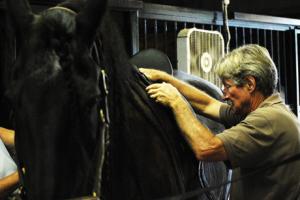
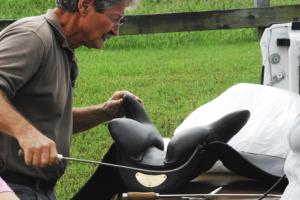
On August 10 and 11, Marty Haist and his wife Beth offered their expert advice to students of dressage trainer Peggy Gaboury at Cranesfield Farm near Macon, TN. Marty Haist has been fitting saddles for about 20 years. He and his wife own the dressage specialty tack store – The Horse of Course – based in Claremore, Oklahoma, and tour the country as a mobile unit most of the year. They have a permanent base in Florida during the winter and attend most of the major east coast dressage shows. Marty has trained in England and Germany, working with some of the leading saddle builders in both countries.
Marty explained the importance of saddle stuffing materials, namely wool verses synthetic; of English verses German saddlery techniques; and determining the individual horse’s body sculpture as it relates to fit. Precise measurements are vital to assure that the saddle allows for the maximum range of motion and does not restrict movement. Balance is affected if the saddle does not fit properly, and this is of utmost importance in dressage, where the center of gravity dictates aids.
Saddle fitting
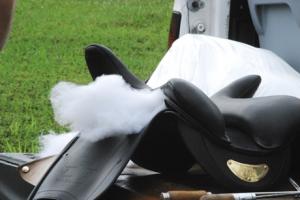
Stuffing materials. Some custom built saddles use materials that cannot be modified after the saddle has been built, or that require special equipment to adjust. Since dressage saddles require regular refitting, as the horse changes his muscle structure in response to the work, a saddle which cannot be adjusted as the horse progresses through the levels can become a problem for the horse. In addition, a saddle built that way has limited value for resale; you have to find a horse that fits it perfectly. Natural flocking materials can always be adjusted as necessary, so that kind of saddle might be a better investment over the long term.
The balance of saddles in relation to the rider. Placement of the stirrup bar is key to rider balance. The stirrup bar should allow the rider to drop the thigh naturally into a position in which the heel stays easily in alignment under the rider’s pelvis. Incorrect placement of the stirrup bar may cause a rider to sit too far back in the saddle. A stirrup bar which is too far forward may push the rider back into somewhat of a chair seat.
The lowest point of the saddle should also encourage the rider to easily maintain her body alignment – shoulder over hip over heel – and place the rider’s center of gravity over the horse’s center of gravity. A saddle which is too big for the rider, or which has its balance point too far back, will also leave the rider in a chair seated position. That position means that the rider’s center of gravity will swing back and forth in the posting trot and the rider will end up “pushing” the horse from behind instead of sitting easily in the middle of the movement.
Balance for the horse. A saddle which sits too far forward on the horse’s shoulder will restrict the horse’s shoulder movement; a saddle which sits down too much in front may pinch the shoulders. Either of these balance problems may lead to behavioral problems and, of course, performance problems. The horse may refuse to move forward, and may even buck or rear out of discomfort. A correctly fitted saddle allows the horse to move freely forward, and to carry a rider in comfort.
Bits
Beth offered her advice on bits, explaining how different bits can provide various levels of control, and how both type of metal and bit design and fit can assist the rider in gaining maximum control.
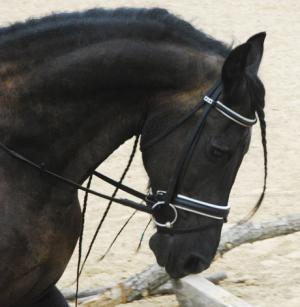
Width of bits– especially the curb in the double bridle. The curb should rest on the bars of the horse’s mouth, not out on the lips. Most horses are much narrower in the bars than people realize. Beth typically fits even very large Warmbloods with curb bits that between 4 ½” and 5.” Snaffles need to be wider. A horse with 5” curb might well carry a snaffle which is 5 ¾.” The snaffle does not rest on the bars, and needs to be wide enough not to pinch the lips.
Horses have only limited space in their mouths. Shape and size of the tongue, and the shape of the horse’s palate, determine how much space there is for the bits. A horse with limited space may need narrower bits. Bits that are too large in the mouthpiece may place too much pressure on the tongue, causing the horse to develop evasive habits, sticking the tongue out, or pushing it back and above the bit.
Shape and structureof the bit also have to be related to the horse’s temperament and style of response to the rider. A quick, sensitive horse who tends to back behind the aids may need a bit with fewer pieces, something that lies quietly in the mouth and minimizes reactivity. A horse who wants to lean on the bit and lay on the rider’s hands may need a different bit altogether. Both of these behavior patterns may reflect bit fitting problems. An expert bit fitter can quickly look at the shape of the horse’s mouth and determine the effect of various shaped bits on that particular horse.
Marty and Beth said that they prefer particular brands, stating that they like to stick with manufacturers who consistently produce a quality product. The Horse of Course offers top proven brands, innovative new products, complete customized saddle fitting and customized bit fitting. “We provide fashion, an extensive selection of breeches, show clothes, custom shadbellies, as well as a complete selection of dressage tack,” said Beth. “My husband, Marty, is a saddler, not just a fitter, and he provides professional, personal service to our customer’s saddle needs.”
For more information on products and to schedule custom fittings, contact them at: http://thehorseofcourse.com/and on their facebook page: https://www.facebook.com/thehorseofcourseinc
On their website, you can find a complete guide to tracing your horse’s withers. You can try out any saddle they offer for a free 10-day trial.
Marty explained the importance of saddle stuffing materials, namely wool verses synthetic; of English verses German saddlery techniques; and determining the individual horse’s body sculpture as it relates to fit. Precise measurements are vital to assure that the saddle allows for the maximum range of motion and does not restrict movement. Balance is affected if the saddle does not fit properly, and this is of utmost importance in dressage, where the center of gravity dictates aids.
Saddle fitting
Stuffing materials. Some custom built saddles use materials that cannot be modified after the saddle has been built, or that require special equipment to adjust. Since dressage saddles require regular refitting, as the horse changes his muscle structure in response to the work, a saddle which cannot be adjusted as the horse progresses through the levels can become a problem for the horse. In addition, a saddle built that way has limited value for resale; you have to find a horse that fits it perfectly. Natural flocking materials can always be adjusted as necessary, so that kind of saddle might be a better investment over the long term.
The balance of saddles in relation to the rider. Placement of the stirrup bar is key to rider balance. The stirrup bar should allow the rider to drop the thigh naturally into a position in which the heel stays easily in alignment under the rider’s pelvis. Incorrect placement of the stirrup bar may cause a rider to sit too far back in the saddle. A stirrup bar which is too far forward may push the rider back into somewhat of a chair seat.
The lowest point of the saddle should also encourage the rider to easily maintain her body alignment – shoulder over hip over heel – and place the rider’s center of gravity over the horse’s center of gravity. A saddle which is too big for the rider, or which has its balance point too far back, will also leave the rider in a chair seated position. That position means that the rider’s center of gravity will swing back and forth in the posting trot and the rider will end up “pushing” the horse from behind instead of sitting easily in the middle of the movement.
Balance for the horse. A saddle which sits too far forward on the horse’s shoulder will restrict the horse’s shoulder movement; a saddle which sits down too much in front may pinch the shoulders. Either of these balance problems may lead to behavioral problems and, of course, performance problems. The horse may refuse to move forward, and may even buck or rear out of discomfort. A correctly fitted saddle allows the horse to move freely forward, and to carry a rider in comfort.
Bits
Beth offered her advice on bits, explaining how different bits can provide various levels of control, and how both type of metal and bit design and fit can assist the rider in gaining maximum control.
Width of bits– especially the curb in the double bridle. The curb should rest on the bars of the horse’s mouth, not out on the lips. Most horses are much narrower in the bars than people realize. Beth typically fits even very large Warmbloods with curb bits that between 4 ½” and 5.” Snaffles need to be wider. A horse with 5” curb might well carry a snaffle which is 5 ¾.” The snaffle does not rest on the bars, and needs to be wide enough not to pinch the lips.
Horses have only limited space in their mouths. Shape and size of the tongue, and the shape of the horse’s palate, determine how much space there is for the bits. A horse with limited space may need narrower bits. Bits that are too large in the mouthpiece may place too much pressure on the tongue, causing the horse to develop evasive habits, sticking the tongue out, or pushing it back and above the bit.
Shape and structureof the bit also have to be related to the horse’s temperament and style of response to the rider. A quick, sensitive horse who tends to back behind the aids may need a bit with fewer pieces, something that lies quietly in the mouth and minimizes reactivity. A horse who wants to lean on the bit and lay on the rider’s hands may need a different bit altogether. Both of these behavior patterns may reflect bit fitting problems. An expert bit fitter can quickly look at the shape of the horse’s mouth and determine the effect of various shaped bits on that particular horse.
Marty and Beth said that they prefer particular brands, stating that they like to stick with manufacturers who consistently produce a quality product. The Horse of Course offers top proven brands, innovative new products, complete customized saddle fitting and customized bit fitting. “We provide fashion, an extensive selection of breeches, show clothes, custom shadbellies, as well as a complete selection of dressage tack,” said Beth. “My husband, Marty, is a saddler, not just a fitter, and he provides professional, personal service to our customer’s saddle needs.”
For more information on products and to schedule custom fittings, contact them at: http://thehorseofcourse.com/and on their facebook page: https://www.facebook.com/thehorseofcourseinc
On their website, you can find a complete guide to tracing your horse’s withers. You can try out any saddle they offer for a free 10-day trial.


