

By Leigh Ballard
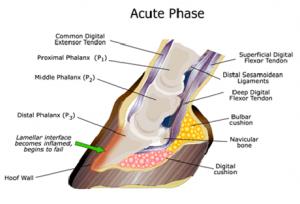
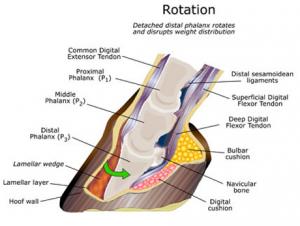
Laminitis is a painful condition of inflammation of the sensitive laminae of the hoof wall. Laminitis episodes can range from mild to severe, but generally any episode should be considered an emergency since progression from laminitis to founder (rotation of the coffin bone) is a severely debilitating condition.
Although laminitis can sometimes be triggered by injury, systemic illnesses, or events like retained placenta in post-partum mares, the vast majority of laminitis episodes are due to diet. Laminitis is a metabolic condition that comes about from a complex set of events that often begin in the digestive tract. An overload of sugar and starch, non-structural carbohydrates (NSC), whether in a grain diet or forage, often triggers laminitis.
Certain horses are at high risk for laminitis. Breeds that are considered to be “easy keepers” and ponies who don’t need much feed are at risk because they might be fed more than they need. Any horse who is obese or is being fed too much for the exercise he/she gets is at risk. Horses with cresty necks or abnormal fat deposits around the withers shoulder and tail area are possibly insulin resistant and therefore at risk. Horses with Cushings Disease are at risk.
Any horse who has had more than one previous bout of laminitis is at risk for future episodes. Horses with unrestricted access to high NSC pasture are at risk. And, of course, any horse who gets loose in the feed room is at risk because of the sudden massive overload of carbohydrates.
There are varying degrees of laminitis, and it doesn’t always develop into full blown founder. Episodes can be mild, with the horse showing some slight tenderness and heat in the hooves, to severe with rotation of the coffin bone. A severe episode is characterized by the classic stance with the hind feet forward under the belly and the weight rocked back to keep weight on the heels. The horse won’t walk unless forced and then with very small painful steps.
Horses that have recurring bouts of laminitis are considered chronic “laminitic” horses. Unfortunately, these horses require a focused management protocol to keep them sound and usable.
The most important strategy is to modify their diet. Sugar and starch should be strictly controlled. Since both feed concentrates and pasture (as well as hay) contain certain levels of NSC, drastic changes in horse-keeping are usually necessary. First, the horse should be fed as little NSC in the feed ration as possible. And pasturing is not the answer to reducing the feed ration. Green grass may have too much sugar also. Usually grazing needs to be limited, and putting the horse in a dry lot or paddock with no grass is generally considered the best control to limit grazing. Horses that can tolerate some grazing for short periods of time might need to be hand grazed, introducing grass slowly. Also, the time of day that laminitic horses are allowed to graze matters, with morning hours being the best time. For horses that can tolerate grass, especially during the season when NSC is lower, a grazing muzzle lets them be out longer while still controlling their intake. Grazing muzzles should have a breakaway capability for safety, and need to be checked to make sure that the horse is not wearing through it and eating too much.
Hay should be tested for sugar content. Testing is very easy by sending samples to a lab that will send back a report of the hay’s nutritional content. (Visit www.equi-analytica.com) Hay can be soaked to leach out excess sugar. Finally, a horse who has real problems with sugar doesn’t need any grain-based treats, or even apples and carrots which are high sugar!
Other management strategies for laminitic horses should involve good hoof care by a farrier experienced with problems caused by laminitis. Some special attention in trimming and/or shoeing can keep a laminitic horse sound and usable indefinitely.
A veterinarian should be involved with monitoring the heath of a laminitic horse. Research is ongoing to understand laminitis, and new protocols may be helpful. Testing insulin levels and using supplements might also be helpful, based on veterinary recommendations.
Dr. Ashley Phelps at Equine Veterinary Associates of Olive Branch uses Lamina Saver with her patients who have foundered. She says it comes in an emergency dose, for when the horse first founders, and a maintenance dose. “I have had some very good, positive results from it,” she said. “I use it mainly for strengthening the foot and the laminae.” Dr. Jennifer Dunlap of Dunlap Equine Services agrees, “I really like Lamina Saver.”
Dr. Phelps said she usually sees some horses founder in the fall, “mainly due to a metabolic imbalance,” she explained. Also, if pastures are over seeded with rye, there could be some founders from the rich winter grass. However, the majority that she sees are related to metabolic imbalance, she said.
Another new product is Laminil, an injectable drug developed to inhibit inflammatory mediators and other chemicals from being released from the mast cell in excess. However, Laminil is an investigational drug going through the FDA approval process. The developer is Charles Owen of Willowcroft Pharm Inc., a privately held company of Littleton, Colorado. Owen described his product to The Equine Chronicle in May 2013: “The product has been in the works for ten years, and the theory behind Laminil took 17 years to develop. It is a mast cell stabilizer that inhibits inflammatory responses from being released from the mast cells. The inflammatory response is the activator of laminitis. Understanding the proper sequence of the laminitis cascade is vital to understanding how to treat laminitis.”
Resources:
Clare Barfoot, “Laminitis: What Every Horse Owner Should Know.” www.farrierspages.com/laminitis.htm
Don Walsh, DVM and Kathryn Watts, “Laminitis Attack: The First Line of Defense.” www.safergrass.org
www.animal healthfoundation.com
www.wirralfarrier.com/laminitis.html
www.aaep.org/health_articles_view.php?id=281
See the Mid-South Horse Review July 2013 issue for the article “How Can Pasture Cause Laminitis?”
A PowerPoint presentation from UT College of Veterinary Medicine on “Cushings Disease and Other Metabolic Disorders,” focusing on “Laminitis and Hormonal Disorders” http://www.vet.utk.edu/departments/LACS/monthly_features/pps/hormonal_disorders_geriatric_horses.pps
The 2013 International Equine Conference on Laminitis and Diseases of the Foot will be held November 1-3, 2013 in West Palm Beach, FL. For information about the conference, visit: www.laminitisconference.com/laminitis.html.
Laminitis is a painful condition of inflammation of the sensitive laminae of the hoof wall. Laminitis episodes can range from mild to severe, but generally any episode should be considered an emergency since progression from laminitis to founder (rotation of the coffin bone) is a severely debilitating condition.
Although laminitis can sometimes be triggered by injury, systemic illnesses, or events like retained placenta in post-partum mares, the vast majority of laminitis episodes are due to diet. Laminitis is a metabolic condition that comes about from a complex set of events that often begin in the digestive tract. An overload of sugar and starch, non-structural carbohydrates (NSC), whether in a grain diet or forage, often triggers laminitis.
Certain horses are at high risk for laminitis. Breeds that are considered to be “easy keepers” and ponies who don’t need much feed are at risk because they might be fed more than they need. Any horse who is obese or is being fed too much for the exercise he/she gets is at risk. Horses with cresty necks or abnormal fat deposits around the withers shoulder and tail area are possibly insulin resistant and therefore at risk. Horses with Cushings Disease are at risk.
Any horse who has had more than one previous bout of laminitis is at risk for future episodes. Horses with unrestricted access to high NSC pasture are at risk. And, of course, any horse who gets loose in the feed room is at risk because of the sudden massive overload of carbohydrates.
There are varying degrees of laminitis, and it doesn’t always develop into full blown founder. Episodes can be mild, with the horse showing some slight tenderness and heat in the hooves, to severe with rotation of the coffin bone. A severe episode is characterized by the classic stance with the hind feet forward under the belly and the weight rocked back to keep weight on the heels. The horse won’t walk unless forced and then with very small painful steps.
Horses that have recurring bouts of laminitis are considered chronic “laminitic” horses. Unfortunately, these horses require a focused management protocol to keep them sound and usable.
The most important strategy is to modify their diet. Sugar and starch should be strictly controlled. Since both feed concentrates and pasture (as well as hay) contain certain levels of NSC, drastic changes in horse-keeping are usually necessary. First, the horse should be fed as little NSC in the feed ration as possible. And pasturing is not the answer to reducing the feed ration. Green grass may have too much sugar also. Usually grazing needs to be limited, and putting the horse in a dry lot or paddock with no grass is generally considered the best control to limit grazing. Horses that can tolerate some grazing for short periods of time might need to be hand grazed, introducing grass slowly. Also, the time of day that laminitic horses are allowed to graze matters, with morning hours being the best time. For horses that can tolerate grass, especially during the season when NSC is lower, a grazing muzzle lets them be out longer while still controlling their intake. Grazing muzzles should have a breakaway capability for safety, and need to be checked to make sure that the horse is not wearing through it and eating too much.
Hay should be tested for sugar content. Testing is very easy by sending samples to a lab that will send back a report of the hay’s nutritional content. (Visit www.equi-analytica.com) Hay can be soaked to leach out excess sugar. Finally, a horse who has real problems with sugar doesn’t need any grain-based treats, or even apples and carrots which are high sugar!
Other management strategies for laminitic horses should involve good hoof care by a farrier experienced with problems caused by laminitis. Some special attention in trimming and/or shoeing can keep a laminitic horse sound and usable indefinitely.
A veterinarian should be involved with monitoring the heath of a laminitic horse. Research is ongoing to understand laminitis, and new protocols may be helpful. Testing insulin levels and using supplements might also be helpful, based on veterinary recommendations.
Dr. Ashley Phelps at Equine Veterinary Associates of Olive Branch uses Lamina Saver with her patients who have foundered. She says it comes in an emergency dose, for when the horse first founders, and a maintenance dose. “I have had some very good, positive results from it,” she said. “I use it mainly for strengthening the foot and the laminae.” Dr. Jennifer Dunlap of Dunlap Equine Services agrees, “I really like Lamina Saver.”
Dr. Phelps said she usually sees some horses founder in the fall, “mainly due to a metabolic imbalance,” she explained. Also, if pastures are over seeded with rye, there could be some founders from the rich winter grass. However, the majority that she sees are related to metabolic imbalance, she said.
Another new product is Laminil, an injectable drug developed to inhibit inflammatory mediators and other chemicals from being released from the mast cell in excess. However, Laminil is an investigational drug going through the FDA approval process. The developer is Charles Owen of Willowcroft Pharm Inc., a privately held company of Littleton, Colorado. Owen described his product to The Equine Chronicle in May 2013: “The product has been in the works for ten years, and the theory behind Laminil took 17 years to develop. It is a mast cell stabilizer that inhibits inflammatory responses from being released from the mast cells. The inflammatory response is the activator of laminitis. Understanding the proper sequence of the laminitis cascade is vital to understanding how to treat laminitis.”
Resources:
Clare Barfoot, “Laminitis: What Every Horse Owner Should Know.” www.farrierspages.com/laminitis.htm
Don Walsh, DVM and Kathryn Watts, “Laminitis Attack: The First Line of Defense.” www.safergrass.org
www.animal healthfoundation.com
www.wirralfarrier.com/laminitis.html
www.aaep.org/health_articles_view.php?id=281
See the Mid-South Horse Review July 2013 issue for the article “How Can Pasture Cause Laminitis?”
A PowerPoint presentation from UT College of Veterinary Medicine on “Cushings Disease and Other Metabolic Disorders,” focusing on “Laminitis and Hormonal Disorders” http://www.vet.utk.edu/departments/LACS/monthly_features/pps/hormonal_disorders_geriatric_horses.pps
The 2013 International Equine Conference on Laminitis and Diseases of the Foot will be held November 1-3, 2013 in West Palm Beach, FL. For information about the conference, visit: www.laminitisconference.com/laminitis.html.


