

Review By Leigh Ballard
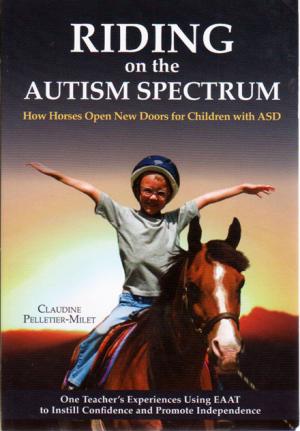
Riding on the Autism Spectrum: How Horses Open New Doors for Children of ASDby Claudine Pelletier-Milet provides valuable insight about how horseback riding can help autistic individuals achieve progress in many areas: social, emotional, physical, communication, and more. Sometimes the book reads more like a scholarly textbook, and it is translated from French, so possibly a bit of style may have been lost in translation. Compared to Rupert Isaacson’s Horse Boy, the documentary of his family’s trek through Mongolia on horseback to find help for his autistic son, Pelletier-Milet’s book seems almost studious. Isaccson’s account of his son’s autism and how he was helped by horses reads like a novel full of interesting experiences and beautifully described scenes. But Isaccson is a travel writer by profession.
Pelletier-Milet is a riding instructor and horse trainer. Her book is not boring by any means, but it’s meant to be instructive rather than entertaining. Interspersed with case studies and excerpts from her journals, the author reveals her intuitive methods of working with autistic persons, who are usually considered to be outside the mainstream. She draws from a wide base of theory and knowledge of child development and child psychiatry, psychology, and education. Her insight, after thirty years experience in equine-assisted therapy, has allowed her to develop a rather unique method of working with autistic children and horses. Her journal accounts reveal the methods that have led to breakthroughs for some of her students. The Publisher’s and Author’s Notes at the beginning of the book are helpful for understanding her departure point.
Pelletier-Milet looks at autism’s characteristics and how working with horses can help a child overcome some of the most debilitating ones. Autistic children are cut off from relationships with others, from understanding their place in the world. She emphasizes that horses help establish connections to the world, and she observes that horses have a subtle way of communicating to autistic individuals. In case after case, the rocking motion of their gait seems to be key: allowing the child to discover new sensations and gain a sense of self awareness and independence. This, in turn, fosters language and behavioral changes. I recommend this book for giving insight to those who are seriously trying to learn about autism.
Riding on the Autism Spectrum: How Horses Open New Doors for Children of ASDby Claudine Pelletier-Milet provides valuable insight about how horseback riding can help autistic individuals achieve progress in many areas: social, emotional, physical, communication, and more. Sometimes the book reads more like a scholarly textbook, and it is translated from French, so possibly a bit of style may have been lost in translation. Compared to Rupert Isaacson’s Horse Boy, the documentary of his family’s trek through Mongolia on horseback to find help for his autistic son, Pelletier-Milet’s book seems almost studious. Isaccson’s account of his son’s autism and how he was helped by horses reads like a novel full of interesting experiences and beautifully described scenes. But Isaccson is a travel writer by profession.
Pelletier-Milet is a riding instructor and horse trainer. Her book is not boring by any means, but it’s meant to be instructive rather than entertaining. Interspersed with case studies and excerpts from her journals, the author reveals her intuitive methods of working with autistic persons, who are usually considered to be outside the mainstream. She draws from a wide base of theory and knowledge of child development and child psychiatry, psychology, and education. Her insight, after thirty years experience in equine-assisted therapy, has allowed her to develop a rather unique method of working with autistic children and horses. Her journal accounts reveal the methods that have led to breakthroughs for some of her students. The Publisher’s and Author’s Notes at the beginning of the book are helpful for understanding her departure point.
Pelletier-Milet looks at autism’s characteristics and how working with horses can help a child overcome some of the most debilitating ones. Autistic children are cut off from relationships with others, from understanding their place in the world. She emphasizes that horses help establish connections to the world, and she observes that horses have a subtle way of communicating to autistic individuals. In case after case, the rocking motion of their gait seems to be key: allowing the child to discover new sensations and gain a sense of self awareness and independence. This, in turn, fosters language and behavioral changes. I recommend this book for giving insight to those who are seriously trying to learn about autism.


