

Article & photos by Tommy Brannon
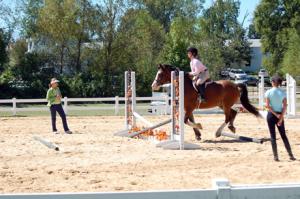
Olympic Equestrian Melanie Smith Taylor gave a two day jumping clinic September 22-23 at Oak View Stables near Olive Branch, MS. Group classes were for beginners to advanced, and all groups rode both days.
Melanie first familiarized herself with each rider so that she could address them by name throughout the class. She used several exercises and grid patterns to evaluate the horse’s response to the rider. She stressed the need for both rider and horse to always be balanced, even when standing still. She expected the riders to keep their horse focused, looking forward and standing square inside an imaginary rectangle, even when standing relaxed. “When your horse is square he is more comfortable. We have to help our horses find their balance. Do not let them look off. Watch their ears, tail, and mouth. A horse can only talk to us through their sign language. Keep them mentally with you. When you have a loose rein, keep him straight. It is the anticipation of an aid, not the aid, that makes him go,” Taylor explained.
She asked the class, “What are the most important qualities of a rider?” Her answer: “Balance, awareness, and feeling. Feeling is the most important one to me. You get a better feel through awareness. The feeling gives you timing, thus accuracy. Stay in the moment. Leave homework and Saturday night’s plans in the barn,” she emphasized. “You need energy from the horse – top down sports car, wind in your hair kind of energy!”
She had the riders repeatedly drop and pick up their stirrups while working both on the flat and jumping. When asking for a shoulder-in at a sitting trot she commented, “The shoulder-in supples the front end and builds strength in the hindquarters. In order for him to be straight, he has to get crooked. The shoulder-in is the first stride of a circle and the haunches-in is the last stride. These are two completely different movements.” She added, “Lateral movements should have a cadence and rhythm just like forward movements. Counter bend then straighten, then counter bend and straighten again, repeating the movement, to get the shoulders even.”
She moved into the jumping phase of the class and had the riders jump four low cross rails positioned in the four points of a circle. She directed each rider while on the course to jump and turn right or left, trot, canter, or stop on command. Her directions: “Let the horse jump up to you to close the angle. Do not lean in. The rider’s position on low jumps should be the same as posting. Less is always more. Focus on doing less.” She emphasized repeatedly, “Ride to the center, ride to the center.” She added, “The frequency of the jumps in an exercise helps your horse find his rhythm. The key is for the horse’s timing and yours to be in sync.” She commented to one rider that her horse needed more energy to increase stride. “You need to step him up a little more. A rider needs to be astute, be aware of the quality of the canter.”
She commented about the clashing of aids. One rider was using a single rein with a gag bit and a running martingale. Taylor said the gag forces the horse to raise his head, while at the same time the martingale is trying to lower his head. “Only use a gag with double rains; that way you can have contact with the upper rein only.” A comment to another rider was, “Spurring and pulling back at the same time is a clashing of aids.”
She had the riders go through a course that included oxers, post and rail jumps, as well as a low box that had to be jumped at a walk. The exercise required several turns and transitions. She told the students: “The most difficult thing for most riders is downward transitions. You cannot practice too many transitions. When applying the aids, don’t nag the horse; be clear with your aids. The more you can do sooner to get the point across, the less you have to do later. Soften when he responds. Don’t hold a grudge. The most important thing in the aid is the release. The horse learns from the release. Your eyes direct the horse where to go. The eyes look, the hand directs and the legs support. Every stride on a course is important. It’s not just about the jump, but about the approach and the departure. ”
She held up her hand and asked each rider on course to tell her how many fingers she was holding up. This kept the riders’ eyes focused on where to go next. “You can only feel where you are to go next when your eyes are working. The eyes are everything. We allow our horses to be dull, and to me, dull is unsafe. Anything you do with your horse affects how he acts when you ride him. You have to be consistent. Your effort everyday should be the same as in the show ring. We can make it pretty, but first we have to make it work.”
Olympic Equestrian Melanie Smith Taylor gave a two day jumping clinic September 22-23 at Oak View Stables near Olive Branch, MS. Group classes were for beginners to advanced, and all groups rode both days.
Melanie first familiarized herself with each rider so that she could address them by name throughout the class. She used several exercises and grid patterns to evaluate the horse’s response to the rider. She stressed the need for both rider and horse to always be balanced, even when standing still. She expected the riders to keep their horse focused, looking forward and standing square inside an imaginary rectangle, even when standing relaxed. “When your horse is square he is more comfortable. We have to help our horses find their balance. Do not let them look off. Watch their ears, tail, and mouth. A horse can only talk to us through their sign language. Keep them mentally with you. When you have a loose rein, keep him straight. It is the anticipation of an aid, not the aid, that makes him go,” Taylor explained.
She asked the class, “What are the most important qualities of a rider?” Her answer: “Balance, awareness, and feeling. Feeling is the most important one to me. You get a better feel through awareness. The feeling gives you timing, thus accuracy. Stay in the moment. Leave homework and Saturday night’s plans in the barn,” she emphasized. “You need energy from the horse – top down sports car, wind in your hair kind of energy!”
She had the riders repeatedly drop and pick up their stirrups while working both on the flat and jumping. When asking for a shoulder-in at a sitting trot she commented, “The shoulder-in supples the front end and builds strength in the hindquarters. In order for him to be straight, he has to get crooked. The shoulder-in is the first stride of a circle and the haunches-in is the last stride. These are two completely different movements.” She added, “Lateral movements should have a cadence and rhythm just like forward movements. Counter bend then straighten, then counter bend and straighten again, repeating the movement, to get the shoulders even.”
She moved into the jumping phase of the class and had the riders jump four low cross rails positioned in the four points of a circle. She directed each rider while on the course to jump and turn right or left, trot, canter, or stop on command. Her directions: “Let the horse jump up to you to close the angle. Do not lean in. The rider’s position on low jumps should be the same as posting. Less is always more. Focus on doing less.” She emphasized repeatedly, “Ride to the center, ride to the center.” She added, “The frequency of the jumps in an exercise helps your horse find his rhythm. The key is for the horse’s timing and yours to be in sync.” She commented to one rider that her horse needed more energy to increase stride. “You need to step him up a little more. A rider needs to be astute, be aware of the quality of the canter.”
She commented about the clashing of aids. One rider was using a single rein with a gag bit and a running martingale. Taylor said the gag forces the horse to raise his head, while at the same time the martingale is trying to lower his head. “Only use a gag with double rains; that way you can have contact with the upper rein only.” A comment to another rider was, “Spurring and pulling back at the same time is a clashing of aids.”
She had the riders go through a course that included oxers, post and rail jumps, as well as a low box that had to be jumped at a walk. The exercise required several turns and transitions. She told the students: “The most difficult thing for most riders is downward transitions. You cannot practice too many transitions. When applying the aids, don’t nag the horse; be clear with your aids. The more you can do sooner to get the point across, the less you have to do later. Soften when he responds. Don’t hold a grudge. The most important thing in the aid is the release. The horse learns from the release. Your eyes direct the horse where to go. The eyes look, the hand directs and the legs support. Every stride on a course is important. It’s not just about the jump, but about the approach and the departure. ”
She held up her hand and asked each rider on course to tell her how many fingers she was holding up. This kept the riders’ eyes focused on where to go next. “You can only feel where you are to go next when your eyes are working. The eyes are everything. We allow our horses to be dull, and to me, dull is unsafe. Anything you do with your horse affects how he acts when you ride him. You have to be consistent. Your effort everyday should be the same as in the show ring. We can make it pretty, but first we have to make it work.”


