

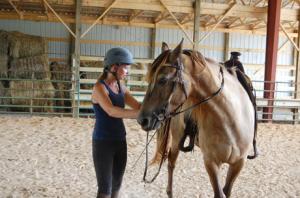
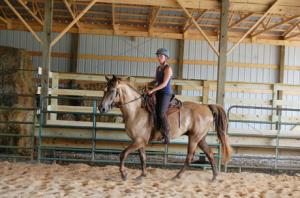
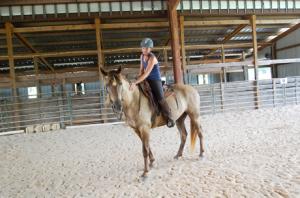
Article & photos by Nancy Brannon
Jennifer Bauer was like many horse crazy young girls, hanging out at the barn and mucking stalls just to get a ride. And like many young girls, her parents were not into horses. She grew up in Caledonia, MN, was active in 4-H, and went to the University of Wisconsin, River Falls, where earned a degree in Animal Science Equine Business. All her life she wanted a life that revolved around horses, and that life-long dream has come true.
She had the opportunity to get started correctly riding and training horses, learning the methods of legendary trainer Jack Brainard, who started the riding program at the University of Wisconsin. Jack has a passion for Cowboy Dressage, and through his friendship with Eitan Beth-Halachmy of Grass Valley, California, the two have make quite an impact on the training of gaited horses and western horses. Well known in the reining horse world, Jack was inducted into the Iowa Quarterhorse Hall of Fame in January 2010 and the National Reining Horse Association Hall of Fame in June 2010.
Jennifer with through the program started by Jack and then linked up with Larry Whitesell. She was working at a Paso Fino farm at the time she met Larry. Folks there were impressed at how the horses got calmer when Jennifer was riding them
She apprenticed with Larry, and then became his business partner at his stable in Baxter, TN, just west of Cookeville, TN. Both Jennifer and Larry teach out of the Baxter facility. “Larry has been training horses about 30 years,” Jennifer said. “Before that he was a school teacher, so he knows how to teach!” That’s a very important attribute, as Jennifer said she has met top-notch riders, who don’t know how to properly teach their methods.
Her training partnership with Larry has turned out to be a very successful one. Larry works primarily with the horse and Jennifer works primarily with the rider. Both have the goal of making both horse and rider more comfortable, mainly by helping the rider be more knowledgeable about and effective with the aids, and riding in a balanced position.
Jennifer is an internationally known gaited horse clinician. She and Larry are booked throughout the year, offering 2-day clinics with both Jennifer and Larry; 5-day clinics at their stable near Cookeville, TN, and 2-day clinics with just Jennifer or just Larry.
Trail riders are their main clients. “Many of them had a horse as a kid; then had a career and family. Now they are getting back into horses, many in their 50s and 60s, and want to ride again. But they have lost their confidence and need to get it back,” Jennifer explained.
Jennifer’s training and teaching philosophy is that a horse is a mirror image of the rider. If the rider does not know what to do or how to do something, confidence is lost in both the horse and rider. As the rider gets tools (or exercises), the rider builds confidence, and the horse follows by gaining confidence. Confidence building in both horse and rider is based on balance, rhythm, and timing. These three elements are extremely important in any horse, but especially in a gaited horse. Every exercise she uses in training the horse or teaching the rider is built on these basic ideas of balance, rhythm, and timing with confidence.
She also emphasizes the importance of the rider’s attitude toward each exercise and the horse. If a rider overreacts to the horse, the horse is going to overreact to the rider. It’s less important how the rider handles things when they are going right, but more important how the rider handles things when they are going wrong.
At the 5-day clinics, attendees bring their own horses and stable there. Jennifer and Larry help “tune up” both rider and horse, with Jennifer focusing mainly on the rider and Larry focusing on training the horse. They have three schooling horses for riders to learn what a proper aid and response feel like, so they know what to look for in their own horse.
They also have “finished” horses, which take a little more perfection from the rider. “Some of our clients have to learn how to canter. With the finished horses, I can give the cue to canter so the client can easily learn how to sit it,” Jennifer said.
“We also teach clients how to ride properly on the trail, especially going up and down hills,” Jennifer added. “We work them through obstacles they might encounter, and get them in the water.” She works with the horses to help them “loosen down” and loosen their back.
Some of the typical problems they see and help correct are: “We see a lot of horses running through the bridle,” Jennifer said. “And riders not understanding that the bridle is connected the horses’ feet, only the head. Being able to soften, turn, stop, and slow are important. The bridle is to help create a frame. So we work with getting the horse to understand the aids and what the bridle and legs mean. We do not work on the gait, per se. But after the horse understands the aids, responds and softens to the aids, the gait automatically improves.
“Whenever the horses pace, that means they are locked down in the back somewhere. We try to figure out how to unlock that place in their back. Bringing them back to the walk when they pace does not accomplish the purpose of stopping the pace; it’s the wrong approach. It actually teaches them that if they pace, they get to come back to walk.
“If the gaited horse trots, that means the horse is ‘strung out,’ not collected; or the rider’s leg is weak and ineffective.
As one might expect, with basic training from Jack Brainard, Jennifer is a student of classical dressage and uses classical dressage methods in training gaited horses. She even has the dressage letters around her indoor arena. “It makes the horse so much better!” she emphasized. “I use the same techniques as in the trotting horse,” flexion, bending, etc. “You just can’t go as deep into the shoulder-in with the gaited horse because they always have one foot on the ground. There is no moment of suspension, as with the trotting horse. I do shoulder fore and a lot of lateral work.”
Larry also learned classical dressage – from Dominique Barbier. “For many years Larry showed a lot and was very successful. He could do anything with horses, but he felt his horses didn’t like him. He saw how Barbier’s horses liked him and wanted to do anything for him. Larry wanted that relationship with horses, too,” Jennifer explained. Barbier believes in keeping a horse “light and happy,” and he focuses on the importance of mental communication and the understanding of the horse's nature.
“With riders, we work on position and understanding the aids. Where is your seat? What are leg aids? When you use your calf, what does that mean to the horse? What are rein aids? Many riders don’t have these basics,” Jennifer said. “The riders need to get into a position where they can use the aids effectively.”
“We work on balance, and getting riders out of the ‘chair seat’! We get the riders in a balanced position.” Jennifer continued. “Women have a natural arch in their backs. When they exaggerate this arch, they stiffen. Men have a naturally flat back, but tend to lean back in the saddle.”
“We also work on saddle fit. So many saddles are made for men. But for women, they need a little bit of crown in the saddle. We can lift it a little to make them more comfortable. Now a few saddle makers are starting to make saddles specifically for women.” The crown is the roundness of the bar side to side. “The majority of women who sit in my saddle love it! I spent hours with the saddle maker making it right!” Jennifer said.
“The crown of the saddle is where you want to concentrate on fit for the rider – in the ground seat. When you get the ground seat right, you don’t need extra padding on the saddle. You can ride without it hurting your hips or your seat.” Poor ground seats that force the rider’s weight to be in an unbalanced position can cause all sorts of problems. Especially common is the seat that throws the rider’s weight to the base of the cantle. If the ground seat is built to place the rider straight, there shouldn’t be a problem with fit.
Jennifer’s and Larry’s stabling facility has several amenities: a 60 foot breaking round pen; a 100 foot round pen; an indoor arena attached to the stalls; stabling for 12 horses; and plenty of turn out pastures. There is a trail obstacle course, including a bridge, tarp, creek, chicken coop (with live chickens), logs and other natural obstacles.
An interesting technique that Jennifer uses with horses who easily get bored is to teach them to pony another horse. “That gives them a job to do and their interest and attitude improves!”
Jennifer has attained the position that every horse crazy girl dreams of: to ride horses every day and get paid for doing it. But she’s not just riding, she’s working to get the best the horse is capable of doing. “Larry is the only trainer I’ve met who doesn’t think he knows it all,” she said. “He never hides things from you, as some other trainers do; he’s very authentic. And he’s always learning something new. He told me he wants me to be better than him, but I’ve got to keep learning, too, to keep up with him!”
For more information about training with Jennifer Bauer and Larry Whitesell, visit these websites:
http://www.gaitedhorsemanship.com/ and http://whitesellgaitedhorsemanship.com/ Their stable is located at 450 Lance Drive, Baxter, TN. You can reach Jennifer by phone at 931-267-6723 or by E-mail: info@gaitedhorsemanship.com.
For information about Dominique Barbier, visit: http://www.dominiquebarbier.net/
For information about Jack Brainard, visit: http://www.jackbrainard.com
Jennifer Bauer was like many horse crazy young girls, hanging out at the barn and mucking stalls just to get a ride. And like many young girls, her parents were not into horses. She grew up in Caledonia, MN, was active in 4-H, and went to the University of Wisconsin, River Falls, where earned a degree in Animal Science Equine Business. All her life she wanted a life that revolved around horses, and that life-long dream has come true.
She had the opportunity to get started correctly riding and training horses, learning the methods of legendary trainer Jack Brainard, who started the riding program at the University of Wisconsin. Jack has a passion for Cowboy Dressage, and through his friendship with Eitan Beth-Halachmy of Grass Valley, California, the two have make quite an impact on the training of gaited horses and western horses. Well known in the reining horse world, Jack was inducted into the Iowa Quarterhorse Hall of Fame in January 2010 and the National Reining Horse Association Hall of Fame in June 2010.
Jennifer with through the program started by Jack and then linked up with Larry Whitesell. She was working at a Paso Fino farm at the time she met Larry. Folks there were impressed at how the horses got calmer when Jennifer was riding them
She apprenticed with Larry, and then became his business partner at his stable in Baxter, TN, just west of Cookeville, TN. Both Jennifer and Larry teach out of the Baxter facility. “Larry has been training horses about 30 years,” Jennifer said. “Before that he was a school teacher, so he knows how to teach!” That’s a very important attribute, as Jennifer said she has met top-notch riders, who don’t know how to properly teach their methods.
Her training partnership with Larry has turned out to be a very successful one. Larry works primarily with the horse and Jennifer works primarily with the rider. Both have the goal of making both horse and rider more comfortable, mainly by helping the rider be more knowledgeable about and effective with the aids, and riding in a balanced position.
Jennifer is an internationally known gaited horse clinician. She and Larry are booked throughout the year, offering 2-day clinics with both Jennifer and Larry; 5-day clinics at their stable near Cookeville, TN, and 2-day clinics with just Jennifer or just Larry.
Trail riders are their main clients. “Many of them had a horse as a kid; then had a career and family. Now they are getting back into horses, many in their 50s and 60s, and want to ride again. But they have lost their confidence and need to get it back,” Jennifer explained.
Jennifer’s training and teaching philosophy is that a horse is a mirror image of the rider. If the rider does not know what to do or how to do something, confidence is lost in both the horse and rider. As the rider gets tools (or exercises), the rider builds confidence, and the horse follows by gaining confidence. Confidence building in both horse and rider is based on balance, rhythm, and timing. These three elements are extremely important in any horse, but especially in a gaited horse. Every exercise she uses in training the horse or teaching the rider is built on these basic ideas of balance, rhythm, and timing with confidence.
She also emphasizes the importance of the rider’s attitude toward each exercise and the horse. If a rider overreacts to the horse, the horse is going to overreact to the rider. It’s less important how the rider handles things when they are going right, but more important how the rider handles things when they are going wrong.
At the 5-day clinics, attendees bring their own horses and stable there. Jennifer and Larry help “tune up” both rider and horse, with Jennifer focusing mainly on the rider and Larry focusing on training the horse. They have three schooling horses for riders to learn what a proper aid and response feel like, so they know what to look for in their own horse.
They also have “finished” horses, which take a little more perfection from the rider. “Some of our clients have to learn how to canter. With the finished horses, I can give the cue to canter so the client can easily learn how to sit it,” Jennifer said.
“We also teach clients how to ride properly on the trail, especially going up and down hills,” Jennifer added. “We work them through obstacles they might encounter, and get them in the water.” She works with the horses to help them “loosen down” and loosen their back.
Some of the typical problems they see and help correct are: “We see a lot of horses running through the bridle,” Jennifer said. “And riders not understanding that the bridle is connected the horses’ feet, only the head. Being able to soften, turn, stop, and slow are important. The bridle is to help create a frame. So we work with getting the horse to understand the aids and what the bridle and legs mean. We do not work on the gait, per se. But after the horse understands the aids, responds and softens to the aids, the gait automatically improves.
“Whenever the horses pace, that means they are locked down in the back somewhere. We try to figure out how to unlock that place in their back. Bringing them back to the walk when they pace does not accomplish the purpose of stopping the pace; it’s the wrong approach. It actually teaches them that if they pace, they get to come back to walk.
“If the gaited horse trots, that means the horse is ‘strung out,’ not collected; or the rider’s leg is weak and ineffective.
As one might expect, with basic training from Jack Brainard, Jennifer is a student of classical dressage and uses classical dressage methods in training gaited horses. She even has the dressage letters around her indoor arena. “It makes the horse so much better!” she emphasized. “I use the same techniques as in the trotting horse,” flexion, bending, etc. “You just can’t go as deep into the shoulder-in with the gaited horse because they always have one foot on the ground. There is no moment of suspension, as with the trotting horse. I do shoulder fore and a lot of lateral work.”
Larry also learned classical dressage – from Dominique Barbier. “For many years Larry showed a lot and was very successful. He could do anything with horses, but he felt his horses didn’t like him. He saw how Barbier’s horses liked him and wanted to do anything for him. Larry wanted that relationship with horses, too,” Jennifer explained. Barbier believes in keeping a horse “light and happy,” and he focuses on the importance of mental communication and the understanding of the horse's nature.
“With riders, we work on position and understanding the aids. Where is your seat? What are leg aids? When you use your calf, what does that mean to the horse? What are rein aids? Many riders don’t have these basics,” Jennifer said. “The riders need to get into a position where they can use the aids effectively.”
“We work on balance, and getting riders out of the ‘chair seat’! We get the riders in a balanced position.” Jennifer continued. “Women have a natural arch in their backs. When they exaggerate this arch, they stiffen. Men have a naturally flat back, but tend to lean back in the saddle.”
“We also work on saddle fit. So many saddles are made for men. But for women, they need a little bit of crown in the saddle. We can lift it a little to make them more comfortable. Now a few saddle makers are starting to make saddles specifically for women.” The crown is the roundness of the bar side to side. “The majority of women who sit in my saddle love it! I spent hours with the saddle maker making it right!” Jennifer said.
“The crown of the saddle is where you want to concentrate on fit for the rider – in the ground seat. When you get the ground seat right, you don’t need extra padding on the saddle. You can ride without it hurting your hips or your seat.” Poor ground seats that force the rider’s weight to be in an unbalanced position can cause all sorts of problems. Especially common is the seat that throws the rider’s weight to the base of the cantle. If the ground seat is built to place the rider straight, there shouldn’t be a problem with fit.
Jennifer’s and Larry’s stabling facility has several amenities: a 60 foot breaking round pen; a 100 foot round pen; an indoor arena attached to the stalls; stabling for 12 horses; and plenty of turn out pastures. There is a trail obstacle course, including a bridge, tarp, creek, chicken coop (with live chickens), logs and other natural obstacles.
An interesting technique that Jennifer uses with horses who easily get bored is to teach them to pony another horse. “That gives them a job to do and their interest and attitude improves!”
Jennifer has attained the position that every horse crazy girl dreams of: to ride horses every day and get paid for doing it. But she’s not just riding, she’s working to get the best the horse is capable of doing. “Larry is the only trainer I’ve met who doesn’t think he knows it all,” she said. “He never hides things from you, as some other trainers do; he’s very authentic. And he’s always learning something new. He told me he wants me to be better than him, but I’ve got to keep learning, too, to keep up with him!”
For more information about training with Jennifer Bauer and Larry Whitesell, visit these websites:
http://www.gaitedhorsemanship.com/ and http://whitesellgaitedhorsemanship.com/ Their stable is located at 450 Lance Drive, Baxter, TN. You can reach Jennifer by phone at 931-267-6723 or by E-mail: info@gaitedhorsemanship.com.
For information about Dominique Barbier, visit: http://www.dominiquebarbier.net/
For information about Jack Brainard, visit: http://www.jackbrainard.com


