

Test Your Jumping Position
By Wendy Murdoch
Copyright© 2012. All rights reserved.
Do you fall forward when riding over fences? Get left behind? Have trouble releasing your horse over the jump? Does your horse consistently take a rail down? Here’s a quick test to find out if your jumping position is optimal.
Next time you ride, observe your jumping position. Do you fold at the waist? Do you pull your shoulders back to sit up only to find that you get pitched forward? Are your heels down but are unstable over jumps? Does your horse hollow his back on approach, take off, or landing? The ability for your horse to jump correctly is directly related to how you use your body.
In a good jumping position the rider’s body forms a series of angles to absorb the horse’s movement. The back is flat with a clean fold at the hips. The pelvis counterbalances the upper body. The amount of fold at the hip is dependent on the length of the stirrups and height of the fence. But if you are trying to achieve a “pose” rather than a “function” your position may be the cause of your troubles.
To find out how balanced your jumping position is do the following exercise. Find a lightweight plastic chair. From behind, grasp the chair with your thumbs and fingers palms down. Assume your jumping position. Do you fold at the hips or the waist? Notice how much weight you place on the chair. Put your heels down (toes up as you are standing on the ground) the way you do on your stirrups. Do you lean onto the chair for support? If so you are relying on your horse’s mouth to stabilize your position.
Intentionally fold at your waist and feel how the pressure on the chair increases. Round your back and feel how much you lean on the chair. Make your back flat, folding at the hips, knees and ankles, and feel how this decreases your lean.
Next, attempt to lift the chair off the ground. You only need to lift about 1 inch because you are only interested in the initial effort to lift. In your jumping position, is it possible to lift the chair? Flatten your back, fold at the hips and find out what happens. Do you need to step closer or further away to make it possible? Experiment with your distance from the chair. Standing too far away is the same as leaning forward onto the horse’s neck, instead of balancing over your feet. Notice if you straighten your legs or bend in the knees when you attempt to lift.
Hollow (arch) your back and try to lift the chair again. Notice how your body weight goes forward pushing the chair down as you are trying to raise it off the ground! This jumping style puts your weight onto your horse’s forehand.
Round your back and again attempt to lift the chair. You have to use a lot of upper back strength to lift in this position. Feel what happens to your shoulders and neck. Return to the flat back position and, as you lift allow, your knees to bend moving in a forward down direction. This will keep you close to the horse, away from the neck, and allow the horse to lift the front end without unnecessary effort.
Use this Murdoch Minute to test your jumping position. Experiment with different ideas while you attempt to lift the chair to feel which is the easiest. When you ride your horse, remember what you learned and find out how he responds to your improved position.
Wendy Murdoch resides in Washington, VA. She teaches riders of all levels and disciplines how to improve the horse’s performance by improving their body position. Her book, 50 5-Minute Fixes to Improve Your Riding, based on the Murdoch Minutes, is available at www.murdochmethod.com. On-line join Wendy’s Facebook group Fans of the Murdoch Method and find more articles and her blog at www: murdochmethod.com.
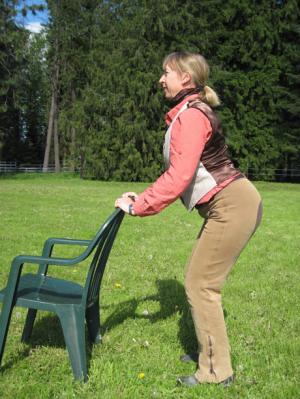
Photo 1. With my back hollow and shoulders pulled back my weight is forward on the chair. I cannot lift it off the ground. Notice how my wrists have dropped down and my hips are closed more than my body angle also indicating that my weight is on the chair and therefore on the horse’s forehand.
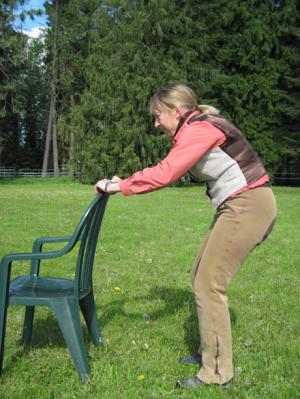
Photo 2. I have rounded my back. To lift the chair I have to use my upper back, shoulders and neck, which is not easy. Notice that my hip joints are overly open.
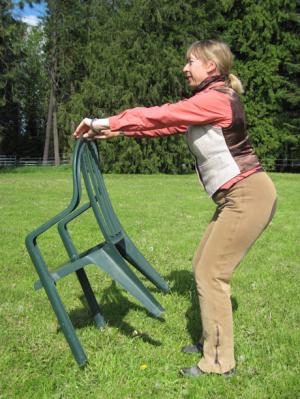
Photo 3. With my back flat and pelvis counterbalancing my upper body I am easily able to lift the chair.
By Wendy Murdoch
Copyright© 2012. All rights reserved.
Do you fall forward when riding over fences? Get left behind? Have trouble releasing your horse over the jump? Does your horse consistently take a rail down? Here’s a quick test to find out if your jumping position is optimal.
Next time you ride, observe your jumping position. Do you fold at the waist? Do you pull your shoulders back to sit up only to find that you get pitched forward? Are your heels down but are unstable over jumps? Does your horse hollow his back on approach, take off, or landing? The ability for your horse to jump correctly is directly related to how you use your body.
In a good jumping position the rider’s body forms a series of angles to absorb the horse’s movement. The back is flat with a clean fold at the hips. The pelvis counterbalances the upper body. The amount of fold at the hip is dependent on the length of the stirrups and height of the fence. But if you are trying to achieve a “pose” rather than a “function” your position may be the cause of your troubles.
To find out how balanced your jumping position is do the following exercise. Find a lightweight plastic chair. From behind, grasp the chair with your thumbs and fingers palms down. Assume your jumping position. Do you fold at the hips or the waist? Notice how much weight you place on the chair. Put your heels down (toes up as you are standing on the ground) the way you do on your stirrups. Do you lean onto the chair for support? If so you are relying on your horse’s mouth to stabilize your position.
Intentionally fold at your waist and feel how the pressure on the chair increases. Round your back and feel how much you lean on the chair. Make your back flat, folding at the hips, knees and ankles, and feel how this decreases your lean.
Next, attempt to lift the chair off the ground. You only need to lift about 1 inch because you are only interested in the initial effort to lift. In your jumping position, is it possible to lift the chair? Flatten your back, fold at the hips and find out what happens. Do you need to step closer or further away to make it possible? Experiment with your distance from the chair. Standing too far away is the same as leaning forward onto the horse’s neck, instead of balancing over your feet. Notice if you straighten your legs or bend in the knees when you attempt to lift.
Hollow (arch) your back and try to lift the chair again. Notice how your body weight goes forward pushing the chair down as you are trying to raise it off the ground! This jumping style puts your weight onto your horse’s forehand.
Round your back and again attempt to lift the chair. You have to use a lot of upper back strength to lift in this position. Feel what happens to your shoulders and neck. Return to the flat back position and, as you lift allow, your knees to bend moving in a forward down direction. This will keep you close to the horse, away from the neck, and allow the horse to lift the front end without unnecessary effort.
Use this Murdoch Minute to test your jumping position. Experiment with different ideas while you attempt to lift the chair to feel which is the easiest. When you ride your horse, remember what you learned and find out how he responds to your improved position.
Wendy Murdoch resides in Washington, VA. She teaches riders of all levels and disciplines how to improve the horse’s performance by improving their body position. Her book, 50 5-Minute Fixes to Improve Your Riding, based on the Murdoch Minutes, is available at www.murdochmethod.com. On-line join Wendy’s Facebook group Fans of the Murdoch Method and find more articles and her blog at www: murdochmethod.com.
Photo 1. With my back hollow and shoulders pulled back my weight is forward on the chair. I cannot lift it off the ground. Notice how my wrists have dropped down and my hips are closed more than my body angle also indicating that my weight is on the chair and therefore on the horse’s forehand.
Photo 2. I have rounded my back. To lift the chair I have to use my upper back, shoulders and neck, which is not easy. Notice that my hip joints are overly open.
Photo 3. With my back flat and pelvis counterbalancing my upper body I am easily able to lift the chair.


