


By Leigh Ballard
Five Point Farm in Rossville, Tennessee hosted a Down Under Horsemanship (DUH) clinic July 10-12, 2012. Six horse and rider teams from west Tennessee and Alabama participated in three days of training with certified clinician, Mark Tarver, of Stephenville, Texas in Clinton Anderson’s horsemanship methods and philosophy. The 3-Day Fundamentals Clinic follows Anderson’s step-by-step groundwork and round-penning process of gaining the horse’s respect and moving the horse’s feet, while always keeping a balance between sensitizing and desensitizing exercises. The DUH methods are developed to create a respectful, responsive, and willing horse.
Fortunately, the July heat wave broke, temporarily, the day before the clinic. The participants were blessed with overcast skies and relatively cool weather to work in, which was good because the round pen exercises are high action, with the horses learning to respond to pressure and the release of pressure.
The beginning fundamental round pen exercises teach the horse to “lock on” to the trainer, in this case, the clinic student. This concept of “locking on” means that the horse turns to the center of the round pen and looks at the trainer with both eyes. Initially, this exercise was challenging for both horses and people who had not done it before. By stepping in front of the horse’s driveline at the shoulder, the participants learned to stop the horse’s forward motion. Then the participants learned to turn the horse toward the inside to reverse. In this exercise, if a horse turns away for reverse, he is not getting the concept and must try again. A horse who stubbornly refuses to lock on and respect the trainer continues to be sent around the round pen until he understands how to follow the trainer’s cues. Eventually the horse follows the trainer freely of his own will as the trainer walks around the pen with his back to the horse.
Another challenging ground exercise for the horse is “circle-driving.” In this exercise, the horse is on the DUH version of a lunge line, which is a 14 foot marine rope with good weight and flexibility. The trainer reaches out his arm holding the training stick on the horse’s withers and walks forward in a small circle, keeping the horse also moving forward in this circle. The training stick is only four feet long, so the horse is very close and bent in an arc around the trainer. This exercise encourages flexibility and teaches the horse to carry himself in a balanced way. The exercise sounds and looks easy, but requires a great deal of coordination and control from the trainer, especially in the fluid reverse maneuver.
In the saddle, the exercises caused more consternation for the riders than the horses! All of the riding exercises in this clinic were done on a completely loose rein with no steering from the rider. In one exercise, the riders learned the “one-rein stop” at all gaits, going whichever direction their horse wanted to go. This was a reasonably controlled scenario in the outdoor arena since the horses were stopping frequently.
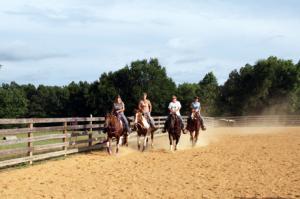
The “cruising exercise” was a real learning experience for both horses and riders. In this exercise, the horse travels wherever he wants to go, again on a loose rein with no steering from the rider. In this clinic, the horse was directed to trot for a long time, all over the outdoor arena. As you might imagine, the horses all wanted to stay in a bunched-up group. Some of the participants gritted their teeth as their horses rode tightly together, running up on each other, jamming into the corners of the arena, and generally looking like a “herd.” It was a good experience for all the riders (and horses!) who were not used to being “in traffic” and everybody was able to laugh about it when it was over.
The clinic aimed to set a good foundation for understanding the fundamentals of the Down Under Horsemanship method. The participants and their horses all came away with a much better understanding of the DUH Fundamentals. They agreed that they made great strides in their horsemanship because having a clinician working with them was much more helpful than just watching videos and trying to do it alone.
Information about Mark Tarver, other DUH clinicians, and how to host your own clinic can be found at Clinton Anderson’s Down Under Horsemanship website, www.downunderhorsemanship.com
Five Point Farm in Rossville, Tennessee hosted a Down Under Horsemanship (DUH) clinic July 10-12, 2012. Six horse and rider teams from west Tennessee and Alabama participated in three days of training with certified clinician, Mark Tarver, of Stephenville, Texas in Clinton Anderson’s horsemanship methods and philosophy. The 3-Day Fundamentals Clinic follows Anderson’s step-by-step groundwork and round-penning process of gaining the horse’s respect and moving the horse’s feet, while always keeping a balance between sensitizing and desensitizing exercises. The DUH methods are developed to create a respectful, responsive, and willing horse.
Fortunately, the July heat wave broke, temporarily, the day before the clinic. The participants were blessed with overcast skies and relatively cool weather to work in, which was good because the round pen exercises are high action, with the horses learning to respond to pressure and the release of pressure.
The beginning fundamental round pen exercises teach the horse to “lock on” to the trainer, in this case, the clinic student. This concept of “locking on” means that the horse turns to the center of the round pen and looks at the trainer with both eyes. Initially, this exercise was challenging for both horses and people who had not done it before. By stepping in front of the horse’s driveline at the shoulder, the participants learned to stop the horse’s forward motion. Then the participants learned to turn the horse toward the inside to reverse. In this exercise, if a horse turns away for reverse, he is not getting the concept and must try again. A horse who stubbornly refuses to lock on and respect the trainer continues to be sent around the round pen until he understands how to follow the trainer’s cues. Eventually the horse follows the trainer freely of his own will as the trainer walks around the pen with his back to the horse.
Another challenging ground exercise for the horse is “circle-driving.” In this exercise, the horse is on the DUH version of a lunge line, which is a 14 foot marine rope with good weight and flexibility. The trainer reaches out his arm holding the training stick on the horse’s withers and walks forward in a small circle, keeping the horse also moving forward in this circle. The training stick is only four feet long, so the horse is very close and bent in an arc around the trainer. This exercise encourages flexibility and teaches the horse to carry himself in a balanced way. The exercise sounds and looks easy, but requires a great deal of coordination and control from the trainer, especially in the fluid reverse maneuver.
In the saddle, the exercises caused more consternation for the riders than the horses! All of the riding exercises in this clinic were done on a completely loose rein with no steering from the rider. In one exercise, the riders learned the “one-rein stop” at all gaits, going whichever direction their horse wanted to go. This was a reasonably controlled scenario in the outdoor arena since the horses were stopping frequently.
The “cruising exercise” was a real learning experience for both horses and riders. In this exercise, the horse travels wherever he wants to go, again on a loose rein with no steering from the rider. In this clinic, the horse was directed to trot for a long time, all over the outdoor arena. As you might imagine, the horses all wanted to stay in a bunched-up group. Some of the participants gritted their teeth as their horses rode tightly together, running up on each other, jamming into the corners of the arena, and generally looking like a “herd.” It was a good experience for all the riders (and horses!) who were not used to being “in traffic” and everybody was able to laugh about it when it was over.
The clinic aimed to set a good foundation for understanding the fundamentals of the Down Under Horsemanship method. The participants and their horses all came away with a much better understanding of the DUH Fundamentals. They agreed that they made great strides in their horsemanship because having a clinician working with them was much more helpful than just watching videos and trying to do it alone.
Information about Mark Tarver, other DUH clinicians, and how to host your own clinic can be found at Clinton Anderson’s Down Under Horsemanship website, www.downunderhorsemanship.com


