

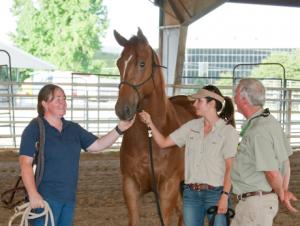
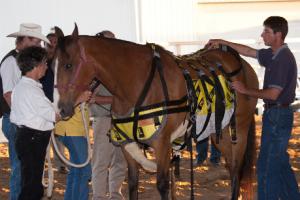
The UT Extension in Shelby County hosted a Large Animal Emergency Rescue Seminar May 22, at the Agricenter Showplace Arena in Memphis, TN. The seminar was open to anyone interested in learning about human safety in a disaster when dealing with large animals and large animal emergency preparedness. The seminar had two themes: First, preparing the human as the first line of help for animals in an emergency. Second, informing the community about the services and personnel, such as Disaster Animal Response Team (DART),that can be called on in an emergency. Jennifer Dunlap, DVM discussed various disaster scenarios such as floods, barn fires and tornados in a classroom presentation. UT Extension agent Becky Muller, staff, volunteers, and the Disaster Animal Response Team (DART)team then demonstrated some of the rescue equipment that can be usedduring disasters.
Some large animal rescue equipment available for participants to check out included the portable corral, with chute, which can temporarily house cattle or horses. This corral can be loaded, disassembled onto a trailer, and set up bytwo people. The corral can be configured into different shapes on uneven ground,such as the side of a highway.
Also on display were large animal glides, an equine first aid kit, and captive bolt gun. They demonstrated harnessing a demo horse with the Anderson Sling, whichis used to airlift a horse by a helicopter. The sling is engineered with numerous parts that help to distribute the horse’s weight for maximum safety. This equipment is available through DART to emergency personnel in Shelby County and adjacent counties in Tennessee, Mississippi and Arkansas.
Dr. Dunlap advisedbeing prepared for general types of equine emergenciesandstressed, “During an emergency there is no time to prepare;you must simply react.”She also advised, “Leave your ego at home. The person who knows the most should be the one in charge”
First, the human must be properly equipped. “You must be properly clothed, shod and hydrated. You can't help your horse if you are cold and hypothermic.Don't be afraid to ask for help if the situation isbeyond your capabilities.”
Second, keep yourbarn clean and free of debris for easy evacuation. Have appropriate halters and lead ropes by each stall. Dr. Dunlap does not consider a nylon halter and lead rope appropriatebecause,“It can melt as you evacuate in a fire. You want a nice cotton leadropewith a brass clasp.” A leather halter is preferred.
Horse owners have the task of stockpiling two weeks of food and water for you and your horses. The stored water should be rotated every two weeks to keep it fresh.
If you have to leave your horse in a disaster,you should leave the horse’s information, but not the original Coggins test,on the cheekpiece of the horse’s leatherhalterin a luggage tag. She warned that attaching the Coggins to the horse is a transportation ticket for a horse thief. She also suggested braiding a luggage tag containing this information into his tail. If you have properly prepared, you will also have the horse microchipped and a photo of your horse taken with your family members. This photo will help prove ownership when you try to get your horse back later.
If you have to leave them behind, have a large sign by your driveway stating the number and particulars of the animals which are left. Another sign large enough to be read from a search airplane should say, “Have animals, need help”or “Have animals, OK for now.”
Your disaster plan should include a network of people to call on, startingwith your immediate neighbors. Get toknow other people who have trucks and trailers, even if you own these things yourselves. Your network also should include government services,whichcan be accessedthrough a call to your local police.
Since the pain and suffering from Hurricane Katrina magnified the need for government funded programs,more services are available. In the aftermath of this disasteran ammendment was added to The Stafford Act, called the Pets Evacuation and Transportation Standards Act (PETS Act),which requires states seeking Federal Emergency Management Agency (FEMA) assistance to accommodate pets and service animals in theirplans for evacuations.
A 12-page guide for disaster preparedness written by Dr. Dunlap that was distributed at the seminar, is available on her website www.dunlapequineservices.com/Disaster_Preparedness_For_Horse_Owners.pdf
The University of Tennessee Extension Service offers its programs to all eligible persons regardless of race, color, national origin, sex, age or disability. Please call Becky Muller at 752-1207 or email at beckymuller@utk.edu with any questions.
Some large animal rescue equipment available for participants to check out included the portable corral, with chute, which can temporarily house cattle or horses. This corral can be loaded, disassembled onto a trailer, and set up bytwo people. The corral can be configured into different shapes on uneven ground,such as the side of a highway.
Also on display were large animal glides, an equine first aid kit, and captive bolt gun. They demonstrated harnessing a demo horse with the Anderson Sling, whichis used to airlift a horse by a helicopter. The sling is engineered with numerous parts that help to distribute the horse’s weight for maximum safety. This equipment is available through DART to emergency personnel in Shelby County and adjacent counties in Tennessee, Mississippi and Arkansas.
Dr. Dunlap advisedbeing prepared for general types of equine emergenciesandstressed, “During an emergency there is no time to prepare;you must simply react.”She also advised, “Leave your ego at home. The person who knows the most should be the one in charge”
First, the human must be properly equipped. “You must be properly clothed, shod and hydrated. You can't help your horse if you are cold and hypothermic.Don't be afraid to ask for help if the situation isbeyond your capabilities.”
Second, keep yourbarn clean and free of debris for easy evacuation. Have appropriate halters and lead ropes by each stall. Dr. Dunlap does not consider a nylon halter and lead rope appropriatebecause,“It can melt as you evacuate in a fire. You want a nice cotton leadropewith a brass clasp.” A leather halter is preferred.
Horse owners have the task of stockpiling two weeks of food and water for you and your horses. The stored water should be rotated every two weeks to keep it fresh.
If you have to leave your horse in a disaster,you should leave the horse’s information, but not the original Coggins test,on the cheekpiece of the horse’s leatherhalterin a luggage tag. She warned that attaching the Coggins to the horse is a transportation ticket for a horse thief. She also suggested braiding a luggage tag containing this information into his tail. If you have properly prepared, you will also have the horse microchipped and a photo of your horse taken with your family members. This photo will help prove ownership when you try to get your horse back later.
If you have to leave them behind, have a large sign by your driveway stating the number and particulars of the animals which are left. Another sign large enough to be read from a search airplane should say, “Have animals, need help”or “Have animals, OK for now.”
Your disaster plan should include a network of people to call on, startingwith your immediate neighbors. Get toknow other people who have trucks and trailers, even if you own these things yourselves. Your network also should include government services,whichcan be accessedthrough a call to your local police.
Since the pain and suffering from Hurricane Katrina magnified the need for government funded programs,more services are available. In the aftermath of this disasteran ammendment was added to The Stafford Act, called the Pets Evacuation and Transportation Standards Act (PETS Act),which requires states seeking Federal Emergency Management Agency (FEMA) assistance to accommodate pets and service animals in theirplans for evacuations.
A 12-page guide for disaster preparedness written by Dr. Dunlap that was distributed at the seminar, is available on her website www.dunlapequineservices.com/Disaster_Preparedness_For_Horse_Owners.pdf
The University of Tennessee Extension Service offers its programs to all eligible persons regardless of race, color, national origin, sex, age or disability. Please call Becky Muller at 752-1207 or email at beckymuller@utk.edu with any questions.


