

By Lisa Sparks
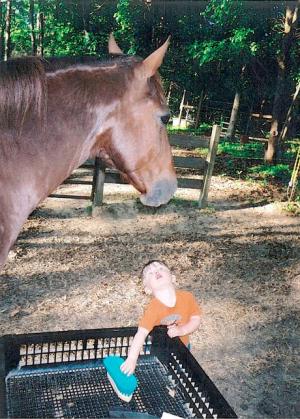
During the month of June, 2011 Fellowship of the Hoof offered a horse communication camp experience for pre-teens and teens. The pilot project was held Monday through Friday from 7:30am – 11:30am during the hot, dusty days of June. There was no promise of riding; just round penning and ground work with rope halters that required extra dexterity, sticks that were too long, horses that were sometimes too tall, and gates that had chain latches. Nothing was designed for the child in mind except the playfulness and curiosity of the horses. Picking up the horses feet required a lot of effort, as well as reaching up to comb their mane. How do you move a horse’s front end over if you only weigh 60 pounds?
But the horse communication camp taught children to address the basic needs of riding through the way we relate to horses: in leading, haltering, grooming, changing sides, asking the hind quarters to move over, asking the front end to move over, backing up, lunging, saddling and bridling. When you consider the steps of preparation for riding and the way they are carried out, an attitude is produced from the horse and rider that continues throughout the ride.
There is not much exciting about these fundamentals until you put them in the hands of the play experts – children. Leading a horse is not an exciting event - until you add fun things like shower curtains, bridges and water sprinklers! Haltering becomes an opportunity to gain respect when you lower the head with the release of pressure, and switch sides with the correct use of your forearm under the horse’s chin.
Grooming can be a time of creating a “spa” environment for the horse by relaxing the poll and neck with simple massage techniques and stretching the neck with treats. Try grooming horses while they eat, using advance/retreat (coming forward then moving away) before they lay back their ears.
Moving the hind quarters over with your body bubble (personal space) can be coordinated in such a way that you can gracefully position your self at the horse’s opposite eye, leading him into a lunging position that flows like dancing the tango. When the handler stands at the front of the horse, a few steps ahead of the right or left direction, a counter turn is produced when you extend the rope and encourage with the noodle or training stick. Noodles, unlike training sticks, are less threatening to horses, thus producing a relaxed, “play” effect.
Backing up with the lead rope requires the handler to use his/her personal space to move the horse’s personal space in timing with their diagonal pair (front foot with diagonal back foot), producing a coordinated rhythm. When these exercises are combined, they flow effortlessly with a rhythm like a dance that leads to the use of music. The horses seem captivated by the change in the handler who is following the feel of the music, while they follow the feel of the handler; then a large sigh is released and they lick and chew.
The verbal limitations of the horse make them masters at non-verbal communication - body language, so the subtle vocabulary learned in working on the ground meets the horse on his own terms, allowing the horse to connect with the human before riding occurs. These little kinetic dialogues produce exponential changes in the horse’s attitude, because we have given them equal consideration in the partnership equation.
Now add the dominant tactile dynamic of a child’s learning process and the energy from within the horse begins to produce a visible outward change in the process. Fear of the unknown changes to acceptance. Awkwardness changes to flowing coordinated moves between partners. Ultimately the child feels connected to the horse; something riding can’t produce if it excludes the fundamentals of the language of the equine: through movement and feel i.e., body language. Now we are acknowledging the intelligence of a creature that lives its life in nature in the open fields of our land. When the human has the patience and will take the time to learn the horse’s language, they can be rewarded by experiencing the “good ride” through communication.
A total of 15 girls ages 7-16 came to the camp to, in their words, find a horse that they could love. Brushing the dirt off only transferred it to them, and laughter would break out during the arduous grooming from head to hindquarter to hoof. They enjoyed feeding the horses and could not resist bringing carrots, apples, and other treats. Many times the pre-set obstacle course, such as bridge crossing, would be rearranged to suit their creative point of view. A couple of tires with a plastic pole across it would be added, along with a barrel to jump. Once leading exercises were learned, running with the horse was perfected. How about bringing out the water sprinkler to add fun to getting the horse to cross over the tarp? The fence game led to mounting bareback and the human curry comb that required them to stretch out on their bellies across the top line of the horse and rub his barrel with their arms. The circle game leads to dancing with your horse to your favorite song. Round penning meant that they could create a mystical feel with the horse so that he/she would follow with comical curiosity, sometimes exhibiting the “Mr. Ed” expression.
Before the end of the week the parents planned a recital. A CD player was plugged in and lawn chairs surrounded the north half of the round pen. The recital was the children’s interpretation of all they had learned, put to music with the horse that they loved. One girl had trouble with her stick, so her father came in and assisted her, demonstrating a heart level of communication. A younger girl had a lower skill level and two others figured out a way to include her by placing her on the horse while they did the circle game. This way she could feel the horse move the front end over and the hindquarters driving. But the biggest surprise of all was demonstrated with Shadow, the unbroken horse, carrying a rider for the first time while being led by another child. The groundwork and round penning she received from the children prepared her for her first ride.
The Fellowship of the horse is offering another Horse communication Camp this June. Monday – Friday, from 7:30am – 11:30am. For more information, please contact Lisa Sparks at 901-606-7523 or by email at lmsmare@aol.com.
During the month of June, 2011 Fellowship of the Hoof offered a horse communication camp experience for pre-teens and teens. The pilot project was held Monday through Friday from 7:30am – 11:30am during the hot, dusty days of June. There was no promise of riding; just round penning and ground work with rope halters that required extra dexterity, sticks that were too long, horses that were sometimes too tall, and gates that had chain latches. Nothing was designed for the child in mind except the playfulness and curiosity of the horses. Picking up the horses feet required a lot of effort, as well as reaching up to comb their mane. How do you move a horse’s front end over if you only weigh 60 pounds?
But the horse communication camp taught children to address the basic needs of riding through the way we relate to horses: in leading, haltering, grooming, changing sides, asking the hind quarters to move over, asking the front end to move over, backing up, lunging, saddling and bridling. When you consider the steps of preparation for riding and the way they are carried out, an attitude is produced from the horse and rider that continues throughout the ride.
There is not much exciting about these fundamentals until you put them in the hands of the play experts – children. Leading a horse is not an exciting event - until you add fun things like shower curtains, bridges and water sprinklers! Haltering becomes an opportunity to gain respect when you lower the head with the release of pressure, and switch sides with the correct use of your forearm under the horse’s chin.
Grooming can be a time of creating a “spa” environment for the horse by relaxing the poll and neck with simple massage techniques and stretching the neck with treats. Try grooming horses while they eat, using advance/retreat (coming forward then moving away) before they lay back their ears.
Moving the hind quarters over with your body bubble (personal space) can be coordinated in such a way that you can gracefully position your self at the horse’s opposite eye, leading him into a lunging position that flows like dancing the tango. When the handler stands at the front of the horse, a few steps ahead of the right or left direction, a counter turn is produced when you extend the rope and encourage with the noodle or training stick. Noodles, unlike training sticks, are less threatening to horses, thus producing a relaxed, “play” effect.
Backing up with the lead rope requires the handler to use his/her personal space to move the horse’s personal space in timing with their diagonal pair (front foot with diagonal back foot), producing a coordinated rhythm. When these exercises are combined, they flow effortlessly with a rhythm like a dance that leads to the use of music. The horses seem captivated by the change in the handler who is following the feel of the music, while they follow the feel of the handler; then a large sigh is released and they lick and chew.
The verbal limitations of the horse make them masters at non-verbal communication - body language, so the subtle vocabulary learned in working on the ground meets the horse on his own terms, allowing the horse to connect with the human before riding occurs. These little kinetic dialogues produce exponential changes in the horse’s attitude, because we have given them equal consideration in the partnership equation.
Now add the dominant tactile dynamic of a child’s learning process and the energy from within the horse begins to produce a visible outward change in the process. Fear of the unknown changes to acceptance. Awkwardness changes to flowing coordinated moves between partners. Ultimately the child feels connected to the horse; something riding can’t produce if it excludes the fundamentals of the language of the equine: through movement and feel i.e., body language. Now we are acknowledging the intelligence of a creature that lives its life in nature in the open fields of our land. When the human has the patience and will take the time to learn the horse’s language, they can be rewarded by experiencing the “good ride” through communication.
A total of 15 girls ages 7-16 came to the camp to, in their words, find a horse that they could love. Brushing the dirt off only transferred it to them, and laughter would break out during the arduous grooming from head to hindquarter to hoof. They enjoyed feeding the horses and could not resist bringing carrots, apples, and other treats. Many times the pre-set obstacle course, such as bridge crossing, would be rearranged to suit their creative point of view. A couple of tires with a plastic pole across it would be added, along with a barrel to jump. Once leading exercises were learned, running with the horse was perfected. How about bringing out the water sprinkler to add fun to getting the horse to cross over the tarp? The fence game led to mounting bareback and the human curry comb that required them to stretch out on their bellies across the top line of the horse and rub his barrel with their arms. The circle game leads to dancing with your horse to your favorite song. Round penning meant that they could create a mystical feel with the horse so that he/she would follow with comical curiosity, sometimes exhibiting the “Mr. Ed” expression.
Before the end of the week the parents planned a recital. A CD player was plugged in and lawn chairs surrounded the north half of the round pen. The recital was the children’s interpretation of all they had learned, put to music with the horse that they loved. One girl had trouble with her stick, so her father came in and assisted her, demonstrating a heart level of communication. A younger girl had a lower skill level and two others figured out a way to include her by placing her on the horse while they did the circle game. This way she could feel the horse move the front end over and the hindquarters driving. But the biggest surprise of all was demonstrated with Shadow, the unbroken horse, carrying a rider for the first time while being led by another child. The groundwork and round penning she received from the children prepared her for her first ride.
The Fellowship of the horse is offering another Horse communication Camp this June. Monday – Friday, from 7:30am – 11:30am. For more information, please contact Lisa Sparks at 901-606-7523 or by email at lmsmare@aol.com.


