

By Tommy Brannon
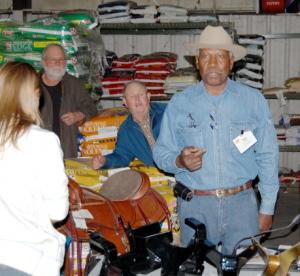
R&J Feed Supply in Jackson, Tennessee hosted a horse information seminar on April 17, 2012. Featured speakers were: farrier Eric Wuelfing, who spoke on hoof care and hoof problems, like laminitis and founder; Jon Law of Purina Mills, on equine nutrition; Ronnie Millican of Equibrand, makers of Martin saddles, demonstrated saddle trees; and Ted Dunn, who showed participants a clever new trailer hitch receiver called D-Wyng that protects truck bumpers and makes hooking to trailers easy.
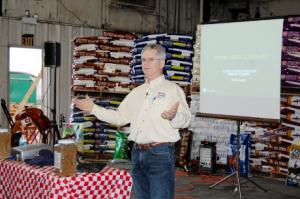
Jon Law of Purina Mills gave an informative, interactive talk on feeding horses. He used power point illustrations to show examples of the body conditioning score system and how to estimate a horse’s weight. He explained the horse’s digestive system and how it differs from other animals, and the horse’s nutritional needs based on breed and use. During his presentation, he frequently asked the audience questions. For example: How many times a day does a foal suckle its dam? The answer: an average of 70 times, far higher than anyone thought. He asked the audience about hay and forage, and how to evaluate a horse’s caloric intake.
Jon showed examples of the various equine feed products that Purina makes and how each can be used to plan a proper feeding program based on each horse’s nutritional needs. He referenced Purina’s website www.horse.purinamills.com for an easy to use feed calculator. He also mentioned that feed dealers such as R&J Feed Supply have scales available to weigh a scoop of feed, so that the proper feeding proportions can be determined.
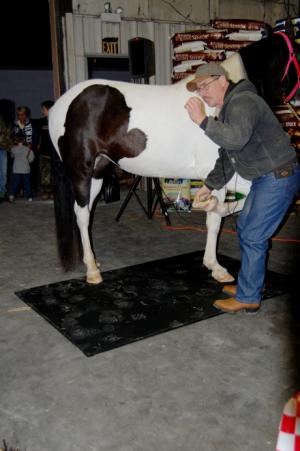
Eric Wuelfing has been shoeing horses for over 40 years, first in Colorado and now in Tennessee. He is extremely knowledgeable about hoof care, so his articulate presentation was quite informative. Eric’s emphasis was on laminitis: its causes, prevention and treatment. He used a horse that had once been foundered to show where the founder takes place. He showed the white line in the hoof, and how wide it should be in a normal hoof, as opposed to how wide it is in a foundered hoof.
Eric explained the causes of founder and laminitis. Most horse owners know that spring grasses are high in sugar and fats, and that too much grazing on spring grasses can cause founder. But that is not the only cause. A hundred different things can cause a fever. Any high fever will move heat to the feet and the heat has no way to disperse in the foot. Thus, the heat in the hoof can cause founder. So, it is important to check the hoof for heat, and cold hose or soak the hoof in cold water to aid in heat dispersion. Timing is critical! Once the laminae have separated, cold hosing to disperse the heat will not solve the problem.
Treatment and rehabilitation, if at all possible, possible, consists of a rigorous regimen of trimming every two weeks, and corrective shoeing at the proper angle to get pressure off of the coffin bone and regrow the hoof. He said that an angle change of only one degree can make a big difference. “You want to get the strain off of the front so that the horse will not compensate by putting too much strain on the back and hips,” Wuelfing explained.
A horse that has foundered once is prone to do it again. Continuous maintenance is necessary to prevent a recurrence. The diet needs to be low starch and low sugar. Timothy and Bermuda grass hays are best for a foundered horse because they are the lowest in starch and sugar.
One audience member asked about using a heart bar shoe for founder. Eric said these shoes put too much pressure on the frog. He said the egg bar is better. In addition, the feet may get dry and brittle, so regular applications of hoof dressing are necessary. He recommended using pine tar applied with a car parts cleaning brush. He said pine tar will last a week; however it will collect dust. “Don’t use it at a horse show,” he advised.
Another question was asked about an incident in which a rock went through a hoof from the top splitting the hoof. Eric demonstrated on a hoof where two quarter clips and a copper band would be placed to keep the split together.
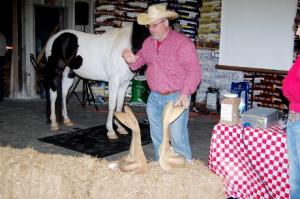
Ronnie Millican from Martin Saddles showed several types of western saddle trees. The tree is the heart of a saddle, the part that a rider never sees. The ones that Martin makes are made of wood and covered in fiberglass or rawhide.
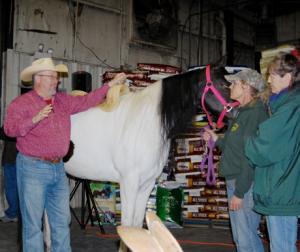
Ronnie explained the advantages and differences of both. Audience members asked about how to measure the seat in a saddle. He explained how the pelvic bone and seat anatomy of men and women are different, thus a man will fit in to a particular saddle in a different place. He said that currently saddle designs are not gender specific, but that may be coming soon. He demonstrated on a horse where the tree rests and what to look for in good saddle fitment.
Ted Dunn of One Stop Trailer Hitch showed several models of the D-Wyng trailer hitch. This device is manufactured in Tennessee of high quality powder coated steel. It is a ball receiver with wings welded behind the ball, which guide the trailer on to the ball without damaging the trailer or the truck. The D-Wyng comes in several sizes and height configurations for different sized trucks and SUVs. The D-Wyng allows one person to hook up the trailer without having to get in and out of the truck several times to check the alignment of the hitch. It is particularly good for SUVs, which have plastic bumper covers that crack when the trailer hitch hits them. R&J Feed supply is a dealer for the D-Wyng Hitch.
R&J Feed Supply in Jackson, Tennessee hosted a horse information seminar on April 17, 2012. Featured speakers were: farrier Eric Wuelfing, who spoke on hoof care and hoof problems, like laminitis and founder; Jon Law of Purina Mills, on equine nutrition; Ronnie Millican of Equibrand, makers of Martin saddles, demonstrated saddle trees; and Ted Dunn, who showed participants a clever new trailer hitch receiver called D-Wyng that protects truck bumpers and makes hooking to trailers easy.
Jon Law of Purina Mills gave an informative, interactive talk on feeding horses. He used power point illustrations to show examples of the body conditioning score system and how to estimate a horse’s weight. He explained the horse’s digestive system and how it differs from other animals, and the horse’s nutritional needs based on breed and use. During his presentation, he frequently asked the audience questions. For example: How many times a day does a foal suckle its dam? The answer: an average of 70 times, far higher than anyone thought. He asked the audience about hay and forage, and how to evaluate a horse’s caloric intake.
Jon showed examples of the various equine feed products that Purina makes and how each can be used to plan a proper feeding program based on each horse’s nutritional needs. He referenced Purina’s website www.horse.purinamills.com for an easy to use feed calculator. He also mentioned that feed dealers such as R&J Feed Supply have scales available to weigh a scoop of feed, so that the proper feeding proportions can be determined.
Eric Wuelfing has been shoeing horses for over 40 years, first in Colorado and now in Tennessee. He is extremely knowledgeable about hoof care, so his articulate presentation was quite informative. Eric’s emphasis was on laminitis: its causes, prevention and treatment. He used a horse that had once been foundered to show where the founder takes place. He showed the white line in the hoof, and how wide it should be in a normal hoof, as opposed to how wide it is in a foundered hoof.
Eric explained the causes of founder and laminitis. Most horse owners know that spring grasses are high in sugar and fats, and that too much grazing on spring grasses can cause founder. But that is not the only cause. A hundred different things can cause a fever. Any high fever will move heat to the feet and the heat has no way to disperse in the foot. Thus, the heat in the hoof can cause founder. So, it is important to check the hoof for heat, and cold hose or soak the hoof in cold water to aid in heat dispersion. Timing is critical! Once the laminae have separated, cold hosing to disperse the heat will not solve the problem.
Treatment and rehabilitation, if at all possible, possible, consists of a rigorous regimen of trimming every two weeks, and corrective shoeing at the proper angle to get pressure off of the coffin bone and regrow the hoof. He said that an angle change of only one degree can make a big difference. “You want to get the strain off of the front so that the horse will not compensate by putting too much strain on the back and hips,” Wuelfing explained.
A horse that has foundered once is prone to do it again. Continuous maintenance is necessary to prevent a recurrence. The diet needs to be low starch and low sugar. Timothy and Bermuda grass hays are best for a foundered horse because they are the lowest in starch and sugar.
One audience member asked about using a heart bar shoe for founder. Eric said these shoes put too much pressure on the frog. He said the egg bar is better. In addition, the feet may get dry and brittle, so regular applications of hoof dressing are necessary. He recommended using pine tar applied with a car parts cleaning brush. He said pine tar will last a week; however it will collect dust. “Don’t use it at a horse show,” he advised.
Another question was asked about an incident in which a rock went through a hoof from the top splitting the hoof. Eric demonstrated on a hoof where two quarter clips and a copper band would be placed to keep the split together.
Ronnie Millican from Martin Saddles showed several types of western saddle trees. The tree is the heart of a saddle, the part that a rider never sees. The ones that Martin makes are made of wood and covered in fiberglass or rawhide.
Ronnie explained the advantages and differences of both. Audience members asked about how to measure the seat in a saddle. He explained how the pelvic bone and seat anatomy of men and women are different, thus a man will fit in to a particular saddle in a different place. He said that currently saddle designs are not gender specific, but that may be coming soon. He demonstrated on a horse where the tree rests and what to look for in good saddle fitment.
Ted Dunn of One Stop Trailer Hitch showed several models of the D-Wyng trailer hitch. This device is manufactured in Tennessee of high quality powder coated steel. It is a ball receiver with wings welded behind the ball, which guide the trailer on to the ball without damaging the trailer or the truck. The D-Wyng comes in several sizes and height configurations for different sized trucks and SUVs. The D-Wyng allows one person to hook up the trailer without having to get in and out of the truck several times to check the alignment of the hitch. It is particularly good for SUVs, which have plastic bumper covers that crack when the trailer hitch hits them. R&J Feed supply is a dealer for the D-Wyng Hitch.


