

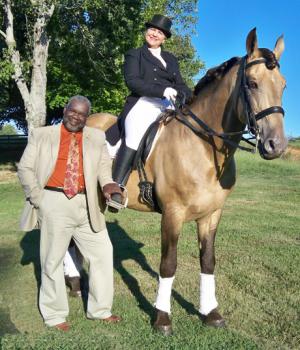
Dressage En Gait
Interview with Nathanael Jackson of Walkin On Ranch in Cookeville, TN
“…before December 1998 you would not find the words Dressage and Gaited horses in the same sentence as being doable. After we introduced Dressage en Gait to the Gaited world, we wrote the first dressage test for TWH's and also competed in that class; that was 2000 at the WHOA International Championship Show.” Mr. Jackson answered questions from the Mid-South Horse Review about the practice of soring and alternative training methods.
Alternative to the practice of soring
“It has been our belief and experience that the practice of soring has its roots deeply entrenched in generational traditions and perceptions, passed from one generation to another. The most glaring reason soring even began was people who did not have a talented horse nor really understand the art of horsemanship, experimented with different methods to get a horse move bigger than the horses that were winning naturally.
“Yes, we (the Jackson Family) were on the leading edge for ending the horrible and unconscionable practice of abusing animal for the sake of entertainment and the associated corruption that powers it.
“However, at the same time of our vigorous protest, Jennie began developing an alternative to soring the horse, with either chemicals or pressure shoeing. Our techniques required basic horsemanship and patience.
“Jennie reached back to her roots of dressage and began to experiment and develop Dressage, As Applied To Gaited Horses. We first published her findings in December 1998.
“Dressage En Gait has been thought to make the gaited horse trot, but this misnomer is far from the truth. Dressage En Gait actually enhances the natural gaits of any gaited horse, by first respecting the horse with rhythm, relaxation, suppleness, contact/connection, impulsion, straightness and finally collection. What horse would not benefit from these practices? Now applied to the gaited horse, it helps with that important aspect of timing, roundness and throughness.
“Our horses are now able to accomplish movements with confidence and surety. My horses gait better and are stronger, as they have learned how to be good load carrier, just as dressage also teaches the rider to be a good load to carry.
“We advocate that people are just going to have to get used to seeing a less going or moving horse, as opposed to the current exaggerated grotesque Performance Horse. We suggest our breed conform to the standards accepted by other breeds; two flats and a wedge is appropriate, with no action devices/chains!
“If you ever see a horse that has chains on, soring has [probably] occurred on that horse’s legs. The sole and primary purpose of their so-called action device is to bang on an area that has been previously sored to elicit the same kind of action we would get if we unintentionally hit a hang nail on our finger.
How widespread is the practice of soring?
“Soring used to permeate just about every state of the lower United States in one way or another, even if the trainer had to travel to other states to show.
“A concerted effort was started to raise the consciousness of the abuses in the Walking Horse Industry, starting in California in the 1970s.
“Through the undying efforts of many dedicated people, the soring issue has, what I call, ‘imploded,’ meaning there is a now an even smaller [approximate] 300-mile circle of influence emanating from Middle Tennessee. Outside of this region the practice of soring has drastically been stopped, or is greatly diminished to fewer, less attended and supported shows.
“It is our belief, from talking to so many people, that it is getting just too hard to reconcile soring in their minds and hearts, hurting one of Gods finest creatures for the sake of entertainment.”
Read more about the Jacksons and Dressage En Gait and see videos at their website: http://www.walkinonranch.com.
The Chattanooga Times Free Press interviewed Nathanael Jackson and his wife in March about the soring issue. “Jennie Jackson walked Champagne Watchout out of the family’s four-stall barn, mounted him and rode in small circles, warming up the animal. After a little coaxing, Champagne transitioned from a free walk to other gaits.
“The walking horse has at least 13 gaits, she said, and described the ideal walk as midway between a pace and a trot. All horses have a natural gait preference that is either more of a pace or a trot, she said.
“In a trot, the rider feels an up-and-down motion, she explained. In a pace the feeling is more side to side, while the walk is forward-back.
“The trainer’s job is to use their legs, reins, body commands and the unspoken communication built through time in the saddle to command the horse to the correct gait at the correct time, she said.” Jennie Jackson said when her family moved from California to Tennessee in 2002, she hoped that one day her grandchildren would see the end of soring, pads and chains. (Chattanooga Times Free Press, March 18, 2012) Read the full article at:
http://www.timesfreepress.com/news/2012/mar/18/indictment-shines-light-abuse-allegations-tennesse/
Interview with Nathanael Jackson of Walkin On Ranch in Cookeville, TN
“…before December 1998 you would not find the words Dressage and Gaited horses in the same sentence as being doable. After we introduced Dressage en Gait to the Gaited world, we wrote the first dressage test for TWH's and also competed in that class; that was 2000 at the WHOA International Championship Show.” Mr. Jackson answered questions from the Mid-South Horse Review about the practice of soring and alternative training methods.
Alternative to the practice of soring
“It has been our belief and experience that the practice of soring has its roots deeply entrenched in generational traditions and perceptions, passed from one generation to another. The most glaring reason soring even began was people who did not have a talented horse nor really understand the art of horsemanship, experimented with different methods to get a horse move bigger than the horses that were winning naturally.
“Yes, we (the Jackson Family) were on the leading edge for ending the horrible and unconscionable practice of abusing animal for the sake of entertainment and the associated corruption that powers it.
“However, at the same time of our vigorous protest, Jennie began developing an alternative to soring the horse, with either chemicals or pressure shoeing. Our techniques required basic horsemanship and patience.
“Jennie reached back to her roots of dressage and began to experiment and develop Dressage, As Applied To Gaited Horses. We first published her findings in December 1998.
“Dressage En Gait has been thought to make the gaited horse trot, but this misnomer is far from the truth. Dressage En Gait actually enhances the natural gaits of any gaited horse, by first respecting the horse with rhythm, relaxation, suppleness, contact/connection, impulsion, straightness and finally collection. What horse would not benefit from these practices? Now applied to the gaited horse, it helps with that important aspect of timing, roundness and throughness.
“Our horses are now able to accomplish movements with confidence and surety. My horses gait better and are stronger, as they have learned how to be good load carrier, just as dressage also teaches the rider to be a good load to carry.
“We advocate that people are just going to have to get used to seeing a less going or moving horse, as opposed to the current exaggerated grotesque Performance Horse. We suggest our breed conform to the standards accepted by other breeds; two flats and a wedge is appropriate, with no action devices/chains!
“If you ever see a horse that has chains on, soring has [probably] occurred on that horse’s legs. The sole and primary purpose of their so-called action device is to bang on an area that has been previously sored to elicit the same kind of action we would get if we unintentionally hit a hang nail on our finger.
How widespread is the practice of soring?
“Soring used to permeate just about every state of the lower United States in one way or another, even if the trainer had to travel to other states to show.
“A concerted effort was started to raise the consciousness of the abuses in the Walking Horse Industry, starting in California in the 1970s.
“Through the undying efforts of many dedicated people, the soring issue has, what I call, ‘imploded,’ meaning there is a now an even smaller [approximate] 300-mile circle of influence emanating from Middle Tennessee. Outside of this region the practice of soring has drastically been stopped, or is greatly diminished to fewer, less attended and supported shows.
“It is our belief, from talking to so many people, that it is getting just too hard to reconcile soring in their minds and hearts, hurting one of Gods finest creatures for the sake of entertainment.”
Read more about the Jacksons and Dressage En Gait and see videos at their website: http://www.walkinonranch.com.
The Chattanooga Times Free Press interviewed Nathanael Jackson and his wife in March about the soring issue. “Jennie Jackson walked Champagne Watchout out of the family’s four-stall barn, mounted him and rode in small circles, warming up the animal. After a little coaxing, Champagne transitioned from a free walk to other gaits.
“The walking horse has at least 13 gaits, she said, and described the ideal walk as midway between a pace and a trot. All horses have a natural gait preference that is either more of a pace or a trot, she said.
“In a trot, the rider feels an up-and-down motion, she explained. In a pace the feeling is more side to side, while the walk is forward-back.
“The trainer’s job is to use their legs, reins, body commands and the unspoken communication built through time in the saddle to command the horse to the correct gait at the correct time, she said.” Jennie Jackson said when her family moved from California to Tennessee in 2002, she hoped that one day her grandchildren would see the end of soring, pads and chains. (Chattanooga Times Free Press, March 18, 2012) Read the full article at:
http://www.timesfreepress.com/news/2012/mar/18/indictment-shines-light-abuse-allegations-tennesse/


