

my last article, while beginning a talk on collection, I talked about vertical flexion. I talked about how vertical flexion was the beginning stage of collection, and pointed out that there were a few other key ingredients necessary to achieve collection, or a horse that is in frame. I also gave a synopsis of a definition for collection as; “collection is vertical flexion with foreword impulsion from the hindquarters”.
In this article I will do my best to explain impulsion another key ingredient to producing collection in the horse. I may start again by giving a short synopsis of the terminology impulsion. It would go something like this; impulsion is the thrust of a horse as it moves forward powerfully and willingly with its hindquarters engaged. I would also like to say up front that there is a big difference in impulsion from a horse and a horse that is impulsive.
Please allow me to talk about impulsiveness for a minute, or at least my explanation of it. A horse that is impulsive is usually a horse that is in a rush; many times this is a very flat moving horse, one which also has a hollow back, thereby causing it to pull from the forehand rather than having its hindquarters engaged in a push, or thrust. A horse in this position cannot make the athletic maneuvers that the horse moving with impulsion from the hindquarters can make. Even though these two words often times overlap in common terminology, it would be the same difference as a horse that is reactive rather than a horse that is responsive. Moreover I'm sure all of us would rather get a response from our horse than a re-action. In like manner, I'm sure once understood we would all rather get impulsion from our horse, than for our horse to be impulsive.
How can we encourage our horse to have impulsion? Upon the assumption that you are a qualified rider, with a good sense of balance, and can post fairly well at the trot; I will have to say the first key ingredient is learning about vertical flexion and teaching vertical flexion to your horse. With that said, I am compelled to say that combined with vertical flexion you must ride your horse with the energy that you expect to come from the horse’s hindquarters in order to have impulsion. One of the main ingredients in this recipe is the way you ride, and within the realm of riding there should be an understanding of energy, and the circular motion of which all energy flows.
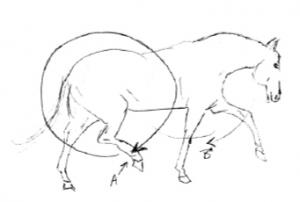
As we observe a horse moving about at the trot freely, without interference from the human, we should notice two elements of energy from the horse; the hindquarters for one, moving about in a large circular motion, and the shoulders moving about in a slightly less, but still obvious circular motion. (This is illustrated in the drawing to the right).
Now then, let's put ourselves in the scenario with the horse mentioned above. However this time we will go a step further and put ourselves on the horse’s back. If we want the horse to move about with the same impulsion that it moved about with, without human interference we would now need to create energy within our core, and allow that energy to match the energy that we wish the horse to move with. As we try this think about the circular movement of energy and as mentioned already focus on the energy from your core and think of that energy moving in a circular motion.
It is essential that the rider post the trot and understand that a circular motion of energy within the core must be produced from the human even at the trot. Allow me to point out that while posting, to the untrained eye it may appear as if we were moving straight up and down, when in fact we should also have a slight circular motion in our pelvis, thus being in rhythm with the circular motion from the hindquarters and shoulder, an entire “gear assembly” working together. We as responsible riders, have an obligation to maintain this circular motion of energy within our core and ride in unison with the horse’s movement, otherwise we become like a cog in a wheel. We ourselves can actually shut down the foreword impulsion by jamming these two powerful gears with our own bodies by not allowing them freedom to move. Simply put; if we ride in unison with the horse we're actually freeing our horse, or releasing the horse to perform naturally.
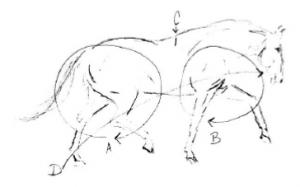
Feel; we should be able to feel for, and feel with our horse as it moves these two powerful gears (the hindquarters, and the forequarters). Once we can feel this we can begin posting on the correct diagonal, thereby encouraging the forward thrust from the hindquarters, while maintaining this circular energy through the entire body of the horse as shown in line “D” of the illustration on the right.
If everything is happening correctly, that is; our energy moving in unison with the horse, allowing the freedom of the hindquarters, while the horse is in vertical flexion. The energy of the thrust will move from the pushing hind foot and travel all the way through and out the front of the horse. Thereby giving us an energetic and powerful forward moving horse whose energy can be collected, and working for us both together.
What if my horse feels slow and lazy? In order for our horse to have good natural impulsion, our horse must be in shape. If your horse seems to be somewhat slow or lazy, my suggestion would be to look at your horse’s diet and exercise program. If you are unsure of what your horse’s diet should be, I would suggest you speak with your veterinarian. As far as a good exercise, I usually recommend walking up hill. By walking uphill the horse is more inclined to use all of the muscles in the hindquarters, however trotting the horse up hill is not completely discouraged, but more attention should be given to the walk. Having said that, allowing the horse to canter uphill allows the horse to move more so with momentum rather than concentrated movements from the hindquarters, and it is those
concentrated movements we want in order to build muscle and strength so that the horse will more easily flow into impulsion.
In this article we have learned what impulsion is; it is the thrust of a horse as it moves forward powerfully and willingly from the hindquarters, while staying collected in the hands of the rider. We also talked about ways to maintain the same impulsion of the horse once under saddle that it would have naturally without human interference.
Mike Branch travels internationally, from Canada to the UK to start horses, hold clinics, and give lectures and demos. Mike has appeared on television in the U.S. as well as all across the United Kingdom. Mike may be available for your next function. You may inquire at flyingbhorsemanship@gmail.com or by calling 865-548-0112
www.mikebranchhorsemanship.com
In this article I will do my best to explain impulsion another key ingredient to producing collection in the horse. I may start again by giving a short synopsis of the terminology impulsion. It would go something like this; impulsion is the thrust of a horse as it moves forward powerfully and willingly with its hindquarters engaged. I would also like to say up front that there is a big difference in impulsion from a horse and a horse that is impulsive.
Please allow me to talk about impulsiveness for a minute, or at least my explanation of it. A horse that is impulsive is usually a horse that is in a rush; many times this is a very flat moving horse, one which also has a hollow back, thereby causing it to pull from the forehand rather than having its hindquarters engaged in a push, or thrust. A horse in this position cannot make the athletic maneuvers that the horse moving with impulsion from the hindquarters can make. Even though these two words often times overlap in common terminology, it would be the same difference as a horse that is reactive rather than a horse that is responsive. Moreover I'm sure all of us would rather get a response from our horse than a re-action. In like manner, I'm sure once understood we would all rather get impulsion from our horse, than for our horse to be impulsive.
How can we encourage our horse to have impulsion? Upon the assumption that you are a qualified rider, with a good sense of balance, and can post fairly well at the trot; I will have to say the first key ingredient is learning about vertical flexion and teaching vertical flexion to your horse. With that said, I am compelled to say that combined with vertical flexion you must ride your horse with the energy that you expect to come from the horse’s hindquarters in order to have impulsion. One of the main ingredients in this recipe is the way you ride, and within the realm of riding there should be an understanding of energy, and the circular motion of which all energy flows.
As we observe a horse moving about at the trot freely, without interference from the human, we should notice two elements of energy from the horse; the hindquarters for one, moving about in a large circular motion, and the shoulders moving about in a slightly less, but still obvious circular motion. (This is illustrated in the drawing to the right).
Now then, let's put ourselves in the scenario with the horse mentioned above. However this time we will go a step further and put ourselves on the horse’s back. If we want the horse to move about with the same impulsion that it moved about with, without human interference we would now need to create energy within our core, and allow that energy to match the energy that we wish the horse to move with. As we try this think about the circular movement of energy and as mentioned already focus on the energy from your core and think of that energy moving in a circular motion.
It is essential that the rider post the trot and understand that a circular motion of energy within the core must be produced from the human even at the trot. Allow me to point out that while posting, to the untrained eye it may appear as if we were moving straight up and down, when in fact we should also have a slight circular motion in our pelvis, thus being in rhythm with the circular motion from the hindquarters and shoulder, an entire “gear assembly” working together. We as responsible riders, have an obligation to maintain this circular motion of energy within our core and ride in unison with the horse’s movement, otherwise we become like a cog in a wheel. We ourselves can actually shut down the foreword impulsion by jamming these two powerful gears with our own bodies by not allowing them freedom to move. Simply put; if we ride in unison with the horse we're actually freeing our horse, or releasing the horse to perform naturally.
Feel; we should be able to feel for, and feel with our horse as it moves these two powerful gears (the hindquarters, and the forequarters). Once we can feel this we can begin posting on the correct diagonal, thereby encouraging the forward thrust from the hindquarters, while maintaining this circular energy through the entire body of the horse as shown in line “D” of the illustration on the right.
If everything is happening correctly, that is; our energy moving in unison with the horse, allowing the freedom of the hindquarters, while the horse is in vertical flexion. The energy of the thrust will move from the pushing hind foot and travel all the way through and out the front of the horse. Thereby giving us an energetic and powerful forward moving horse whose energy can be collected, and working for us both together.
What if my horse feels slow and lazy? In order for our horse to have good natural impulsion, our horse must be in shape. If your horse seems to be somewhat slow or lazy, my suggestion would be to look at your horse’s diet and exercise program. If you are unsure of what your horse’s diet should be, I would suggest you speak with your veterinarian. As far as a good exercise, I usually recommend walking up hill. By walking uphill the horse is more inclined to use all of the muscles in the hindquarters, however trotting the horse up hill is not completely discouraged, but more attention should be given to the walk. Having said that, allowing the horse to canter uphill allows the horse to move more so with momentum rather than concentrated movements from the hindquarters, and it is those
concentrated movements we want in order to build muscle and strength so that the horse will more easily flow into impulsion.
In this article we have learned what impulsion is; it is the thrust of a horse as it moves forward powerfully and willingly from the hindquarters, while staying collected in the hands of the rider. We also talked about ways to maintain the same impulsion of the horse once under saddle that it would have naturally without human interference.
Mike Branch travels internationally, from Canada to the UK to start horses, hold clinics, and give lectures and demos. Mike has appeared on television in the U.S. as well as all across the United Kingdom. Mike may be available for your next function. You may inquire at flyingbhorsemanship@gmail.com or by calling 865-548-0112
www.mikebranchhorsemanship.com


