

Book Review by Leigh Ballard
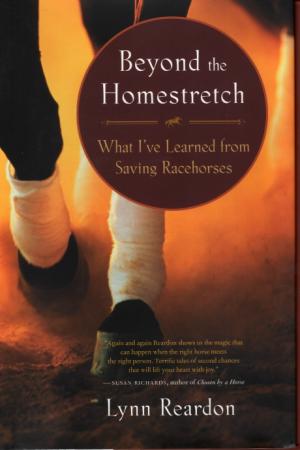
Beyond the Homestretch: What I’ve Learned from Saving Racehorses is an inspiring series of anecdotes from the Lynn Reardon’s experience as founder of a racehorse adoption ranch. The LoneStar Outreach to Place Ex-Racers (LOPE) was the fruition her dreams and efforts, and those of her husband Tom, after they left a sterile office existence in Washington, D.C. for the open spaces in Texas.
Lynn, an accountant, and Tom, a business consultant, were quite unprepared for daily ranch life and constant horse maintenance. The exciting opening of the book quickly grabs the reader’s attention as Lynn is faced with performing an emergency breathing procedure with pieces of rubber hose in the middle of the night, by herself, on a horse who was bitten in the face by a rattlesnake. Excitement continues throughout the book as Lynn tells tongue-in-cheek about how she coped with many harrowing and gory episodes requiring some form of veterinary intervention. Reardon, a dreaming middle-aged woman when she came to the equestrian world, can tell humorously about her fears and insecurities with horses. She calls herself an inept “barn geek”, and she has plenty of self-deprecating, stories about her efforts at horsemanship that will leave you grinning.
Reardon provides much insight into the behavior of racehorses off the track and the reasons some folks think they’re “crazy.” She helps us understand the training and environment (and the medications) that produce their often high-strung behaviors. She reveals the mindset of many trainers and owners – showing some of them as quite sentimental about their “business” of horseracing and not always so cutthroat as racing stories might lead one to believe. She portrays a racing community of owners and trainers who generally cares about the welfare of their animals, although there are exceptions.
The value of this book lies in its touching accounts of how injured, unwanted, discarded yet talented horses find purpose with new owners. So many horses are simply not competitive in race situations, but have excellent value in other jobs. As Reardon works hard to find the right match for them, she is tuned in to their special personalities and abilities. A sweet, but slow, little mare who had been rejected by several prospective adopters turned out to be an absolutely perfect horse for a developmentally disabled girl. The girl came to try her out because she was sweet-tempered and slow, but the mare’s undiscovered innate sensitivity carried the day. Sugarfoot intuitively, and without prior training for the job, accommodated the girl’s disability; her true talent was revealed and she found a forever home. Other racehorses in Lynn’s stories are re-trained and find new jobs in the dressage ring, or on the slow trail which won’t hurt their old injuries. There are as many places for the horses as there are kinds of riders. Adopters just need to know where to look for them, and the book offers the world of ex-racers a potential place to look for your next horse.
More information about Lynn Reardon and adopting ex-racehorses can be found at www.lopetx.org.
Beyond the Homestretch: What I’ve Learned from Saving Racehorses is an inspiring series of anecdotes from the Lynn Reardon’s experience as founder of a racehorse adoption ranch. The LoneStar Outreach to Place Ex-Racers (LOPE) was the fruition her dreams and efforts, and those of her husband Tom, after they left a sterile office existence in Washington, D.C. for the open spaces in Texas.
Lynn, an accountant, and Tom, a business consultant, were quite unprepared for daily ranch life and constant horse maintenance. The exciting opening of the book quickly grabs the reader’s attention as Lynn is faced with performing an emergency breathing procedure with pieces of rubber hose in the middle of the night, by herself, on a horse who was bitten in the face by a rattlesnake. Excitement continues throughout the book as Lynn tells tongue-in-cheek about how she coped with many harrowing and gory episodes requiring some form of veterinary intervention. Reardon, a dreaming middle-aged woman when she came to the equestrian world, can tell humorously about her fears and insecurities with horses. She calls herself an inept “barn geek”, and she has plenty of self-deprecating, stories about her efforts at horsemanship that will leave you grinning.
Reardon provides much insight into the behavior of racehorses off the track and the reasons some folks think they’re “crazy.” She helps us understand the training and environment (and the medications) that produce their often high-strung behaviors. She reveals the mindset of many trainers and owners – showing some of them as quite sentimental about their “business” of horseracing and not always so cutthroat as racing stories might lead one to believe. She portrays a racing community of owners and trainers who generally cares about the welfare of their animals, although there are exceptions.
The value of this book lies in its touching accounts of how injured, unwanted, discarded yet talented horses find purpose with new owners. So many horses are simply not competitive in race situations, but have excellent value in other jobs. As Reardon works hard to find the right match for them, she is tuned in to their special personalities and abilities. A sweet, but slow, little mare who had been rejected by several prospective adopters turned out to be an absolutely perfect horse for a developmentally disabled girl. The girl came to try her out because she was sweet-tempered and slow, but the mare’s undiscovered innate sensitivity carried the day. Sugarfoot intuitively, and without prior training for the job, accommodated the girl’s disability; her true talent was revealed and she found a forever home. Other racehorses in Lynn’s stories are re-trained and find new jobs in the dressage ring, or on the slow trail which won’t hurt their old injuries. There are as many places for the horses as there are kinds of riders. Adopters just need to know where to look for them, and the book offers the world of ex-racers a potential place to look for your next horse.
More information about Lynn Reardon and adopting ex-racehorses can be found at www.lopetx.org.


