

By Leigh Ballard
A horse’s caloric intake to meet energy needs in cold weather is important to consider for maintaining overall health and body condition through the winter. The critical temperature at which a horse’s food intake should increase is 45°F. This critical temperature is modified by other factors such as wind chill, moisture and hair coat.
A significant amount of energy is required to maintain internal body heat when the environmental temperature drops below 45°F. The amount of energy required to meet daily needs is measured as digestible energy (DE) in calories. The average 1,100 lb horse at maintenance level (no work) requires at least 16.4 Mcal per day. For each 1°F decrease below the critical temperature, the horse needs a 1% increase in DE to maintain a consistent body temperature. If a horse is wet and/or in cold wind, the critical temperature increases by 10-15°F. So, at about 55°F a horse needs more calories if the conditions are also windy and wet.
The formula used to determine the increased DE requirements is:
Critical temperature - actual temperature = % DE increase
Here is an example of how to adjust feed intake for an average 1,100 horse at maintenance (no work): The weather is dry with a temperature of 30°F with a wind chill making it feel like 25°F. 45°F-25°F=20% DE increase (Note: if the horse was also wet, the formula changes to 55°F-25°F=30%)
As stated, an average 1,100 lb. horse at maintenance needs 16.4 Mcal per day. In this example, the horse needs a 20% increase in DE. Multiply 16.4 x 20%=3.28 Mcal increase. Now the horse needs 19.68 Mcal per day.
So what does this mean in terms of feeding? Studies show that an average 1,100 lb. horse at maintenance consumes 1.7% of his body weight or 19 lbs. of ration daily. We know from the hay analysis used in the December 2011 MSHR article that the average DE of local Bermuda mix hay is just under 1 Mcal/lb., and most commercial concentrates (horse feeds) are formulated to provide about 1Mcal/lb. for maintenance level. We can calculate the increase in feed as follows: 3.28 Mcal divided by 1Mcal = 3.28 lbs. of additional feed (calories needed divided by calories per lb. equals pounds needed.) The horse already requires 19 lbs.; now add 3.28 for a total of 22.28 lbs. per day total feed required.
How should you give him this increase? Forages provide more heat than concentrates. Concentrates have a little more DE per pound than hay, but the digestion process for concentrates does not produce much heat, and one of our goals is to help keep the horse warm. So, the simplest thing to do is provide more hay. Pasture-kept horses feeding on round bales self-regulate their intake, and the round bales will definitely disappear more quickly when the temperatures drop.
Another method is to provide a little more hay and a little more concentrate in more or less equal proportions. Do not increase the concentrate portion by the full 3 ¼ pounds - that’s too much additional concentrate in the stomach at one time.
The energy density of the concentrate can be increased by adding a fat supplement. Adding fat is a good way to add calories without adding much weight to the pounds fed. Adding fat is especially good for a “poor keeper” or a horse already in poor body condition when cold sets in. A commercial rice bran/flaxseed supplement is a better choice than adding vegetable oils for fat because the Omega-3 and Omega-6 fatty acids are formulated to stay in balance.
Additional fat is a good source of concentrated energy for all horses during prolonged cold periods. Fat does a much better job of providing energy than carbohydrates (high sugar content feeds like sweetfeeds) because it gets the job done with less volume and less risk of digestive upset.
Note that the energy requirements herein have been calculated conservatively for average horses with no work. Pregnant mares or horses working in winter, such as field trialers or foxhunters, will have higher energy requirements. The size of the horse, individual weather tolerance differences, and whether he is wet or dry also influence his needs. Watch your horse’s body condition and appearance to determine feeding adjustments for your own horse. If you know the DE of your hay and feed, plug the numbers into the formulas to determine the correct increase.
In addition to caloric intake, water intake is critical during cold weather. Studies show that most horses drink more water if the temperature is between 45°F and 65°F, with the average 1,100 lb. horse consuming 10-12 gallons per day. A horse might consume as little as 3 gallons when the water is just at freezing. This is problematic, considering how much dry matter the horse is eating during the winter! Low water intake is directly attributed to increased risk of impaction colic.
There are several ways to increase water intake in winter. The first way is to warm the water. If electricity is available, a tank heater for the water trough is an easy, low cost solution. A tank heater costs about $30-$40. Another solution is heated buckets in the stalls. Another practice is to put 1-2 tablespoons of free-flowing white table salt, non-iodized, in the feed, sobe sure to provide water to drink after eating. Another trick is to add water to the feed, or wet the hay when being fed in a stall (not round bales.) Increasing hay 24 hours prior to a drop in temperatures encourages more drinking in advance of the cold.
Winter weather can be tough, especially with drastic fluctuations that can upset horses’ food and water intake. Pay attention to weather forecasts, provide shelter to keep the horses out of the rain and wind, and monitor their food and water for needed increases.
Sources:
Juliet Getty, Feed Your Horse Like a Horse
2) “Cold Weather Feeding Practices for Horses,” North Carolina Cooperative Extension Service Bulletin
3) “High-Fat Diets for Horses,” North Carolina Cooperative Extension Service Bulletin
NOTE: For this article, the calculation information was taken from source #2. The NC formula used for calculating adequate calories uses 16.4 Mcal as daily maintenance level requirement. Charts from UT Extension use 16.7 Mcal as daily maintenance requirement for average 1100 lb horse.
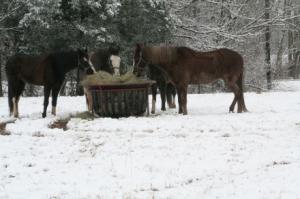
(Photo courtesy of Geneen O’Bryan)
A horse’s caloric intake to meet energy needs in cold weather is important to consider for maintaining overall health and body condition through the winter. The critical temperature at which a horse’s food intake should increase is 45°F. This critical temperature is modified by other factors such as wind chill, moisture and hair coat.
A significant amount of energy is required to maintain internal body heat when the environmental temperature drops below 45°F. The amount of energy required to meet daily needs is measured as digestible energy (DE) in calories. The average 1,100 lb horse at maintenance level (no work) requires at least 16.4 Mcal per day. For each 1°F decrease below the critical temperature, the horse needs a 1% increase in DE to maintain a consistent body temperature. If a horse is wet and/or in cold wind, the critical temperature increases by 10-15°F. So, at about 55°F a horse needs more calories if the conditions are also windy and wet.
The formula used to determine the increased DE requirements is:
Critical temperature - actual temperature = % DE increase
Here is an example of how to adjust feed intake for an average 1,100 horse at maintenance (no work): The weather is dry with a temperature of 30°F with a wind chill making it feel like 25°F. 45°F-25°F=20% DE increase (Note: if the horse was also wet, the formula changes to 55°F-25°F=30%)
As stated, an average 1,100 lb. horse at maintenance needs 16.4 Mcal per day. In this example, the horse needs a 20% increase in DE. Multiply 16.4 x 20%=3.28 Mcal increase. Now the horse needs 19.68 Mcal per day.
So what does this mean in terms of feeding? Studies show that an average 1,100 lb. horse at maintenance consumes 1.7% of his body weight or 19 lbs. of ration daily. We know from the hay analysis used in the December 2011 MSHR article that the average DE of local Bermuda mix hay is just under 1 Mcal/lb., and most commercial concentrates (horse feeds) are formulated to provide about 1Mcal/lb. for maintenance level. We can calculate the increase in feed as follows: 3.28 Mcal divided by 1Mcal = 3.28 lbs. of additional feed (calories needed divided by calories per lb. equals pounds needed.) The horse already requires 19 lbs.; now add 3.28 for a total of 22.28 lbs. per day total feed required.
How should you give him this increase? Forages provide more heat than concentrates. Concentrates have a little more DE per pound than hay, but the digestion process for concentrates does not produce much heat, and one of our goals is to help keep the horse warm. So, the simplest thing to do is provide more hay. Pasture-kept horses feeding on round bales self-regulate their intake, and the round bales will definitely disappear more quickly when the temperatures drop.
Another method is to provide a little more hay and a little more concentrate in more or less equal proportions. Do not increase the concentrate portion by the full 3 ¼ pounds - that’s too much additional concentrate in the stomach at one time.
The energy density of the concentrate can be increased by adding a fat supplement. Adding fat is a good way to add calories without adding much weight to the pounds fed. Adding fat is especially good for a “poor keeper” or a horse already in poor body condition when cold sets in. A commercial rice bran/flaxseed supplement is a better choice than adding vegetable oils for fat because the Omega-3 and Omega-6 fatty acids are formulated to stay in balance.
Additional fat is a good source of concentrated energy for all horses during prolonged cold periods. Fat does a much better job of providing energy than carbohydrates (high sugar content feeds like sweetfeeds) because it gets the job done with less volume and less risk of digestive upset.
Note that the energy requirements herein have been calculated conservatively for average horses with no work. Pregnant mares or horses working in winter, such as field trialers or foxhunters, will have higher energy requirements. The size of the horse, individual weather tolerance differences, and whether he is wet or dry also influence his needs. Watch your horse’s body condition and appearance to determine feeding adjustments for your own horse. If you know the DE of your hay and feed, plug the numbers into the formulas to determine the correct increase.
In addition to caloric intake, water intake is critical during cold weather. Studies show that most horses drink more water if the temperature is between 45°F and 65°F, with the average 1,100 lb. horse consuming 10-12 gallons per day. A horse might consume as little as 3 gallons when the water is just at freezing. This is problematic, considering how much dry matter the horse is eating during the winter! Low water intake is directly attributed to increased risk of impaction colic.
There are several ways to increase water intake in winter. The first way is to warm the water. If electricity is available, a tank heater for the water trough is an easy, low cost solution. A tank heater costs about $30-$40. Another solution is heated buckets in the stalls. Another practice is to put 1-2 tablespoons of free-flowing white table salt, non-iodized, in the feed, sobe sure to provide water to drink after eating. Another trick is to add water to the feed, or wet the hay when being fed in a stall (not round bales.) Increasing hay 24 hours prior to a drop in temperatures encourages more drinking in advance of the cold.
Winter weather can be tough, especially with drastic fluctuations that can upset horses’ food and water intake. Pay attention to weather forecasts, provide shelter to keep the horses out of the rain and wind, and monitor their food and water for needed increases.
Sources:
Juliet Getty, Feed Your Horse Like a Horse
2) “Cold Weather Feeding Practices for Horses,” North Carolina Cooperative Extension Service Bulletin
3) “High-Fat Diets for Horses,” North Carolina Cooperative Extension Service Bulletin
NOTE: For this article, the calculation information was taken from source #2. The NC formula used for calculating adequate calories uses 16.4 Mcal as daily maintenance level requirement. Charts from UT Extension use 16.7 Mcal as daily maintenance requirement for average 1100 lb horse.
(Photo courtesy of Geneen O’Bryan)


