

Article & photos by Nancy Brannon
Blue Creek Arena, in beautiful Humphreys County, TN hosted a team roping clinic with World Champion Walt Woodard October 14-16. Eight headers and nine heelers came to learn from the master.
Two years ago, Walt took a year off from team roping. But this year he came back, which is almost like coming back as a rookie. In June when he started; he won the Cheyenne show, and so far this year has won $80,000, when his original goal was to win $25,000. No one else has qualified for the National Finals Rodeo (NFR) in such a short amount of time. Walt is now in the top ten for the NFR.
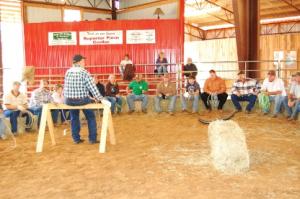
Walt begins all his clinics with an introductory lecture, explaining his approach to team roping, the whys and wherefores about the sport. “Horsemanship is very important,” Woodard emphasized. “Horsemanship and team roping might as well be one word. If you’re having problems, whether it’s the heading box or the heeling box, I can give you the skills to become a better horseman in the roping pen. The essentials are: you must get in position and hold it. The basic elements of the delivery are the swing and the target.”
Asked why he temporarily “retired” from roping, he said, “You have to go to 70 rodeos or more to qualify for the world standings. All that travel can get tiring. But I like teaching and I’m drawn back to competing. I wonder if what I’m teaching is actually true. I have to challenge myself against the best ropers in the world. If I can win, I know what I’m teaching is true.” So Woodard tests his theories about what he’s teaching in real competitions.
Improving one’s performance in this sport is a learning pyramid, just as in other equestrian sports. Skill levels are progressive, one building on the foundation of the previous skills. “To get better, you have to do 1 to 2 steps correctly, then move to the next step. Then you have to pull all the pieces in place to get the entire picture.”
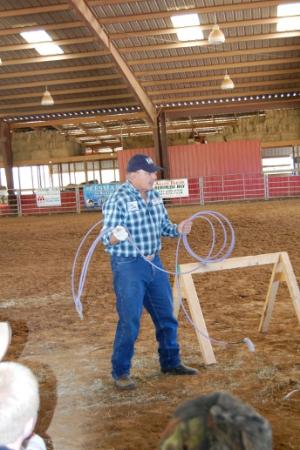
After the introductory lecture, Woodard has participants practice their roping techniques on sawhorses or hay bales with plastic calf heads. He carefully watches each one, then offers comments. One participant was roping the dummy well, but wasn’t getting the results he wanted from horseback. Walt said to him, “I’ll tell you three reasons why you’re not getting the results, and you tell me which one it is.” The participant correctly answered the reason; then Walt gave him advice on what to work on to improve.
Following the practice and advice time, Walt held a Q & A session, where he answered participants’ questions, and debunked long-held notions about team roping. Woodard spent time talking about arm techniques and swinging the rope. He mentioned that most folks know that you don’t lean until the tip of the rope goes through. “But most people don’t know why this is true,” he said. He then explained the history of how this adage came about.
“Back in the day, people rode their horses all day long. But today, people’s time is too valuable. People don’t have three hours to ride their horse and then rope on him.”
The way Woodard described the mechanics of team roping; it’s really a geometry lesson. Advice for headers: “A great header can take a fast steer or a slow steer and take him across the arena at the same speed. Too many headers get out of the box and run down the arena trying to catch the steer. Speed kills intermediate headers! The heeler needs the header to keep the steer straight; set him down, bend his head first, then bend the horse.”
Advice for heelers: “Wait until the header starts towing the steer. Then make your move to get in position to swing to the target when the horse’s nose is even with the steer’s middle. You need to be 2 to 3 feet behind the tailhead. If you swing over the front feet, you’re too close!
“Hazing is done in the first three strides out of the box, when the header is still behind the rope barrier. You want the steer to go straight. The steer will eventually go right. And haze with your horse, not your mouth. Don’t scream!
“As soon as the header swings, the heeler moves up and gets in the game. Stay straight until the steer is in tow. If the steer goes to the fence, you can still rope, but keep the horse away from the fence and don’t throw the rope over the plane of the fence.”
Timing is the critical issue with all team ropers. Formerly when he was conducting clinics, his primary critique with most ropers was a lack of timing, a skill that is nearly impossible to teach. “You can’t make students get in time.” But he devised a way to help students better understand how to develop their own sense of timing. “You have to time your swing to the steer. When the steer’s back leg is up, swing down. When the steer’s hind feet are off the ground, the heeler must get his rope on the steer’s feet. This is hard to coordinate on a running horse!
In high school, I never went to a dance on a date. I roped all the time. But I think I could dance because dancing is all about timing.” Woodard then asked a participant to walk in front of him, while Woodard swung his rope. He told the audience to watch the guy’s feet, and when his back foot came up to take the next step, Walt showed that is when to swing your rope.
In the afternoon session, participants put the methods they had been learning and practicing into action on horseback.
Want to dance with Walt Woodard, or learn more about team roping from him?
Find more information at his website: http://waltwoodard.net/


