

By Li’l Matt, Editor, Mid-South Kitty Review
You look in the feed bin and notice it is time to make a trip to the feed store. You walk in the door and there displayed on the counter or on a sack of feed is the Feed Store Cat, purring and awaiting petting. The life of a feed store, or tack store, cat is good, considering that one has to work (ugh!), particularly for human-friendly cats. There are plenty of mice to catch! In spite of the store owner’s efforts to keep the numbers of mice in check, all that grain lying around inevitably attracts the delicious critters. Some feed stores and grain mills are located in the country, next to open fields, where the mice live (more tasty morsels!). It is the job of the Feed Store Cat to catch these mice, and certainly, cat petting is a main part of the job description.
Cats with friendly personalities, who are not too shy, make the best Feed Store Cats. Customers with children often come in the store, and children are easy targets for petting. Cats have several methods they use to entice unsuspecting humans to pet them.
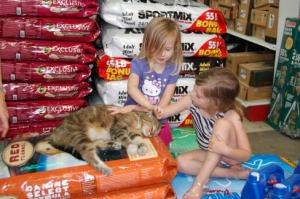
The artful display is a popular method, whereby the cat simply lounges atop feed sacks available for petting to any customer. Another popular place is on the counter, deliberately interposing themselves with the cash transactions taking place. This forces the humans to break from their stressful, hectic schedule to engage in some relaxing petting. Occasionally Feed Store Cats have to resort to meowing to get petted, but this simply enhances humans’ feeling of self-worth, since getting recognition from a cat is highly valued!
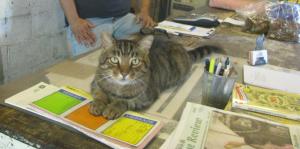
Cowboy The Tom Cat at The Brunswick Feed Store in Brunswick, TN is 8 years old. He has survived that long because he’s smart enough to stay out of the busy road in front of the store. He likes to lie sprawled on the front counter, but is discriminating in how and when he allows humans to pet him. If the human comes on too strong, he may give a swat or a nip, saying, “I’m not that kind of Kitty.”
The cats at Hall’s Feed and Seed in Collierville, TN love the attention, but need their nap time breaks, so they find cozy retreats around the store to get away from humans (cats can only take so much of humans!). They find solace on feed sacks in the store and warehouse, on bales of hay, or on the dog beds in the pet section (cats just love thumbing their noses at dogs!). Remember: “Dogs consider humans their masters. Cats consider humans their staff.”
There is something about the outside of a cat that is good for the inside of a human.
Tack stores do not have the same attraction for cats that feed stores and grain mills do. Unfortunately, many tack stores have resident dogs (shudder at the thought!). Cindy at Bedford Tack in Bell Buckle, TN said that they had cats in the past, but unless cats are declawed, they would scratch the patrons or the leather goods. Bedford Tack now has a Jack Russell Terrier named Chip. Some folks come in just visit with Chip (there’s no accounting for taste!).
You horse people might like to know that Linda Tellington Jones, with her Tellington T-Touch Training, has developed a series of manuals to help humans develop their cat petting skills. For example, Getting in TTouch with Your Cat offers advice on how cat petting can solve a wide range of human behavioral and physical problems. Her accompanying DVD, “Tellington TTouch Magic for Cats,” shows humans in a variety of situations with different kinds maladies being helped by TTouch cat petting methods.
The therapeutic value of cat petting has finally been established by human scientific research, something cats have known intuitively for eons. An article in the Journal of Social Issues (September 2009), “The Effects of Animals on Human Health and Well-Being,” by Deborah L. Wells, concludes: “This paper explores the mounting evidence that cats contribute to human health and well-being. The article initially shows the value of cats for short- and long-term physical health, then focuses on the ability of cats to serve as a ‘therapist’ to humans. The literature reviewed is largely supportive of the widely held and long-standing belief that ‘cats are good for us.’”
Coming soon near a theater near you, MATT, the documentary about the “Human Whisperer” cat who deals with "cats with people problems."
Staff cat feeder at the Mid-South Horse Review, Ken Opener (shamelessly stolen from Click & Clack), contributed to this article.
You look in the feed bin and notice it is time to make a trip to the feed store. You walk in the door and there displayed on the counter or on a sack of feed is the Feed Store Cat, purring and awaiting petting. The life of a feed store, or tack store, cat is good, considering that one has to work (ugh!), particularly for human-friendly cats. There are plenty of mice to catch! In spite of the store owner’s efforts to keep the numbers of mice in check, all that grain lying around inevitably attracts the delicious critters. Some feed stores and grain mills are located in the country, next to open fields, where the mice live (more tasty morsels!). It is the job of the Feed Store Cat to catch these mice, and certainly, cat petting is a main part of the job description.
Cats with friendly personalities, who are not too shy, make the best Feed Store Cats. Customers with children often come in the store, and children are easy targets for petting. Cats have several methods they use to entice unsuspecting humans to pet them.
The artful display is a popular method, whereby the cat simply lounges atop feed sacks available for petting to any customer. Another popular place is on the counter, deliberately interposing themselves with the cash transactions taking place. This forces the humans to break from their stressful, hectic schedule to engage in some relaxing petting. Occasionally Feed Store Cats have to resort to meowing to get petted, but this simply enhances humans’ feeling of self-worth, since getting recognition from a cat is highly valued!
Cowboy The Tom Cat at The Brunswick Feed Store in Brunswick, TN is 8 years old. He has survived that long because he’s smart enough to stay out of the busy road in front of the store. He likes to lie sprawled on the front counter, but is discriminating in how and when he allows humans to pet him. If the human comes on too strong, he may give a swat or a nip, saying, “I’m not that kind of Kitty.”
The cats at Hall’s Feed and Seed in Collierville, TN love the attention, but need their nap time breaks, so they find cozy retreats around the store to get away from humans (cats can only take so much of humans!). They find solace on feed sacks in the store and warehouse, on bales of hay, or on the dog beds in the pet section (cats just love thumbing their noses at dogs!). Remember: “Dogs consider humans their masters. Cats consider humans their staff.”
There is something about the outside of a cat that is good for the inside of a human.
Tack stores do not have the same attraction for cats that feed stores and grain mills do. Unfortunately, many tack stores have resident dogs (shudder at the thought!). Cindy at Bedford Tack in Bell Buckle, TN said that they had cats in the past, but unless cats are declawed, they would scratch the patrons or the leather goods. Bedford Tack now has a Jack Russell Terrier named Chip. Some folks come in just visit with Chip (there’s no accounting for taste!).
You horse people might like to know that Linda Tellington Jones, with her Tellington T-Touch Training, has developed a series of manuals to help humans develop their cat petting skills. For example, Getting in TTouch with Your Cat offers advice on how cat petting can solve a wide range of human behavioral and physical problems. Her accompanying DVD, “Tellington TTouch Magic for Cats,” shows humans in a variety of situations with different kinds maladies being helped by TTouch cat petting methods.
The therapeutic value of cat petting has finally been established by human scientific research, something cats have known intuitively for eons. An article in the Journal of Social Issues (September 2009), “The Effects of Animals on Human Health and Well-Being,” by Deborah L. Wells, concludes: “This paper explores the mounting evidence that cats contribute to human health and well-being. The article initially shows the value of cats for short- and long-term physical health, then focuses on the ability of cats to serve as a ‘therapist’ to humans. The literature reviewed is largely supportive of the widely held and long-standing belief that ‘cats are good for us.’”
Coming soon near a theater near you, MATT, the documentary about the “Human Whisperer” cat who deals with "cats with people problems."
Staff cat feeder at the Mid-South Horse Review, Ken Opener (shamelessly stolen from Click & Clack), contributed to this article.


