

By Lisa Sparks
April 2011
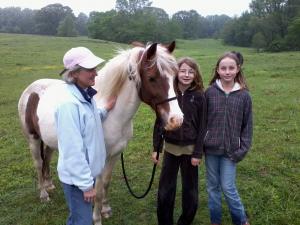
Since last summer my friend, Missy Flanigan, has brought a group of home school girls to my pasture of 14 horses to experience horses. The horses graze in a pasture of about 85 acres of rolling hills and wooded trails. The pond is partially surrounded by a wooded area and becomes the spa area for them to frolic and run through. It is not unusual for them to hide among the trees and ravines as they forage across the green meadows in search of the abundant grass.
Basic grooming, cleaning the hoofs, and haltering is done in preparation for body communication class through leading the horse down the path, moving them in the fenced round pen and sending them in a circle around them. The idea of having a personal space described as a body bubble presents the opportunity to teach boundaries of respect. We use our body bubble to push the horse away from us in an attempt to establish our leadership in the hierarchy. If they push toward us and burst our body bubble then we have to use clearer body language by making ourselves bigger with our intentions or our arms longer with a training stick. A lot of time is spent on establishing our presence with the horse because the children are small in stature. The Dennis Reis Home Study Course has given us steps to follow in how to use the lead rope to signal a back up and how to use the training stick to ask the horse to move faster in the round pen. To develop a rhythm with the girls we will use music so they can see that the change in their body energy produces a change in the horse. By pretending to be horses we develop non-verbal abilities through role-playing.
Gestures, posturing, and use of our eyes are important aspects of horse communication. Hannah was able to complete her round penning task with Dandy, a small very alert horse, because her movements were timed in such a way as to get the correct response that produced licking and chewing, the indicator of understanding. Missy and her mare, Beauty, needed clarity in moving her front feet over so she focused her eyes on the mare’s neck as she used her training stick to suggest the task. Morgan lost the respect of Cha Cha when she ran away from her to play with the younger horses in the field. Discouraged by this, we decided to follow her to the field and watch her body language in play. She made circles with her friends at the faster gaits with mane and tail flowing in the breeze only to return to her place at the gate, ready to resume class. Catching the horses in the field tests their ability to draw the horse to them through position of their body behind the withers and in front of the withers at the right moment using the release of pressure when the horse looks at them.
The commitment to body language as it applies to round penning and ground work has given credence to the horse’s ability to communicate. Now we have to understand that every move we make means something and to what degree we ask that movement is an important component of the request. The girls are willing to develop their skills on the ground before riding because it is fun to use your imagination in learning this new language. They build obstacle courses to test their ability to lead their horse across the bridge or through the plastic bag tunnel. They write stories and draw pictures about their favorite horse. Several of the girls have earned money to buy a rope halter and training stick to better equip themselves.
In May we are having a bake sale in Hernando, Mississippi, at the 1st Security Bank on May 14 at 8:30 am, to earn money for Horse Communication Camp in June. They are excited about training their favorite horse for 5 consecutive days to prepare for the obstacle course and/or complete the round penning exercise with music. The Horse Communication Camp will also be open to participants from nine years old to adult in order to teach the round penning and ground work skills necessary for the good ride. I am presently a member of Dennis Reis’s No Dust Club and taking lessons from a level III student, P. K. Theobold of Hillside Stables and would like to share with the community my Horse Communication Camp as their horse experience toward the good ride.
HORSE COMMUNICATION CAMP
8585 Highway 301 N.
Lake Cormorant, Ms. 38641
(Just west of Hernando)
901-606-7522
Each week in June
7:30am – 11:30 am
Monday – Friday
Teaching ground work that explains horse movement
April 2011
Since last summer my friend, Missy Flanigan, has brought a group of home school girls to my pasture of 14 horses to experience horses. The horses graze in a pasture of about 85 acres of rolling hills and wooded trails. The pond is partially surrounded by a wooded area and becomes the spa area for them to frolic and run through. It is not unusual for them to hide among the trees and ravines as they forage across the green meadows in search of the abundant grass.
Basic grooming, cleaning the hoofs, and haltering is done in preparation for body communication class through leading the horse down the path, moving them in the fenced round pen and sending them in a circle around them. The idea of having a personal space described as a body bubble presents the opportunity to teach boundaries of respect. We use our body bubble to push the horse away from us in an attempt to establish our leadership in the hierarchy. If they push toward us and burst our body bubble then we have to use clearer body language by making ourselves bigger with our intentions or our arms longer with a training stick. A lot of time is spent on establishing our presence with the horse because the children are small in stature. The Dennis Reis Home Study Course has given us steps to follow in how to use the lead rope to signal a back up and how to use the training stick to ask the horse to move faster in the round pen. To develop a rhythm with the girls we will use music so they can see that the change in their body energy produces a change in the horse. By pretending to be horses we develop non-verbal abilities through role-playing.
Gestures, posturing, and use of our eyes are important aspects of horse communication. Hannah was able to complete her round penning task with Dandy, a small very alert horse, because her movements were timed in such a way as to get the correct response that produced licking and chewing, the indicator of understanding. Missy and her mare, Beauty, needed clarity in moving her front feet over so she focused her eyes on the mare’s neck as she used her training stick to suggest the task. Morgan lost the respect of Cha Cha when she ran away from her to play with the younger horses in the field. Discouraged by this, we decided to follow her to the field and watch her body language in play. She made circles with her friends at the faster gaits with mane and tail flowing in the breeze only to return to her place at the gate, ready to resume class. Catching the horses in the field tests their ability to draw the horse to them through position of their body behind the withers and in front of the withers at the right moment using the release of pressure when the horse looks at them.
The commitment to body language as it applies to round penning and ground work has given credence to the horse’s ability to communicate. Now we have to understand that every move we make means something and to what degree we ask that movement is an important component of the request. The girls are willing to develop their skills on the ground before riding because it is fun to use your imagination in learning this new language. They build obstacle courses to test their ability to lead their horse across the bridge or through the plastic bag tunnel. They write stories and draw pictures about their favorite horse. Several of the girls have earned money to buy a rope halter and training stick to better equip themselves.
In May we are having a bake sale in Hernando, Mississippi, at the 1st Security Bank on May 14 at 8:30 am, to earn money for Horse Communication Camp in June. They are excited about training their favorite horse for 5 consecutive days to prepare for the obstacle course and/or complete the round penning exercise with music. The Horse Communication Camp will also be open to participants from nine years old to adult in order to teach the round penning and ground work skills necessary for the good ride. I am presently a member of Dennis Reis’s No Dust Club and taking lessons from a level III student, P. K. Theobold of Hillside Stables and would like to share with the community my Horse Communication Camp as their horse experience toward the good ride.
HORSE COMMUNICATION CAMP
8585 Highway 301 N.
Lake Cormorant, Ms. 38641
(Just west of Hernando)
901-606-7522
Each week in June
7:30am – 11:30 am
Monday – Friday
Teaching ground work that explains horse movement


