

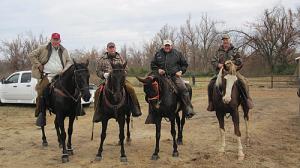
by Nancy Brannon
Horses are an integral part of bird dog field trials, as well as other sports like foxhunting. In fact, good field trial and foxhunting horses have many common characteristics. Horses must be not only reliable, basic transportation traversing all kinds of country, but must have other sound qualities of both body and mind.
Smoothness of gait and good temperament are two basic requirements of all good field trial horses. People may be in the saddle for hours at a stead, fairly fast pace, so riding a trotting or pacing horse can be too tiresome. Gaited horses are preferred and the breeds ridden in field trials vary from Tennessee Walking Horses to all kinds of Saddle Horses and Gaited Mountain Horses. The smoother the ride the better! The horses also need to be very fit since they are ridden over varied and sometimes rough terrain for long hours.
Good temperament is the next most important characteristic. This refers to a combination of sensibility and intelligence, "heart" and willingness. "A good field trial horse must have lots of stamina, get up and go, and strength," said Guy Hendrix, field trialer and owner of national championship qualifying dogs. "They are around a lot of people and other horses, so must be personable. You want one with a good disposition, who's level-headed, sensible. They can't be crazy; can't rear and kick. On the other hand, you don't want a dead-head either. They've got to have heart – get up and go. They have to be able to leave the pack and be independent. They also have to be ridden with other horses and be sane in the group."
Blake Kukar, owner National Championship qualifying dogs, agreed that smooth gait and sure-footedness are the best characteristics of a good field trial horse. In addition, "the horse must be mentally sound and not spook even with dogs all around them. The riders have to have complete confidence in their horses. The horses must have spirit; they can't be a dead-head, because you may have to ride through the muck for three hours or more. The horse has to go through changes in gaits and speeds effortlessly, be maneuverable and biddable. The handler may have to run out (away from the gallery), cut the dogs off, and then be back in the field later. They have to ground tie, tolerate gun fire, and negotiate variable terrain."
The horse should not spook or be easily upset (continued p. 19 Field Trial Horse) (Field Trial Horse, continued from p. 8) by the variety of things going on. The horse has be well-behaved in a large gallery of thirty horses or more, but at other times may have to leave the group and be ridden off independently as the handlers go after dogs. There are times when energy and enthusiasm are needed and other times when the horse should stand quietly and conserve energy. A good field trial horse is versatile enough to do both.
A good field trial horse should tolerate dogs running up suddenly from behind, dogs underfoot, dogs running under their bellies, puppies and debris going under their legs or running into them, dogs in the saddle or jumping to the saddle from the ground.
The horse must tolerate gunfire. Blanks are fired from special pistols that the handler carries in a holster. They give a loud bang, simulating the shot in hunting and proving to the judge that your dog is not gun shy.
A good field trial horse must stand tied, or "ground tie," meaning that when the reins are dropped, the horse stands without running off.
Field Trial horses have different tasks depending on who is riding them: the judge, the handler, the bird planter, the field marshall, and members of the gallery.
From the handler's horse, the bird dog is in a harness and attached by a thirty-foot rope to the harness from the saddle. The dog is taught to lean into the rope and harness and pull hard while the rider and horse follow. This is similar to what a good roping horse must learn. The dog usually stays out in front of the horse so the horse must tolerate the rope crossing over his chest as the dog moves from the left to the right.
A handler's horse must be able to do this too, as well as be able to gallop and stop on demand when needed. These are also characteristics of a good cutting horse. These movements are needed when the handler has to move quickly to prevent a dog from chasing or catching a bird that it has flushed during the trial.
Judges require horses that can go anywhere willingly and can be separated from the other horses without fuss. They must go into the woods on occasion to observe a dog on point. They must stand quietly while the judges write notes and confer with each other. Since judges usually are out all day, they want their horses be smooth in gait and built for comfort.
The Field Marshall's job is to control the gallery, which may be as large as sixty or seventy riders at some trials. The Field Marshall's horse must tolerate other horses riding behind and nearby, go bravely over any terrain, be able to ride up to a ground tied horse so the Field Marshall can hold its reins. The horse must not fight with other horses. The Field Marshall has to watch each brace and be ready to step in and judge; he may also be the time keeper.
The Bird Planter puts out the birds and carries them in a special bag made for that purpose. He rides out and salts the course with birds; then during the trials, he rides along well behind the dogs, judges, and gallery. He stops and places birds where they would likely be found by a hunting dog, replenishing the course for each brace. His horse must be able to tolerate the fluttering of the birds without spooking and be willing to work away from the other horses.
A good field trial horse has characteristics similar to horses used in other sporting events. Much is asked and required of the horse, but good horses also learn the sports they are being asked to play and can enjoy them as much as the rider. For additional information about field trials and field trial horses see:http://www.gaitedhorses.net/Articles/FT/FieldTrial.shtml
Horses are an integral part of bird dog field trials, as well as other sports like foxhunting. In fact, good field trial and foxhunting horses have many common characteristics. Horses must be not only reliable, basic transportation traversing all kinds of country, but must have other sound qualities of both body and mind.
Smoothness of gait and good temperament are two basic requirements of all good field trial horses. People may be in the saddle for hours at a stead, fairly fast pace, so riding a trotting or pacing horse can be too tiresome. Gaited horses are preferred and the breeds ridden in field trials vary from Tennessee Walking Horses to all kinds of Saddle Horses and Gaited Mountain Horses. The smoother the ride the better! The horses also need to be very fit since they are ridden over varied and sometimes rough terrain for long hours.
Good temperament is the next most important characteristic. This refers to a combination of sensibility and intelligence, "heart" and willingness. "A good field trial horse must have lots of stamina, get up and go, and strength," said Guy Hendrix, field trialer and owner of national championship qualifying dogs. "They are around a lot of people and other horses, so must be personable. You want one with a good disposition, who's level-headed, sensible. They can't be crazy; can't rear and kick. On the other hand, you don't want a dead-head either. They've got to have heart – get up and go. They have to be able to leave the pack and be independent. They also have to be ridden with other horses and be sane in the group."
Blake Kukar, owner National Championship qualifying dogs, agreed that smooth gait and sure-footedness are the best characteristics of a good field trial horse. In addition, "the horse must be mentally sound and not spook even with dogs all around them. The riders have to have complete confidence in their horses. The horses must have spirit; they can't be a dead-head, because you may have to ride through the muck for three hours or more. The horse has to go through changes in gaits and speeds effortlessly, be maneuverable and biddable. The handler may have to run out (away from the gallery), cut the dogs off, and then be back in the field later. They have to ground tie, tolerate gun fire, and negotiate variable terrain."
The horse should not spook or be easily upset (continued p. 19 Field Trial Horse) (Field Trial Horse, continued from p. 8) by the variety of things going on. The horse has be well-behaved in a large gallery of thirty horses or more, but at other times may have to leave the group and be ridden off independently as the handlers go after dogs. There are times when energy and enthusiasm are needed and other times when the horse should stand quietly and conserve energy. A good field trial horse is versatile enough to do both.
A good field trial horse should tolerate dogs running up suddenly from behind, dogs underfoot, dogs running under their bellies, puppies and debris going under their legs or running into them, dogs in the saddle or jumping to the saddle from the ground.
The horse must tolerate gunfire. Blanks are fired from special pistols that the handler carries in a holster. They give a loud bang, simulating the shot in hunting and proving to the judge that your dog is not gun shy.
A good field trial horse must stand tied, or "ground tie," meaning that when the reins are dropped, the horse stands without running off.
Field Trial horses have different tasks depending on who is riding them: the judge, the handler, the bird planter, the field marshall, and members of the gallery.
From the handler's horse, the bird dog is in a harness and attached by a thirty-foot rope to the harness from the saddle. The dog is taught to lean into the rope and harness and pull hard while the rider and horse follow. This is similar to what a good roping horse must learn. The dog usually stays out in front of the horse so the horse must tolerate the rope crossing over his chest as the dog moves from the left to the right.
A handler's horse must be able to do this too, as well as be able to gallop and stop on demand when needed. These are also characteristics of a good cutting horse. These movements are needed when the handler has to move quickly to prevent a dog from chasing or catching a bird that it has flushed during the trial.
Judges require horses that can go anywhere willingly and can be separated from the other horses without fuss. They must go into the woods on occasion to observe a dog on point. They must stand quietly while the judges write notes and confer with each other. Since judges usually are out all day, they want their horses be smooth in gait and built for comfort.
The Field Marshall's job is to control the gallery, which may be as large as sixty or seventy riders at some trials. The Field Marshall's horse must tolerate other horses riding behind and nearby, go bravely over any terrain, be able to ride up to a ground tied horse so the Field Marshall can hold its reins. The horse must not fight with other horses. The Field Marshall has to watch each brace and be ready to step in and judge; he may also be the time keeper.
The Bird Planter puts out the birds and carries them in a special bag made for that purpose. He rides out and salts the course with birds; then during the trials, he rides along well behind the dogs, judges, and gallery. He stops and places birds where they would likely be found by a hunting dog, replenishing the course for each brace. His horse must be able to tolerate the fluttering of the birds without spooking and be willing to work away from the other horses.
A good field trial horse has characteristics similar to horses used in other sporting events. Much is asked and required of the horse, but good horses also learn the sports they are being asked to play and can enjoy them as much as the rider. For additional information about field trials and field trial horses see:http://www.gaitedhorses.net/Articles/FT/FieldTrial.shtml


