

By Nancy Brannon
Pilates for Riders is written by Grand Prix dressage rider Lindsay Wilcox-Reid. She came to incorporate Pilates into her riding and training after successfully training a number of horses to medium level dressage, but being unable to progress further.
Her chance encounter with international Grand Prix rider and coach Angela Weiss helped her realize that the plateau she had reached was the result of her position being crooked, a legacy from her days as a cellist. "Angela introduced me to a new feeling – doing much less, allowing time to receive feedback from the horse instead of applying aids before, and keeping them on long after, they were necessary. Giving myself and my horse this time to process information opened up the sensation of 'feel.'"
With greater awareness of the effect of the rider's body on the horse's performance, "it became increasing apparent that the horse's body is a mirror of the rider's, and vice versa – and usually not the way that the rider intends." These experiences led her to embrace "the vision of Joseph Pilates and the ability of his exercises to recondition the human body. I fully embrace the Pilates approach to life, applying the principles every time I ride my horses."
The first half of the book emphasizes the importance of good position and balance to riding effectiveness. To obtain good position and balance, she proposes a series of Pilates exercises designed to strengthen and condition all the muscle groups of the body, beginning with the core. The second half of the book gives a Pilates workout exercise list. Exercises are clearly described and illustrated with photos, showing them done correctly and incorrectly. They are marked as basic introductory exercises; next step exercises which build on the introductory ones; and advanced exercises.
Pilates is a series of exercises designed to help the body function better, by first strengthening the deep abdominal muscles that support the spine, then working progressively on all other muscles. The goal is to promote symmetry, increase mobility, flexibility, and strength, and improve circulation and lymphatic drainage. It combines mental focus, controlled breathing, and specific movements of deep muscles to promote core stability.
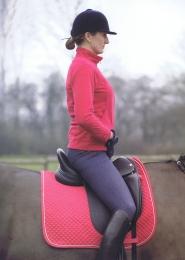
From Wilcox-Reid's perspective, Pilates helps develop the skills needed to become a more competent and effective rider: balanced alignment, core stability, flexibility, and balance, plus self awareness through the mind-body connection. She likens the principles of Pilates to the scale of training for the horse: rhythm and relaxation, suppleness, contact, impulsion, straightness, and collection. Wilcox-Reid takes the basic principles of Pilates and hones them to her "Trinity of Infinity:" alignment, breathing and centring [sic], devoting a chapter to each one. They are well-illustrated with photos shot from varying angles to show how the rider looks in the saddle in good alignment, and skewed alignment.
Alignment establishes the "neutral spine" as a base for all movement. Correct alignment begins with the "neutral pelvis," sitting evenly on the seat bones with the pelvis neither tilted forward nor backward. Atop the pelvis is the ribcage. "An effective way to keep your ribcage box properly stacked and your spine aligned is to visualize your chest as a pair of headlights," keeping them level and neither tilted up nor down. The ribcage is not centered if it shifts laterally to the left or right. Her rib slide exercise increases awareness of how a lateral shift in the ribcage feels. Next, being able to squeeze the shoulder blades together to engage the trapezius muscle in the upper back is key to riding with a consistent and elastic feel of the reins. "Think of your rein contact not beginning in your hands, but in your shoulders and elbows." The top box in alignment is the head. "Taking care to keep the head in neutral when riding helps to prevent the body scrunching into crookedness." Breathing exercises are an integral part of Pilates. She introduces "lateral breathing," which "is directed primarily towards the sides and back of the ribs during inhalation. Exhalation is supported by the conscious use of core muscles – transverses abdominus and obliques." Later she expands to "four-dimensional breathing," which focuses on the psoas muscles. "Four-dimensional breathing assists to release tension and to communicate with the horse with greater sensitivity and clarity."
The book describes and illustrates well the various muscles groups, and how to develop awareness of them. The illustrations show a person in riding position, with the skeletal and muscle groups' locations highlighted. These are complemented with exercises designed to strengthen each muscle group and correct alignment problems.
Improved awareness and correct alignment lead to increased "feel – the art of conversation with your horse. The timing of your reactions and application of your aids has a major influence on how responsive and how pleasurable to ride your horse is. Being aware of your position is a good place to start." She debunks the myth that stronger and more frequent use of aids will achieve everything. She devotes a chapter to the half-halt: the muscles to use, how to use them, and why it works.
The last two chapters describe the exercises and how to structure your own exercise regimen. Learn more about Wilcox-Reid's Equipilates at: http://www.equipilates.com/
Pilates for Riders is written by Grand Prix dressage rider Lindsay Wilcox-Reid. She came to incorporate Pilates into her riding and training after successfully training a number of horses to medium level dressage, but being unable to progress further.
Her chance encounter with international Grand Prix rider and coach Angela Weiss helped her realize that the plateau she had reached was the result of her position being crooked, a legacy from her days as a cellist. "Angela introduced me to a new feeling – doing much less, allowing time to receive feedback from the horse instead of applying aids before, and keeping them on long after, they were necessary. Giving myself and my horse this time to process information opened up the sensation of 'feel.'"
With greater awareness of the effect of the rider's body on the horse's performance, "it became increasing apparent that the horse's body is a mirror of the rider's, and vice versa – and usually not the way that the rider intends." These experiences led her to embrace "the vision of Joseph Pilates and the ability of his exercises to recondition the human body. I fully embrace the Pilates approach to life, applying the principles every time I ride my horses."
The first half of the book emphasizes the importance of good position and balance to riding effectiveness. To obtain good position and balance, she proposes a series of Pilates exercises designed to strengthen and condition all the muscle groups of the body, beginning with the core. The second half of the book gives a Pilates workout exercise list. Exercises are clearly described and illustrated with photos, showing them done correctly and incorrectly. They are marked as basic introductory exercises; next step exercises which build on the introductory ones; and advanced exercises.
Pilates is a series of exercises designed to help the body function better, by first strengthening the deep abdominal muscles that support the spine, then working progressively on all other muscles. The goal is to promote symmetry, increase mobility, flexibility, and strength, and improve circulation and lymphatic drainage. It combines mental focus, controlled breathing, and specific movements of deep muscles to promote core stability.
From Wilcox-Reid's perspective, Pilates helps develop the skills needed to become a more competent and effective rider: balanced alignment, core stability, flexibility, and balance, plus self awareness through the mind-body connection. She likens the principles of Pilates to the scale of training for the horse: rhythm and relaxation, suppleness, contact, impulsion, straightness, and collection. Wilcox-Reid takes the basic principles of Pilates and hones them to her "Trinity of Infinity:" alignment, breathing and centring [sic], devoting a chapter to each one. They are well-illustrated with photos shot from varying angles to show how the rider looks in the saddle in good alignment, and skewed alignment.
Alignment establishes the "neutral spine" as a base for all movement. Correct alignment begins with the "neutral pelvis," sitting evenly on the seat bones with the pelvis neither tilted forward nor backward. Atop the pelvis is the ribcage. "An effective way to keep your ribcage box properly stacked and your spine aligned is to visualize your chest as a pair of headlights," keeping them level and neither tilted up nor down. The ribcage is not centered if it shifts laterally to the left or right. Her rib slide exercise increases awareness of how a lateral shift in the ribcage feels. Next, being able to squeeze the shoulder blades together to engage the trapezius muscle in the upper back is key to riding with a consistent and elastic feel of the reins. "Think of your rein contact not beginning in your hands, but in your shoulders and elbows." The top box in alignment is the head. "Taking care to keep the head in neutral when riding helps to prevent the body scrunching into crookedness." Breathing exercises are an integral part of Pilates. She introduces "lateral breathing," which "is directed primarily towards the sides and back of the ribs during inhalation. Exhalation is supported by the conscious use of core muscles – transverses abdominus and obliques." Later she expands to "four-dimensional breathing," which focuses on the psoas muscles. "Four-dimensional breathing assists to release tension and to communicate with the horse with greater sensitivity and clarity."
The book describes and illustrates well the various muscles groups, and how to develop awareness of them. The illustrations show a person in riding position, with the skeletal and muscle groups' locations highlighted. These are complemented with exercises designed to strengthen each muscle group and correct alignment problems.
Improved awareness and correct alignment lead to increased "feel – the art of conversation with your horse. The timing of your reactions and application of your aids has a major influence on how responsive and how pleasurable to ride your horse is. Being aware of your position is a good place to start." She debunks the myth that stronger and more frequent use of aids will achieve everything. She devotes a chapter to the half-halt: the muscles to use, how to use them, and why it works.
The last two chapters describe the exercises and how to structure your own exercise regimen. Learn more about Wilcox-Reid's Equipilates at: http://www.equipilates.com/


