

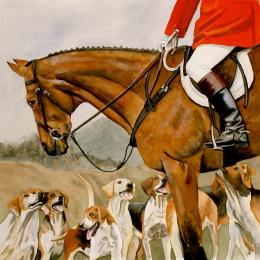
Foxhunting
2010-2011 Foxhunting Season in the mid-south
by Tommy Brannon
The traditional sport of mounted foxhunting, or riding to hounds, which runs from September through mid-March, has begun for Mid-South foxhunt clubs. The season begins with early morning, informal Cub Hunts in September and October. November brings Opening Meets and Blessing of the Hounds, which signals the beginning of Formal Hunts that continue through the rest of the season. Most hunts welcome guests and some have Joint Meets with other hunts during the season.
The sport is steeped in traditions that date to the eighteenth century. The traditional Blessing of the Hounds is a formal event, by invitation, in which the riding members turn out in formal hunt livery, with the horses braided and groomed to a high gloss. A priest or minister in full vestments asks God’s blessings to be bestowed on hounds, horses, riders, landowners, and the quarry. Then the hounds are cast and a great day of sport is expected. Non-mounted spectators usually have transportation on Tallyho wagons to watch the pageantry and observe the hunting activities. When the hunt is over, the riders and spectators sit down to a great feast called a Hunt Breakfast.
Another tradition is the Livery or attire that one wears when mounted. Formal attire consists of Scarlet coat (for officials) or Black hunt coat (for members), white breeches with tall boots, and a stock tie with plain gold pin. For hunts designated as “Rat Catcher,” a tweed coat is substituted for the Black or Scarlet coat. After Opening Meet, the hunting days are more workmanlike without the braiding, but still formal. Weekend and Holiday hunts are formal, while midweek hunts are Rat Catcher. After the hunts, a sumptuous meal is never skipped, although depending on the fixture (location of the day’s hunt), it may be a potluck tailgate or fancy meal in someone’s home.
Foxhunting is one of the most fun activities one can do on horseback, riding with a group of friends over open ground, through woods and streams, jumping fences, or waiting, watching, and listening to nature. Some people hunt to ride, while others ride to hunt. The course is not marked and one does not count strides to jumps, but riding and horse-training skills honed in the arena are essential for a safe and fun foxhunt. Jumps are either post-and-rail or coops set over barbed wire. There is usually a second field available for non-jumpers, but a fit horse is absolutely necessary for both jumping and non-jumping fields.
The goal of foxhunting is not to kill the fox (or coyote), but to give chase. Fox hunting is not a gun sport, and no captured fox is ever released for the chase. All hunting is up to the hounds, and the quarry is a wild animal found in its home territory. It is very rare for the hounds to catch the fox (or coyote).
The last thing a foxhunter wants is for the hounds to run deer. Lots of training effort is made to keep the foxhounds on the correct game. Occasionally, the scent of a fox will be drug along the ground for several miles to simulate where a fox would go on a run, and the hounds follow that scent. This is called a drag hunt and is used when the hunt country is too small for live hunting.
Runs may be long or short depending on scenting conditions and, of course, the fox or coyote. When hunting wild game, one never knows where the quarry will take the hounds. The cooler temperatures with, hopefully, more moisture in the air and on the ground are conditions that make the smells left by moving animals across the land stick closer to the ground for longer periods of time. These are the scents that foxhounds are bred and trained to follow. Viewing the quarry (fox or coyote) is the highlight of the foxhunter’s day, especially if the hounds follow “hot on the line.” Upon viewing, the tradition is to shout “Tally Ho!”
Since it takes thousands of acres to foxhunt, many hunts have multiple fixtures that may be miles away from each other, even in different states. The hound kennel may be in Tennessee or Alabama, but the day’s fixture may be in Mississippi. The membership of the hunt club come from all directions and may be spread over hundreds of miles. Consequently, everyone who foxhunts expects to make a full day of it, or may spend the night at the fixture and hunt again the next day.
For more information about Foxhunting, visit the Masters of Foxhounds Association (MFHA) website: www.mfha.com. A listing and contact information for Mid-South foxhunts follows:
Beech Grove Hunt, Beech Grove, TN: www.Beechgrovehunt.com
Chula Homa Hunt, Vicksburg, MS: www.chulahomahunt.com
Hard Away Whitworth Hounds, Greensboro, AL:
www.hardawaywhitworthhounds.com
Hillsboro Hounds, Cornersville, TN: contact Bill Haggard 615-569-4716
Longeen Foxhounds, Rossville, TN: contact Susan Walker 901-754-1172 http://www.Longreenfoxhounds.com
Mells Fox Hounds, Pulaski TN: contact Joy Smith 931-424-6264
Moorland Hunt, Madison, AL: hunting by invitation only
Oak Grove Hunt Club, Moscow TN: www.oakgrovehuntclub.com
Tennessee Valley Hunt, Strawberry Plains, TN: www.tvhfox.com
Camargo Hunt, Burlington, KY: www.camargohunt.org
Iroquois Hunt, Lexington, KY:
www.iroquoishunt.com
Long Run Hounds, Prospect, KY: www.longrunhounds.org
Woodford Hounds, Keene, KY: www.thewoodfordhounds.org


