

Foraging Ahead To Greener Pastures
Fall Renovation with Legumes
by Nancy Brannon
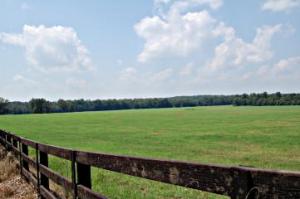
Grazing high quality pastures is the best way to provide nutrients to your horse. So, improve your pastures and increase nutrients to your horses.
In his article “Renovation n Plant Clovers in Grass Pastures,” Gary Bates, Assistant Professor, Plant and Soil Science at the University of Tennessee Agricultural Extension Service, wrote that adding clovers to your pastures can increase yield and nitrogen fixation. The bacteria, Rhizobium, inside the nodules on the roots of legumes take nitrogen from the atmosphere and put it into a form the plant can use. The nitrogen is available not only to the legume, but also to surrounding grass plants. Research in Tennessee has shown that grasses over seeded with a combination of white clover, red clover, and lespedeza produce more forage, and legumes can replace about 60 pounds of nitrogen per acre.
Bates further finds that clovers are more digestible and contain more nutrients than grasses. Plus, their presence in a pasture improves the palatability of the forage. Research has shown that including clovers in an endophyte-infected tall fescue pasture helps decrease fescue toxicosis, he said.
As former UT Extension Agent Steve Hutton said, “2, 4, 8 n let’s renovate!” That means seeding 2 pounds white clover, 4 pounds red clover, and 8 pounds lespedeza per acre to renovate grass pastures.
The majority of growth from cool season grasses occurs during the fall and spring. Fall is the best time to establish or re-seed fall grasses and clovers. John Fox at Russell’s Farm Supply in Collierville, TN recommended planting seeds starting around September 15, “depending on soil moisture and heat levels. You want adequate moisture and mild temperatures. Don’t plant if the soil is too dry. Fall is the ideal time to plant. Fall gives the plants time to grow a little, and they will continue to grow during the winter when the temperatures are in the 50s and 60s.”
Several feed and seed stores carry bulk seed for pastures, including Russell’s, Mid-South Feed and Seed in Millington, TN, and Wood’s Farm Supply in Byhalia, MS: Kentucky 31 fescue; Pennington MaxQ, a fungus-free fescue variety; annual and perennial rye grasses; Kenland red clover; and two kinds of white clover - ladino and Durana white clovers. John advises that you use less Durana than ladino white clover to plant an area, and it has about twice the life span as ladino.
Bates’ recommended steps for pasture renovation are: (1) remove excess pasture growth prior to renovation. Mow or graze to a 1-inch stubble in fall. (2) Soil test, then lime and fertilize accordingly. Legumes require a higher soil pH and fertility level than do grasses. Fertilize by soil test to achieve adequate potash and phosphate levels, but do not apply nitrogen. (3) Select the proper legumes, and cool season grasses if needed. (4) Broadcast the seed August 15 to October 1. Seed is dependent upon soil moisture for germination and establishment and good seed-to-soil contact. If grass sod is thick, it may be necessary to use a disk.
Meeting Reminder
UT Extension- Shelby County offers a seminar on September 14: “Pastures, Winter Weed Control and Cool Season Forages” with Brian White and Becky Muller. They will discuss winter weed ID, herbicides for winter weed control, fertility, and using cool season forages. John Booth from DuPont will also speak on the herbicide Pastora. Seminar will be in Memphis, TN, Agricenter International, Banquet Room C Wing at 6:00 p.m.
Seed Gardens, Too
The farm supply stores mentioned above and Brunswick Feed Store also have cover crops and vegetable seeds for fall gardens: buckwheat; crimson clover; greens n turnip, mustard, collards, and kale; lettuce; carrots; spinach; beets; radishes; cauliflower; and swiss chard. Starting September first, they will have fall garden plants: broccoli, cauliflower, collards, Brussels sprouts, spinach, and lettuce starts.
Organic Remedies for Armyworms
Armyworms have been a problem in Bermuda grass fields in the mid-south this summer. Russell’s has two organic products that will kill armyworms and a variety of other pest worms: Dipel Dust and Thuricide (a liquid). The active ingredient in both is Bacilllus thuringiensis; they can be used on vegetables and are non-toxic in the environment.
B. thuringiensis is a naturally occurring, soil-dwelling bacterium, commonly used as a biological alternative to a pesticide. B. thuringiensis occurs naturally in the gut of caterpillars of various types of moths and butterflies, as well as on the dark surface of plants. B. thuringiensis has gained popularity for its ability to control certain insect pests in a natural, environmentally friendly manner.
Reference:
Bates, Gary. “Renovation: Plant Clovers in Grass Pastures.” http://forages.tennessee.edu/Page%204-%20Planting/sp435a.pdf


