

Chiropractic Adjustments and Stretches For Flexibility
Dr. Jim Reynolds with All Creatures Chiropractic
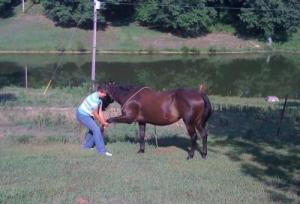
On June 10, 2010, Dr. Jim Reynolds of All Creatures Chiropractic came to Lisa Sparks’ facility in Lake Cormorant, Mississippi to demonstrate chiropractic techniques and stretches on eleven horses. The horses had a variety of problems ranging from adjustment of sacroiliac joints to neck adjustments in the cervical spine. Some of the horses had been adjusted before, and adjustments were easier to do because they had been maintained with the stretching exercises recommended by Dr. Reynolds. Horses who were adjusted for the first time required more time and consideration because they were not as flexible.
One horse exhibited a short stride with the left front leg due to stiffness in the right hip. Another horse had pain and soreness in the back end from an incident in a sinkhole. Several other horses needed adjusting from just being trailered. Dr. Reynolds explained that trailering doesn’t give the horse the opportunity to balance him/herself, predisposing an area in the pelvic complex to get stuck. One very sway backed horse was adjusted, and Dr. Reynolds recommended the horse have lightweight riders and limited trailering.
Lisa explained the importance of Dr. Reynolds’ work: “Dr. Reynolds comes here about twice a year to do adjustments on the horses for flexibility. He checks their sacrum and pelvic girdle to see if they’re moving properly from their backs. He checks their lumbar, spine, sacrum, and ilium. With the ilium, the adjustment is a diagonal adjustment. If the left hip is out of alignment, he makes the adjustment, then checks the opposite front leg. If the horse is not reaching out with the front leg (as in extended gaits), often the problem comes from the opposite hip.”
Lisa explained how the stretching exercises work. The horse has seven cervical vertebrae, which include C1 the atlas and C2 the axis that support and help move the skull. All the exercises are based on the horse’s reflexes, and the human just gives a soft (eyeball-light) touch to stimulate the reflex. Begining with “head down,” this stretch requires a gently squeezing of the poll area just behind the atlas vertebrae to allow the neck to relax in the stretch. Next, the “head right and left” stretch is a reflex response when a hoof pick simulates a “fly bite” on the off shoulder. Leg stretches work for both front and back legs. “Front legs forward” involves a forward shift of the horse’s weight from the opposite rear leg and pelvis when the front leg is raised at a 45 degree angle. “Rear legs forward” allows the butt muscles to stretch. The “tail stretch” allows the horse to counterbalance as you gently release the tail at the dock and lean back. The “butt tickle” reflex results when two hoof picks, one on each side of the buttocks, are brought downward from the croup along the butt angle, producing a tail tucking reflex which is essential for flexibility and collection under saddle. The “backstroke” is a maneuver performed from either side of the spine to cause the horse to drop his back while raising the tail; this stretch exercise increases flexibility and motion in the pelvis. Finally the horse is circled tightly three times to the right and three to the left, with legs crossing in the rear; then is asked to back up straight five to seven steps. Lowering the head first helps the horse relax into the movements.
Dr. Jim Reynolds has been a licensed Chiropractor for twenty years and lives in Chapel Hill, Tennessee. He is certified by the American Veterinary Chiropractic Association and has served as a diplomat instructor for Options for Animals in Hillsdale, Illinois. He travels extensively throughout Tennessee and surrounding states treating “all creatures great and small” and promoting chiropractic care. He is a featured lecturer for the Volunteer Horse Fair, Sam Powell Holistic Horsemanship clinics, and Purina Mills. For more information about All Creatures Chiropractic, visit the website at: http://www.allcreatureschiropractic.com. Dr. Reynolds is available for telephone consultation at 615-585-9810 or by email at jrdcacgas@integrity.com.
Lisa Sparks uses chiropractic care as part of the maintenance program with her horses. She has observed that with increased flexibility and less pain, the horses are more balanced physically and mentally prepared for the “good ride.” She uses the stretching exercises to get the maximum benefit from the periodic adjustments. Once the horse becomes accustomed to being stretched, he anticipates the routine and works willingly. What might take fifteen minutes in the beginning to do, now only takes her five minutes. She believes this time invested in her horse helps to cultivate the trust and respect needed for better riding. When her horse licks and chews after a stretching session she knows he is relaxed.


