

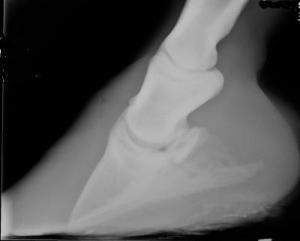
Laminitis
Permanent damage to the laminae can result
From PowerPoint presentation by Jennifer Dunlap, DVM and other equine medical sources
Laminitis, also known as founder, has been recognized and treated for over 250 years. It is acutely painful inflammation of the sensitive laminae in the hoof, most commonly in front feet. It is second only to colic as a killer of horses. Laminitis is often fatal, so proper care and management to prevent the disease is essential!
In the worst cases, permanent damage to the laminae can result and the attachment of the coffin bone to the hoof wall breaks down. The whole weight of the horse bears down on the coffin bone, so without the attachment to the hoof wall, the bone rotates down and can actually be pushed through the sole.
Signs of laminitis include: the horse standing in the “founder stance” with the front legs stretched out in front and the hind legs camped under the body to put as much weight on the back legs/feet and take as much weight off the front feet as possible. The horse may be reluctant to walk. The feet will feel hot and the digital artery, located over the fetlock joint, will have a pounding pulse. Each attack of acute laminitis can leave a ring on the hoof wall. A horse suffering from chronic founder may have multiple rings on his hooves, as well as a “seedy toe:” separation of the hoof wall from the sensitive laminae in the toe area. If left untrimmed, the hoof wall overgrows to form a “slipper foot.”
Particular breeds are over-represented in the population of horses who get laminitis: ponies, Quarter Horses and Paints.
Medical causes of laminitis include: retained placenta in mares, diarrhea, severe colic, grain overload, shipping fever, severe load bearing injuries (e.g., hard or fast work on a hard surface), Cushing’s disease, metabolic syndrome, grass founder (over grazing on lush pasture, particularly in overweight horses), eating lawn grass clippings, or drinking large amounts of water when overheated.
After a mare foals, if she has not delivered the placenta within 4 to 6 hours post foaling, then you have a medical emergency. Treatment requires multiple oxytocin injections. Tie a wet towel to the hanging placenta, but do not attempt to pull out the placenta. Administer systemic antibiotics, flush the uterus, and give Banamine. Ingestion of fescue hay during pregnancy can be a cause of retained placenta.
When a horse has diarrhea so severe that it “paints the walls,” aggressive hospital care is required. Try to find the cause, if possible.
There are several types of severe colic that can lead to founder and aggressive hospital care is required if the horse is to survive.
Anterior Enteritis (also referred to as duodenitis) is an inflammatory disease of the small bowel of horses that causes colic and toxic shock. It is inflammation of the first part of the small intestine close to the stomach. Surgery is often required. Decompression at surgery and appropriate antibiotic and anti-inflammatory treatment usually results in a rapid return to normality.
Volvulus or twist: A volvulus is a bowel obstruction in which a loop of bowel has abnormally twisted on itself. Torsion is abnormal twisting of the intestine. Volvulus involves twisting of the intestine on its mesentery. Torsion and volvulus almost always cause a total blockage of the intestine and require immediate surgery.
Endotoxin release may contribute to colic and founder. Endotoxins are part of the outer membrane of the cell wall of Gram-negative bacteria, whether the organisms are pathogenic or not. Although the term “endotoxin” is occasionally used to refer to any cell-associated bacterial toxin, in bacteriology it is properly reserved to refer to the lipopolysaccharide complex associated with the outer membrane of Gram-negative pathogens such as Escherichia coli, Salmonella, Shigella, Pseudomonas, Neisseria, Haemophilus influenzae, Bordetella pertussis and Vibrio cholerae.
Grain overload: can be mild to severe, can be life threatening, worse if cattle or other animal grains are involved. Make sure your feed is labeled for horses!
Shipping fever: Horses that travel long distances are particularly susceptible to developing pleuropneumonia, commonly called “shipping fever,” a respiratory infection that affects the lungs and pleural (chest) cavity in horses. “Pleuropneumonia is a bacterial pneumonia that becomes severe enough to affect both lungs and extend into the pleural space surrounding the lungs,” said Corinne R. Sweeney, D.V.M., a veterinary internal medicine specialist and professor at the University of Pennsylvania's New Bolton Center in Kennett Square. “While a horse can get it by not even leaving its stall, it is often associated with transporting horses over an extended distance.” Severe results can be lung abscesses/pleural effusion, high severe fevers. This requires hospital care. Vaccinate for shipping fever if you plan to transport your horse long distances!
Severe loadbearing injuries: fractures, severe lacerations.
Cushing’s disease: usually seen in older horses and/or ponies. There are blood tests to determine the disease. Symptoms include inappropriate fat placement, long hair, bulging eye pads, founder, and pour wound healing. Treatment is life-long. Pergolide is the primary medication.
Metabolic Syndrome is a diabetes-like condition; blood tests can determine the disease, and the horse is typically very fat. Treatment medicines include Thyro-L and feeds such as Purina Well Solve L/S.
Grass founder occurs most commonly in the spring and is the most common cause for founder in our area. Horses with Cushing’s disease, overweight horses and horses with metabolic issues predisposed. Grass founder can become chronic. Grazing muzzles can be used as preventive measures.
Manmade causes of Laminitis include: neglect causing mechanical founder. Use of medications: excessive use of NSAIDs (bute most commonly) which leads to colitis and diarrhea; also excessive use of steroids.
Treatment of founder depends on whether the condition is acute versus chronic. Try to find the cause; develop a game plan; and get the farrier and veterinarian involved. It is very important for the veterinarian, farrier and owner to work together to achieve a successful outcome!
Treatment in acute cases begins with elimination of the cause of laminitis. Place the horse in a deeply bedded stall, give “Bute” for pain relief, and ice the feet to relieve edema. Can give DMSO in IV fluids, Pentoxyfylline, do bloodwork to rule out metabolic causes and Cushing’s disease; and give antibiotics.
Mechanical treatment for acute cases includes providing foot support: Styrofoam, deep bedding n shavings or sand; Lily pads, Soft-ride boots. Do not remove shoes! With mechanical treatment for chronic founder, the Farrier-Veterinarian team is critical, especially if the coffin bone has rotated. Here is where farrier care is critical: support the bony structure; reduce strain from digital deep flexor (DDF) tendon, remove sole pressure, and resculpt the hoof capsule around bone. The DDF tendon runs down the back of the cannon and soft tissue in that area and under the navicular bone before attaching to the back of the coffin bone. The DDF tendon flexes the coffin joint, and the navicular bone acts as a fulcrum that the DDF tendon runs over. Heroic treatment may include DDF tenotomy, drilling and grooving.
Following are some general recommendations from Dr. Dunlap about care of a horse who has foundered:
1. Weight control: restrict access to grass, possibly use a grazing muzzle; feeds such as Purina Well Solve L/S are also good.
2. Excellent farrier care. Relieving pressure at toe is best either with a frog support pad and shoes or a heart bar, or if the sole is thick enough, a good trim to bring the toe back.
3. The dead laminae will not reattach, but new laminae will attach as the hoof continues to grow in. One year is required to grow a new hoof.


