

Book Review: Xenophon the Art of Horsemanship
Oldest known work of equestrian literature
by Nancy Brannon
The Greek historian, Xenophon wrote the oldest known work of equestrian literature, On the Art of Horsemanship. Written c. 350 BC, it is one of the earliest extant treatises on horsemanship in the Western world, detailing the principles of classical dressage, including training the horse in a manner that is non-abusive.
Xenophon is often cited as being the original "horse whisperer," advocating sympathetic horsemanship. In this famous literary masterpiece, Xenophon details the selection, care, and training of horses for the use in the military and for general use. Their training consisted of movements to improve their agility and sophistication as instruments of battle, which have evolved into modern day dressage.
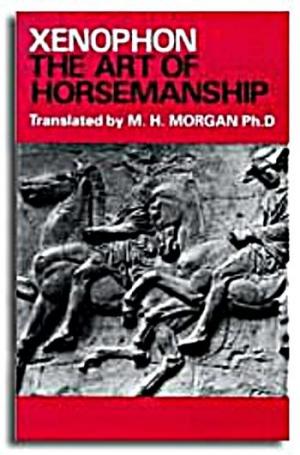
A widely known English translation is the 1893 edition by Morris H. Morgan, Ph.D., first published in 1894 by J. M. Dent & Co. Later versions were reproduced from the original and published by J.A. Allen & Co. in 1962 and subsequent years.
In Morgan’s translation, “Chapter I, Xenophon On Horsemanship” begins with Xenophon’s comments on his own expertise: “It has been my fortune to spend a great deal of time in riding, so I think myself versed in the horseman’s art. This makes me willing to set forth to the younger of my friends what I believe would be the best way for them to deal with horses.”
Xenophon’s advice begins with a detailed description of the horse’s conformation n what features to look for when choosing to buy a horse, starting with the hooves. “His frame is what you must test and in his frame, the first things you ought to look at are his feet.” It is here that the adage “no hoof, no horse” originated: “Just as a house would be good for nothing if it were very handsome above but lacked the proper foundations, so too a horse, even if all his other points were fine, would be good for nothing if he had bad feet.”
The owner should look for a horse with a good temperament and gentle nature. The horse should trust people, knowing that they are the providers of food and water. If this is done correctly, the young colt should grow to love people. The groom should stroke or scratch the colt, so that he enjoys human company, and should take the young horse through crowds to accustom him to different sights and noises. If the colt is frightened, the groom should reassure him, rather than punish him, and teach the animal that there is nothing to fear.
The ability to determine the age of a horse is important. “The knowledge of the teeth as a criterion of age is rudimentary,” Xenophon wrote in Chapter 3.
On Caring for the Horse, Xenophon advises that the horse should be housed in a stable where he may be easily checked on by the master. This allows the master to ensure his animal is receiving appropriate care. The master should watch for symptoms indicating early signs of sickness so that the horse can be treated soon and properly by the veterinarian.
Chapter 4 is devoted to properly stabling of the horse. Xenophon again stressed the importance of caring for the horse's feet. He suggested that the flooring of the stable should not be damp and should not be smooth, and that the stable should be built with sloped channels of cobblestones the size of the horse's hoof. The stableyard should be of pebbles to strengthen the hooves, and should be surrounded by a skirt of iron so that the pebbles do not scatter. These surfaces are intended to strengthen the hoof wall, frog, and sole of the hoof.
In the Chapter 5 on Grooming the Horse, Xenophon writes: the horse's groom should be well-trained. The groom should be instructed to clean the animal's stall every day. Xenophon wrote in detail properly tying of the horse so as to avoid injury. The groom should curry the horse after he is fed each morning, and should unhalter the horse after he has been fed. The groom should stand near the shoulder blade facing toward the back of the horse, out of the way of the animal's leg, so as not to be kicked or knocked by the knee when grooming the horse. He should avoid approaching the head or tail straight on, as the horse can easily overpower him by rearing or kicking. Therefore, the side is the safest place to stand.
The groom should first clean the head and mane, and work his way down the animal's body. The hair should be brushed first against the grain, to lift the dirt, and then in the direction of the hair, to remove the dirt. The head should be cleaned only with water, because it is bony and will be injured otherwise. The forelock should also be cleaned with water alone. Xenophon notes that the forelock prevents irritants from getting in the horse's eyes. The tail and mane should be washed, to keep the hairs growing, as the tail is used to swat insects and the mane may be grabbed by the rider more easily if long. It is suggested that the legs not be washed, as the hooves deteriorate from daily washing, but should simply be rubbed and curried by hand.
When leading the horse, the groom should not lead in front, which would prevent the groom from protecting himself and would allow the horse to do as he pleases. The horse should also not lead the way, as he may easily cause trouble or might turn around to face the groom. Therefore, it is best to lead the horse from the side, as there he will be most controllable.
Chapter 7 describes how to properly mount the horse. The groom should know how to give a leg up in the Persian fashion.
Chapter 8 describes riding up and down hills: “As the horse will frequently have to gallop down hill and up hill and along a slope, and as he will have to leap over, and to leap out, and to jump down at various times, the rider must teach and practise both himself and his horse in all these things. For thus they will be able to help each other, and will be thought altogether more efficient.”
In Chapter 9, Xenophon turns to dealing with difficult horses: “So far we have described how to avoid being cheated in buying a colt or a horse, how to avoid spoiling him in usage and how to impart to a horse all the qualities required by a cavalryman for war. It is time perhaps to give directions, in case one has to deal with a horse that is too spirited or too sluggish, for the correct way of managing either.”
In Chapter 10, he explains the undesirable results one gets from pulling on a horse’s mouth or spurring too vigorously: “If a man wants to make a useful war-horse look more stately and showy when ridden, he must avoid pulling his mouth with the bit, and using the spur and whip, means by which most people imagine that they show off a horse. In point of fact the results they produce are the very opposite of what they intend. For by dragging the mouth up they blind their horses instead of letting them see ahead, and by spurring and whipping, flurry them so that they are startled and get into danger. That is the behaviour of horses that strongly object to being ridden and that behave in an ugly and unseemly fashion.”
Foxhunters, and other hunters, might be interested in reading Xenophon’s work, On Hunting: “Game and hounds are the invention of gods, of Apollo and Artemis. They bestowed it on Cheiron and honoured him therewith for his righteousness. And he, receiving it, rejoiced in the gift, and used it.” He even wrote about political and economic issues on Ways and Means.
The English translation, Xenophon, On the Art of Horsemanship, by E. C. Marchant, G. W. Bowersock, tr. Constitution of the Athenians., Ed. is available via the Perseus Project (digital library) at Tufts University. Link: http://www.perseus.tufts.edu/hopper/text?doc=Perseus%3Aabo%3Atlg%2C0032%2C013&redirect=true


